Introduction
I am increasingly convinced that awe is an emotion that wants to be shared; this is what drives me to make art.
I recently began experimenting with drawing machines that engage directly with the landscape. These simple constructions — feathers, charcoal, and twine suspended from trees — record the unseen movements of wind and time. Once placed, they no longer belong solely to me; they become instruments through which the landscape expresses its own gestures. I would like my work to ask questions about ecological facts around our environment and our relationship with it – can my making turn it into feelings for viewers?
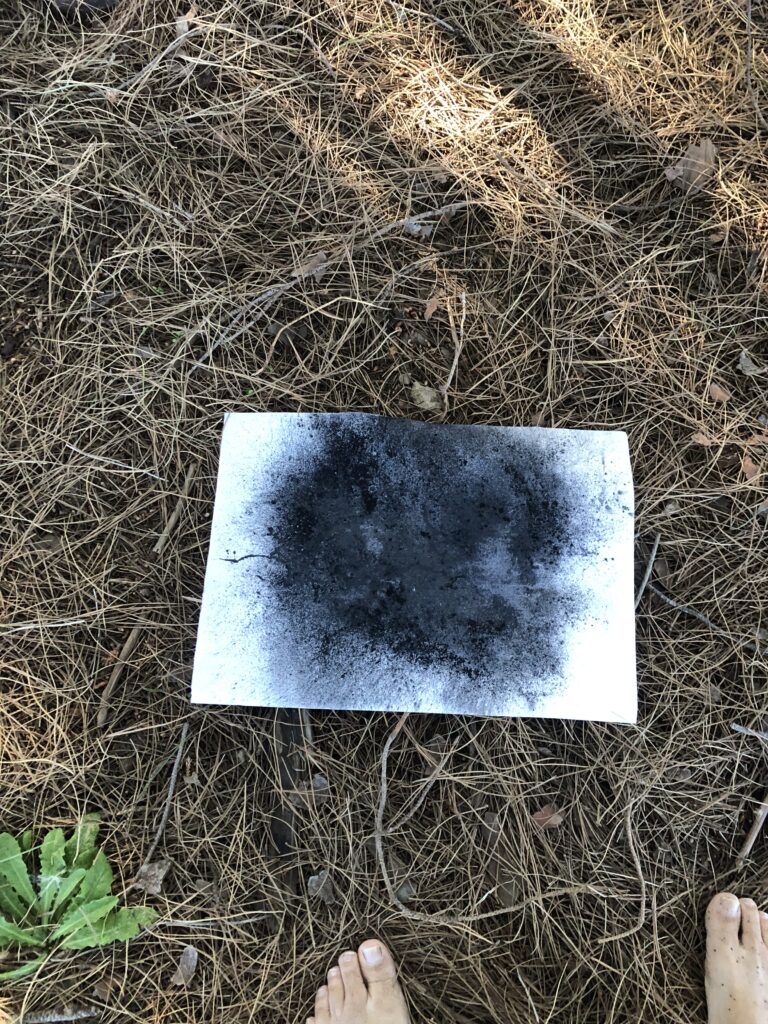
Below are images of exploratory drawings with wind under a Rhus tree in the farmyard where I live.
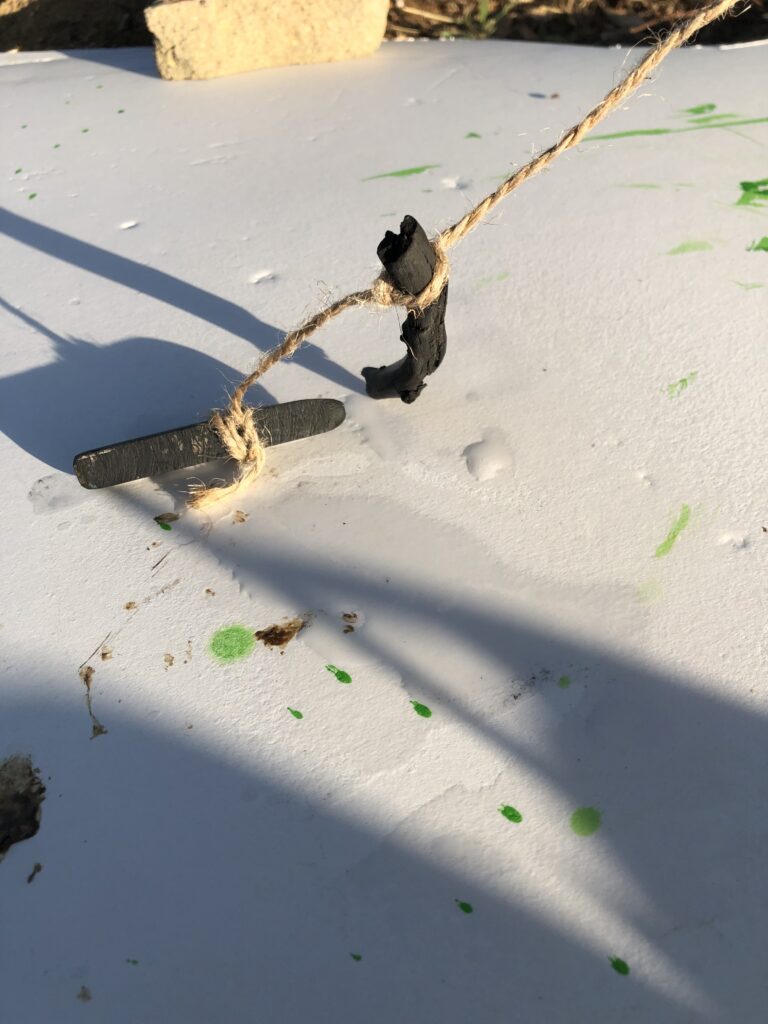
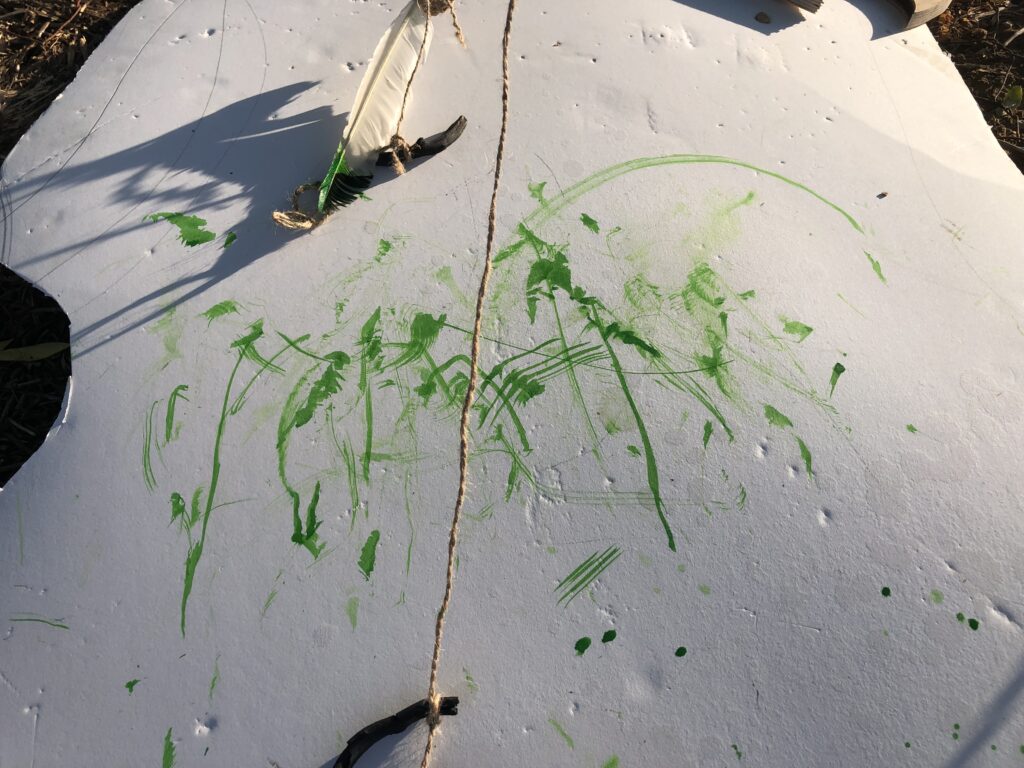
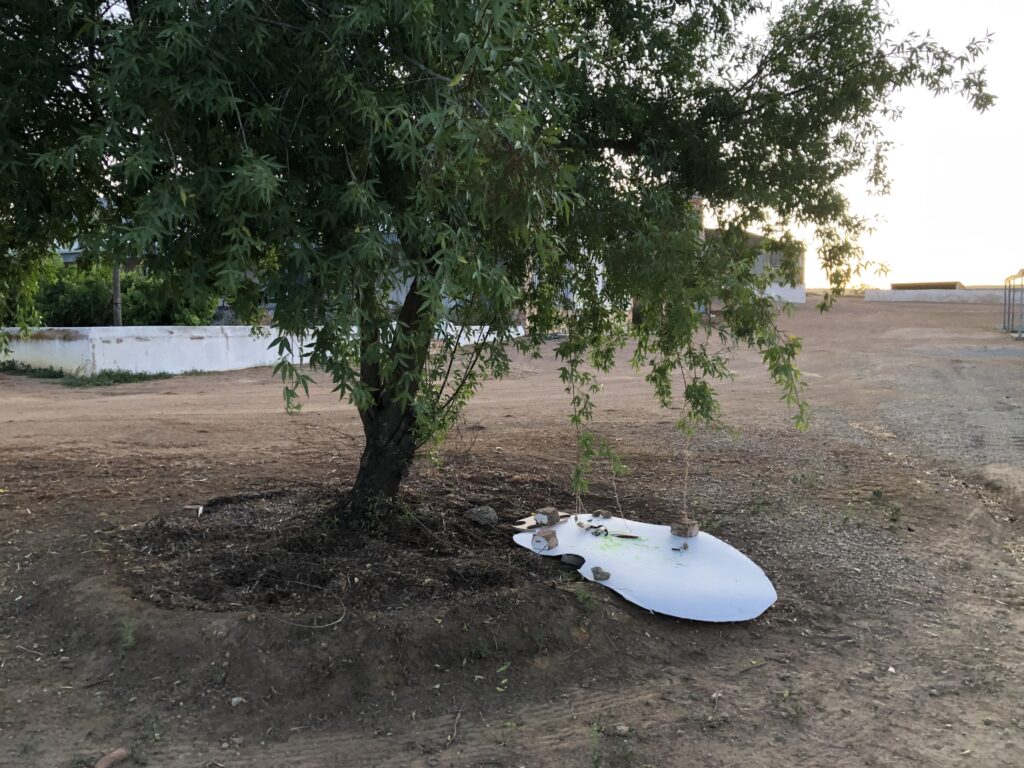
Following my explorations I found a site on a working wine and olive farm, and with the farm’s ecological restoration efforts, through the replanting of indigenous species and the protection of the Swartland Shale Renosterveld and ancient Afromontane forest, it offers a living example of how human and ecological systems can interweave. I intend to situate my practice within this shared space of care and renewal.
The drawing machines, in this setting, act as a threshold between human agency and ecological process. They bring human attentiveness — the act of tying, balancing, preparing — into relation with the rhythms of wind, growth, and weather. The resulting drawings are traces of collaboration, not control: a form of correspondence between art and ecology. It also reminds us that art, as life, embraces things that last for a moment and then are gone.
I need to understand how to belong in a contested landscape, as the forest I will start to work in is not an indigenous forest. Working in this pine forest has required its own kind of learning. These pines—Pinus pinea, the Mediterranean Stone Pine—are not indigenous to the Western Cape but have long since naturalised here. At first, I felt hesitation: how do I work in a place that is not native, not “belonging” in the ecological sense? Yet this hesitation opened something essential, as I need to acknowledge that the forest is not neutral; it is shaped by colonial history. Forestry and farming in South Africa are inseparable from colonial land seizure, labour regimes that often exploited rural workers, monoculture spread and alien species naturalising in new ecologies.
When I work in this forest, I am working in the residue of all of this — not as an activist shouting at it, but as an artist listening carefully within it.
Instead of questioning the forest’s legitimacy, I began to question my own assumptions about place, belonging, and the materials given to me. For my own development, I realised I needed a separate interaction with this forest and wanted to work to connect myself with it. I wanted to work with the materials in the forest, and the idea to create a spiral, which refers to the Golden Ratio became a way of entering into a relationship with this forest on its own terms. Made from its fallen needles, cones, and fragments, it follows the golden ratio—the same spiralling geometry found inside the pine cones themselves. The work should become a quiet gesture of approach, a daily act of attention through which I learn the forest rather than judge it. The spiral is not an attempt to naturalise the pines, nor to deny their history, but to acknowledge that this is the place where our paths meet: a hybrid, changing landscape where I can practise attunement, care, and slow correspondence. The spiral can become a way of asking:
How do I make peace with a landscape shaped by histories I cannot undo?
How do I enter into a relationship without erasing the past?
Ecological thoughts developed through my reading and research into the work of Tim Ingold, Peter Wohlleben, Tim Knowles, and Robert Smithson, and later, Thomas Saraceno.
Contemporary understandings of trees have shifted from seeing them as static, silent organisms to recognising them as relational beings, constantly in correspondence with their environment. This project draws on several thinkers and practitioners — who each, in different ways, offered me pathways toward a more entangled understanding of trees, movement, landscape, and artistic process.
The drawing practice I employ grows from an ecology of attention — a slowing down, a listening, and a willingness to be moved by the non-human life around me. Working among the pine trees at Kringe in die Bos, the drawings emerge not from my hand alone but from the correspondence between wind, tree, and charcoal. In line with Tim Ingold’s understanding of drawing as a form of “following-along-with” the world, the work becomes a record of shared movement rather than representation. Echoing Peter Wohlleben’s insights into trees as breathing, sensing beings, the trembling of pine needles becomes a form of expression — a kind of inhalation and exhalation made visible. Building on Tim Knowles’s tree drawings, the trees here act not as tools but as collaborators: quiet participants whose breath, vibrations, and presence shape the marks. This project invites viewers to reconsider the trees that stand among us not as scenery, but as witnesses, co-makers, and agents in the rhythms of place.
Robert Smithson’s ideas of Site and Nonsite extend this relational thinking. In this project, the forest becomes both Site and collaborator. The suspended wind-drawing circle and the hidden ground spiral exist as Site works—inseparable from their terrain, shaped by wind, gravity, breath, and the slow fall of pine matter. Rather than being artworks placed into a landscape, they are gestures that arise through correspondence with it. Meanwhile, the documentation produced through daily logs, field recordings, and photographs forms the Nonsite—the displaced, reflective counterpart to the living Site—holding fragments and translations of processes that cannot be transported. Together, the Site and Nonsite articulate a practice grounded in ecological attention: a slow, reciprocal exchange in which human intention, atmospheric motion, and arboreal life converge to form an evolving field of experience rather than a fixed object.
The art of “letting the wind make a drawing” falls into a broader field of process art, land art, and collaborative nature-based practices, often referred to as “wind drawings.” There is no single, universally accepted term, as each artist finds their own way of working with the more-than-human world. What remains central is an ethic of care. Each intervention in this project is temporary and non-invasive, attached gently with biodegradable materials and removed without harm. The work unfolds through listening and observation — allowing the trees’ movements, rather than human intent, to guide the mark, and recognising the forest as a dynamic partner in the making.
TIM INGOLD
Ingold invites us to shift from thinking about trees to moving with trees. He suggests that life is lived along lines, not inside bounded forms. To him, the wind is the tree’s double: its breath made audible in the rustle of leaves, its gestures made visible in sway and vibration.
Ingold reframes the tree as a living movement, not a static structure. When the pine trembles, it expresses its presence. When my charcoal pendulum and or drawing machines respond, it corresponds. Drawing is not representation, but correspondence — a moving-along-with another being.
My drawing apparatus becomes a line of relation, a joining rather than an imitation. From Ingold’s influence, I am treating drawing as:
- a co-presence
- a mutual attunement
- a shared gesture with wind and tree
PETER WOHLLEBEN
Where Ingold describes the relational field, Wohlleben describes the physiology of that relation. According to Wohlleben, leaves (and pine needles) act as lungs, exchanging gases, sensing humidity and responding to pressure shifts. Roots breathe, drawing oxygen from soil moisture and exhaling CO₂ back into the microbial network. A tree’s entire body is involved in respiration — trunk, bark, leaves, and mycelial collaborations.
Wind is not an external force, but a partner: assisting water transport through trunk sway, activating sound, awakening the tree’s sensory systems. In Wohlleben’s terms, these drawings are not merely marks made by motion — they are traces of a living, breathing organism in action. When I let a pine tree shape a charcoal line, I am acting as if the tree:
- has a presence
- expresses movement
- co-produces the mark
Wohlleben would say I am not fantasising agency — I am recognising it.
ROBERT SMITHSON
Robert Smithson’s writings on Site and Nonsite were an early spark for this project. Smithson understood that art could exist both in the landscape and beyond it—that the work created in a specific place (the Site) carried a presence and a logic that could never be fully moved indoors. What travelled instead were fragments, notes, materials, maps, and traces—the Nonsite. This way of thinking allowed me to recognise that the forest at Kloovenburg is not simply the backdrop to my work, but its co-author. The suspended wind drawings, the hidden spiral built from fallen pine matter, the sounds of breath and movement among the trees: these are Site works, inseparable from their terrain. The documentation I make each day—photos, audio recordings, logs, data sheets—becomes the Nonsite, the way this process might later be shared, translated, or re-experienced elsewhere. Smithson’s influence helps me hold these two halves together: the living work in the forest, and the reflective work that grows around it.
Robert Smithson’s idea of the entropic landscape is profoundly useful for understanding this forest. Smithson saw certain landscapes as “de-structured” or “already falling apart”—places shaped by human intervention, extraction, industrial time, or abandonment. These were not pristine environments, but entropic systems caught between construction and decay. I will be making art within the entropic residue of colonial forestry and farming.
Smithson teaches me not to seek purity in landscapes marked by human intervention. The pine forest at Kloovenburg is an entropic space: ordered systems that have begun to unravel into semi-wild ecologies. They carry the weight of colonial farming and foresty ideas which altered indigenous vegetation, yet they also host new forms of life, new soils, new rhythms. My work here takes place inside this tension. The wind-drawn circle and the quiet spiral built from fallen pine matter are ways of entering into relationship with a landscape I do not fully belong to, yet one that asks for attention rather than judgment. To work here is to acknowledge complexity: the history underfoot, the forest’s breath above, and the slow negotiation of belonging in a place shaped by both human intention and natural time.
TIM KNOWLES
Knowles’ Tree Drawings (2005–) pioneered the idea of allowing trees to “draw” by attaching pens to branch tips so that wind-driven movement produces marks. What Knowles demonstrated that trees can act as co-authors in the drawing process. The wind becomes a collaborator, not noise. Art becomes a record of interaction, not depiction. His work is mechanically direct: branch → pen → paper. Where Knowles uses mechanical linkages,
I use:
- wind
- vibration
- breath
- charcoal dust
- listening
THOMAS SARACENO
More ideas followed and Thomas Saraceno’s work, Movement (2021) also left its mark on my thoughts. In thinking about the invisible movements (we cannot see the wind moving, we see the branches and charcoal moving) that shape my wind drawings, I was drawn to Tomás Saraceno’s Movement (2021). In this work, Saraceno uses aerosolar sculptures whose flight paths are recorded and transformed into augmented reality aeroglyphs—three-dimensional drawings made by the movement of air itself. Through technology, he allows viewers to witness the atmosphere leaving a trace, turning the sky into a drawing field.
Although my practice operates at a far smaller and more intimate scale, I recognise a parallel impulse: a desire to make air legible, to show how the atmosphere composes its own gestures. Where Saraceno uses AR to track the sky’s vast trajectories, I work with the localised movements of wind within the forest—its turbulence, softness, acceleration through branches, and the breath of pine needles.
The suspended charcoal apparatus I use becomes a simple analogue aeroglyph instrument. It translates wind into marks, recording the micro-atmospheric shifts specific to this pine forest. The drawings are shaped by the canopy’s vibrations, the sway of young trunks, and the subtle rhythms of air slipping between needles. In contrast to Saraceno’s large-scale technological mediation, my approach is grounded in presence, repetition, and ecological attention. The technology I use is the forest itself.
What we share, perhaps most strongly, is the belief that air becomes visible when allowed to leave a trace—and that the atmosphere carries its own form of expression. My work invites viewers to consider the forest’s breath-lines as quietly as Saraceno asks us to consider the sky’s. Both practices reveal a world already drawing, already making marks, if only we slow down enough to see them.
So where am I?
Taken together, these thinkers and artists opened a way for me to understand the forest not just as a setting, but as an active field of movement, breath, and exchange. Their ideas helped shift my focus from making marks myself to creating conditions in which the atmosphere, the trees, and the site could draw. As I developed the suspended charcoal apparatus and the daily practices of observation and listening, I realised that the core of this project is not only about trees, or site, or collaboration — it is about the air itself, and the ways it becomes visible through material traces. This led me to a deeper question at the heart of the work: why draw with air at all?
Why Draw With Air?
To draw with air is to acknowledge that the atmosphere is already moving, already shaping the world, already leaving traces we rarely notice. Wind is not an empty force or a background condition — it is a living presence that interacts with trees, breathes through pine needles, carries temperature, humidity, and scent, and sculpts the environment continuously. Drawing with air is a way of listening to these movements rather than imposing my own.
Working in the pine forest at Kringe in die Bos, I became aware of how the atmosphere behaves as a kind of collaborator. The trembling of pine needles, the sway of young trunks, the soft turbulence of air slipping through branches — these are gestures the forest makes. By suspending charcoal on canvas and allowing wind to move it, I create a surface where these gestures can leave a trace. The drawing becomes a record of correspondence: air, tree, and material meeting in a moment of shared motion.
This approach is deeply influenced by the artists and thinkers who shaped this project. Tim Ingold speaks of drawing as “following along with” the movements of the world — a practice of attunement rather than depiction. Peter Wohlleben reminds us that trees breathe and respond to air pressure, humidity, and vibration; their movement is not passive, but a form of communication and presence. Tim Knowles’s tree-drawing systems demonstrate how wind and branches can co-author marks, while Robert Smithson’s Site/Nonsite thinking helps me understand the forest as both the location of the work and the generator of traces that can travel elsewhere. Tomás Saraceno’s atmospheric aeroglyphs further inspire the idea that air itself draws — that movement becomes line.
To draw with air is therefore to let the world write itself. It is a shift from control to collaboration, from representation to encounter. The resulting drawings are not images of the forest but expressions with it — breath-lines, motion-maps, and momentary signatures of an atmosphere always in transition.
In this sense, drawing with air is a way of asking how to be present in a place that carries complex histories, layered ecologies, and shifting forms of belonging. It is a gesture of humility. A form of listening. A way of acknowledging that the land and the air are already speaking, and that art can sometimes become a surface on which their voices can be traced.
Ideally, I would want a branch where drawing tools are attached to move lightly in all directions, without becoming overloaded and intermittent but intentional contact, producing an accumulated and layered vocabulary of distinct mark types over time.
Location: https://maps.app.goo.gl/tip5Qh8oMiGqdQur6
-33.28099088024681, 18.881435337006664
Conceptual Thoughts Going Forward With This Project
By grounding this project in above research I move from trees and wind as drawing instruments to trees as correspondents, breathers, and co-makers. At Kloovenburg’s Kringe in die Bos, the pine forest becomes a site of correspondence — a place where wind, pine, and drawing apparatus form a temporary ecology of making.
From Tim Ingold, I adopt the principle that the pine’s rustle is its breath made audible — and that drawing with trees is not representation but moving along with their gestures. His concept of correspondence allows the drawing to emerge as a shared movement rather than a controlled act.
From Peter Wohlleben, I recognise the pine as a breathing body: its needles functioning as lungs, its roots as slow breathers, its trunk and canopy as responsive surfaces shaped by wind and soil. The charcoal traces become breath-maps — visual records of a living respiratory exchange.
From Tim Knowles, I inherit the methodology of co-authorship, but rework it into a gentler, non-invasive collaboration. The pendulum setups and charcoal-tipped tools record pine-needle vibrations, canopy-driven air disturbances, and the rhythmic sway of trees — atmospheric signatures shaped as much by the forest as by me.
From Robert Smithson, I take an understanding of the forest as both Site and Nonsite. The suspended drawing and the hidden spiral exist as Site works — inseparable from their terrain, shaped by wind, slope, gravity, and the slow fall of pine matter. The daily photographs, sound notes, and weather logs form the Nonsite: a displaced, reflective counterpart that carries fragments of the process into another space. This duality allows the work to exist simultaneously in the forest and in the conceptual and documentary forms that translate it.
Where Saraceno uses AR to track the sky’s vast trajectories, I work with the localised movements of wind within the forest—its turbulence, softness, acceleration through branches, and the breath of pine needles. The suspended charcoal drawing machine becomes a simple analogue aeroglyph instrument. It translates wind into marks, recording the micro-atmospheric shifts specific to this pine forest. The drawings are shaped by the canopy’s vibrations, the sway of young trunks, and the subtle rhythms of air slipping between needles. In contrast to Saraceno’s large-scale technological mediation, my approach is grounded in presence, repetition, and ecological attention. The technology I use is the forest itself.
Together, these influences shape a practice grounded in ecological attention: a slow, reciprocal exchange in which human intention, atmospheric motion, and arboreal life converge. The drawing surface becomes a membrane where three breath-lines meet — the tree’s breath, the wind’s breath, and my own breath, present in the acts of listening, preparing, and receiving.
The series will focus on collaborative drawing, non-invasive ecological engagement, and a material study of pine-breath and wind — a site-specific dialogue with the Kloovenburg landscape. By situating this work in their forest, I hope to create a bridge between cultivated land and communal experience. Visitors may encounter the drawing in motion, in formation, or simply feel the presence of the trees at work. The installation becomes both a form of drawing and an act of care — a way of honouring what sustains us, materially and spiritually, while leaving the lightest possible trace.
Ultimately, the project asks what it means to draw with the forest, not from it.
The preparation of the surface
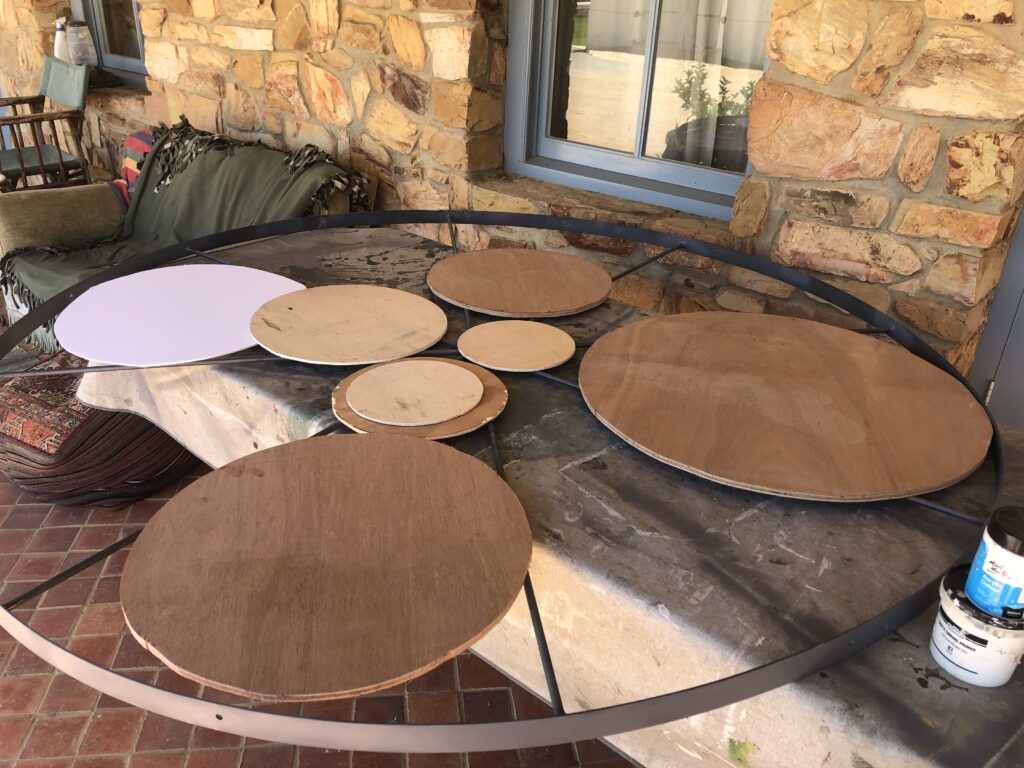
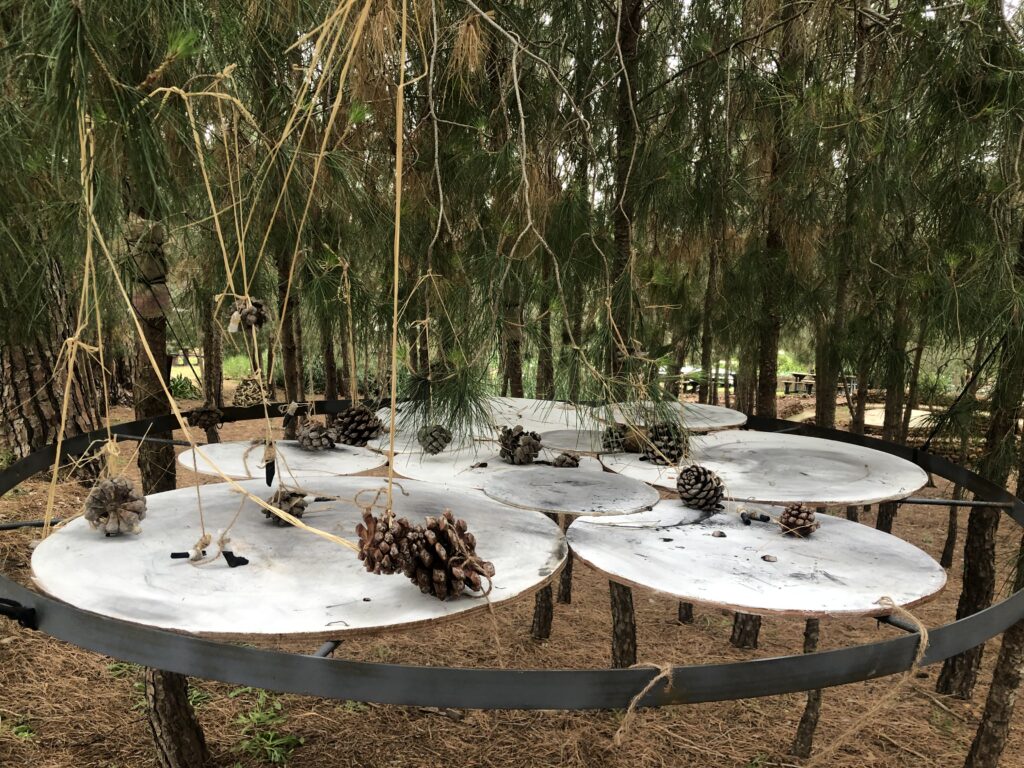
Originally when I decided to make the circular work, I thought to use one size and work on prepped canvas. I have since changed my plan and decided to make smaller circles to fit into the big steel frame – I worked with MDF board and prepped each wooden circle to be ready to have charcoal move on their surface. Some have canvas paper attached to it, others are painted with Gesso and others with Acrylic primer.
The ‘non site holder’
In this project, the forest becomes both Site and Collaborator. The suspended wind-drawing circle and a planned ‘hidden’ ground spiral exist as Site works (in Smithson’s sense)—inseparable from their terrain, shaped by wind, gravity, breath, and the slow fall of pine matter. They are not artworks brought to a landscape, but gestures that arise through a process of correspondence with it, echoing Tim Ingold’s understanding of making as “moving along with” the world rather than imposing form upon it. The daily shifts of wind and needle vibration register what Peter Wohlleben describes as the tree’s breath—an expression of presence, sensitivity, and the forest’s own rhythms. The marks made by the suspended charcoal apparatus recall Tim Knowles’ Tree Drawings, where wind and branches become co-authors, yet here the collaboration extends vertically: the forest moves the drawing above while shaping the spiral below.
I plan to create a ‘field station’ near the big circular drawing machine, where I will display the daily log sheets, place a book for comments, and leave collected materials from the forest floor. Visitors may browse the logsheets as a soft archival trace, leave a note or make a work and leave it behind. The look will be that of a temporary cache – a weathered wooden box with a lid could do. In there, the field notes on a clipboard, notebook for messages with a pencil tied and a bag with forest ‘finds’.
The documentation produced through daily logs, field recordings, and photographs forms the Nonsite—the displaced, reflective counterpart to the living Site—holding fragments, traces, and translations of processes that cannot be transported. Together, the Site and Nonsite articulate a practice grounded in ecological attention: a slow, reciprocal exchange in which human intention, atmospheric motion, and arboreal life converge to form an evolving field of experience rather than a fixed object.
I do think it will give the work theoretical depth. I can connect my practice to Land Art history, justify my documentation ritual, clarify my exhibition strategy, amplify the importance of the field site and stabilise my conceptual language. Even more so, it helps me articulate how my practice exists both in the land and in the world beyond it – without collapsing the two.
The Hidden project
This is not an indigenous forest where I will be working, I see the opportunity to learning about belonging in a contested landscape.
Working in this pine forest has required its own kind of learning and ‘noticing’. These pines—Pinus pinea, the Mediterranean Stone Pine—are not indigenous to the Western Cape but have long since naturalised here. At first, I felt hesitation: how do I work in a place that is not native, not “belonging” in the ecological sense? Yet this hesitation opened something essential, as I need to acknowledge that the forest is not neutral; it is shaped by colonial history. Forestry and farming in South Africa are inseparable from colonial land seizure, labour regimes that often exploited rural workers, monoculture spread and alien species naturalising in new ecologies.
When I work in this forest, I am working in the residue of all of this — not as an activist shouting at it, but as an artist listening carefully within it.
Instead of questioning the forest’s legitimacy, I began to question my own assumptions about place, belonging, and the materials given to me. I am planning a circular structure, which may give me a way of entering into a relationship with this forest on its own terms. This could be by placing a circular board covered in charcoal beneath the canopy and filled with a light circle of fallen needles, the slightest movement of air, the tremble of fallen needles, and the quiet exhalation of the forest become visible as soft traces. The board becomes a horizontal breath-sensor, a place where the atmosphere writes its own marks in collaboration with time, gravity, and material. If the hanging drawing records the wind’s gestures, the breath circle below records the forest’s respiration — a double register of the unseen movements that shape this non-native landscape. Together, they form a vertical correspondence: the forest drawing itself through air, light, and breath.
The work becomes a quiet gesture of approach, a daily act of attention and being grateful through which I learn the forest rather than judge it. It is not an attempt to naturalise the pines, nor to deny their history, but to acknowledge that this is the place where our paths meet: a hybrid, changing landscape where I can practise attunement, care, and slow correspondence. The spiral can become a way of asking:
How do I make peace with a landscape shaped by histories I cannot undo?
How do I enter into a relationship without erasing the past?
I plan to work on a circular project, which I will, for now, call Breath Circles. This will involve a commitment to spend 30 minutes per day while the installation is operational, and work with the collected materials on the forest floor. I have doubts about doing it whilst visitors are in the space, and will consider not working on it during weekend times.
The work’s secrecy emphasises that the Site cannot be fully transported. Its documentation is the only way to bring fragments into a gallery or online world.
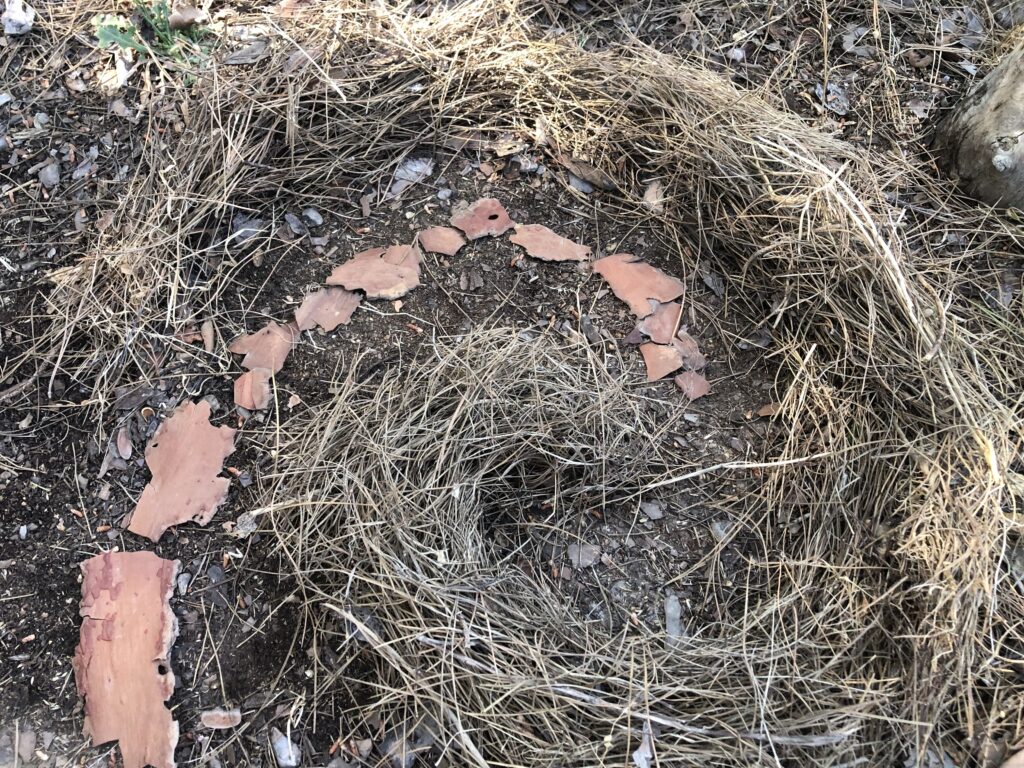
II will take photos daily as a type of archive, as the work will become ephemeral. In the image below, on the left, I made a spiral with pine needles and bark. (found objects on the site)
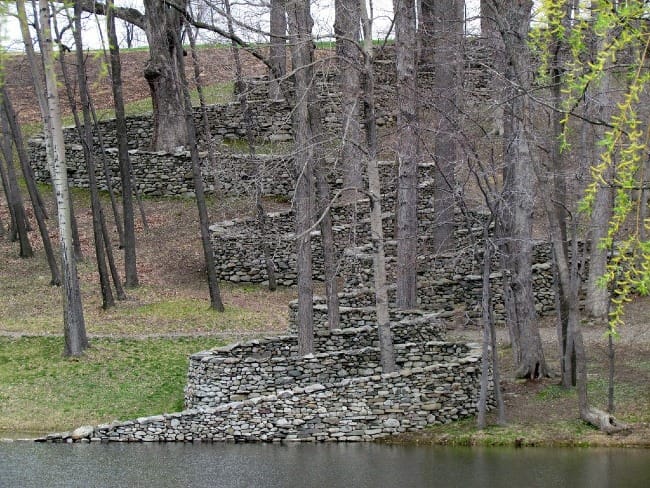
The image on the Right is a work by Andy Goldsworthy, Storm King Wall (1997-98). What I like about this work is that it also functions as a symbolic reminder of the history of the land. For the artist, this is also the history of mankind, through the appropriation of ancient devices for land demarcation. Goldsworthy asks us to consider how we co-opt land to define our own boundaries, even if its natural state is one of unfettered freedom and dispossession.
Personal learning from this research and project planning:
I trust that this work will reinforce my theme of ecology of attention: it will encourage slow looking and create a ritual of humility and care. I like that it mirrors the hidden, unfolding patterns in nature, and allows the work to breathe without being “displayed”. This transforms discovery into participation. It will be important for me that the spiral’s secrecy becomes part of the work.
I will not share this location or the fact that I work until the end of the process. I would like for this to be discovered quietly – no signage, no mention, no social media posts,, no guidance, only for those who walk in the space, by discovery. The core principle or meaning: I will simply build the spiral daily, in the same gentle place, with no expectation of audience, and the discovery becomes part of the artwork. If someone does find it, they become part of the ecology of attention – not an audience, but a witness. To me, the secrecy in this work, is not concealment but reciprocity: an agreement between artist, forest, and those who happen upon the work, to leave things undisturbed so that the process may continue. The spiral holds the trace of this shared attention, returning it daily to the forest that shapes it.
The spirals exists, but is not announced.
It is found — not visited.
Possible material explorations: Pine needles – stacked, or broken into smaller pieces
A note I could leave at the spiral – if a visitors find the space:
If you find this spiral,
You have discovered a quiet work taking shape in a forest that holds its own complicated history. These pines are not indigenous, yet they breathe, shed, and grow into this land in their own way. This spiral is built slowly from what the forest gives—needles, cones, fragments—an attempt to listen to the place rather than claim it. Please allow the work to remain undisturbed, and keep our presence here gentle.
or
You have discovered a quiet spiral,
made from what the forest offers.
This place is not neutral;
it carries histories of planting and change.
Please keep our secret.
Do not touch.
Let the forest shape what will become.
Anthropocene, a word coined to define an epoch in which human activity leaves an impact so great that it profoundly modifies terrestrial ecosystems.
Prayer: God help me. My boat is so small, and your sea is so immense!
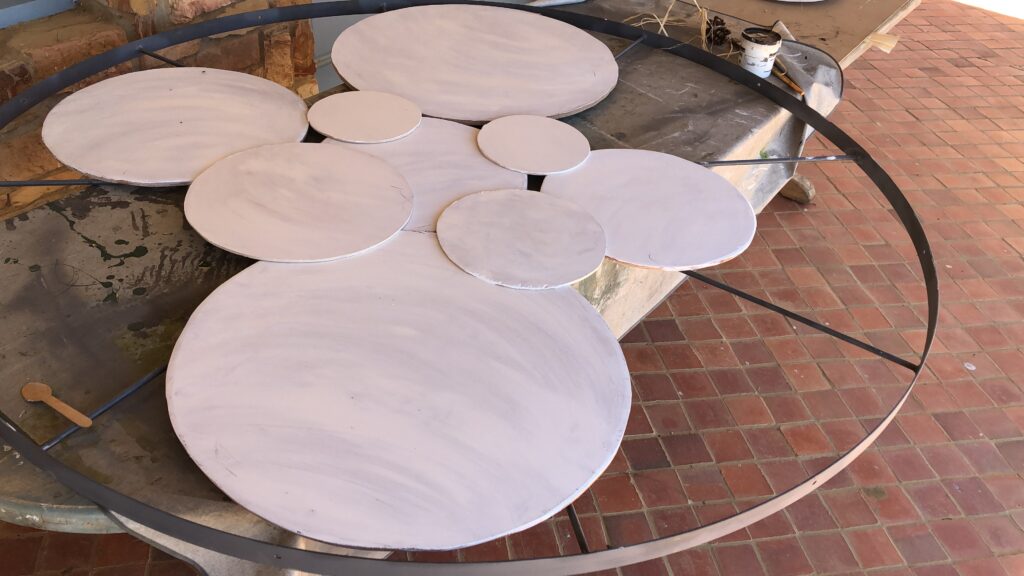
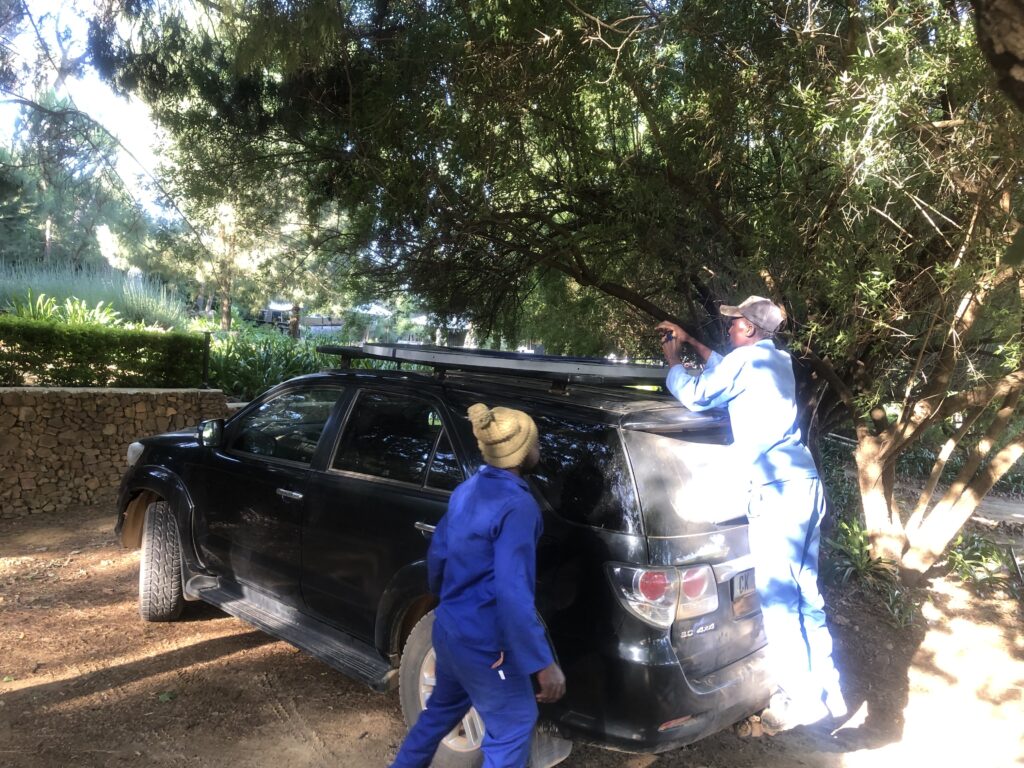
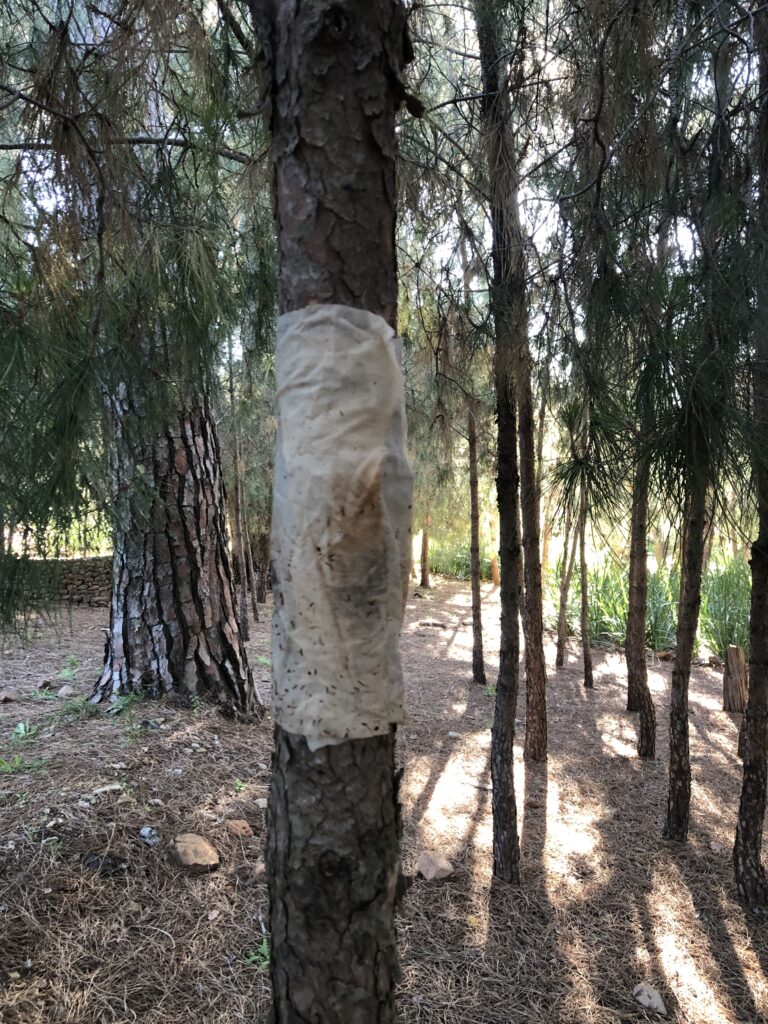
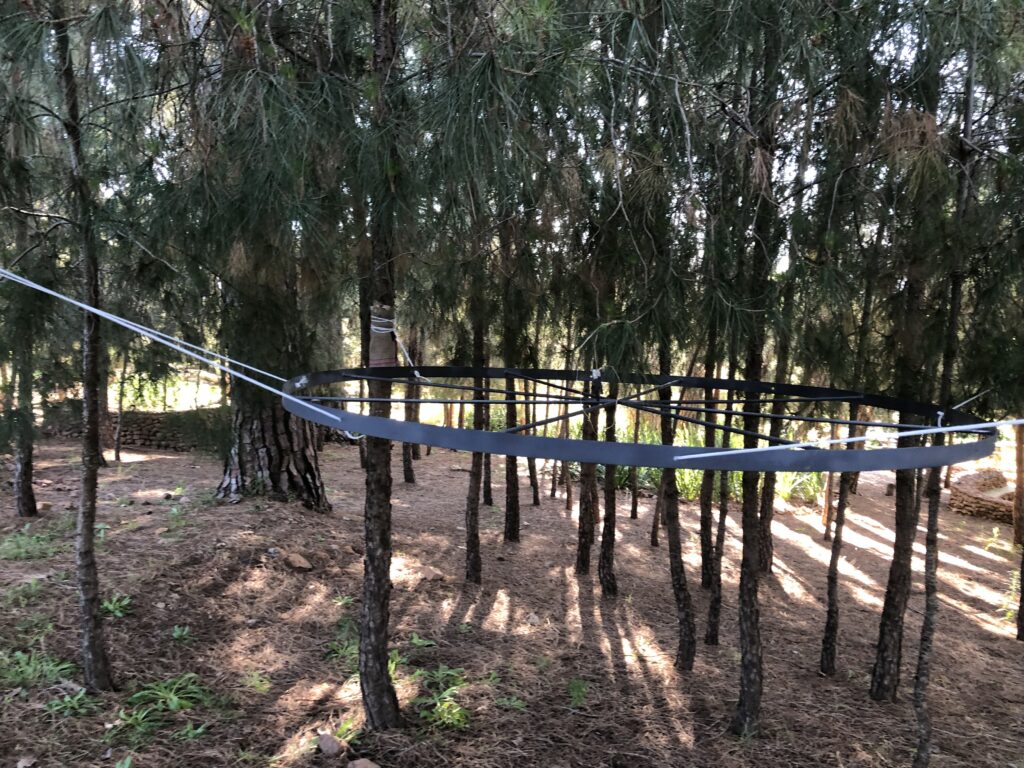
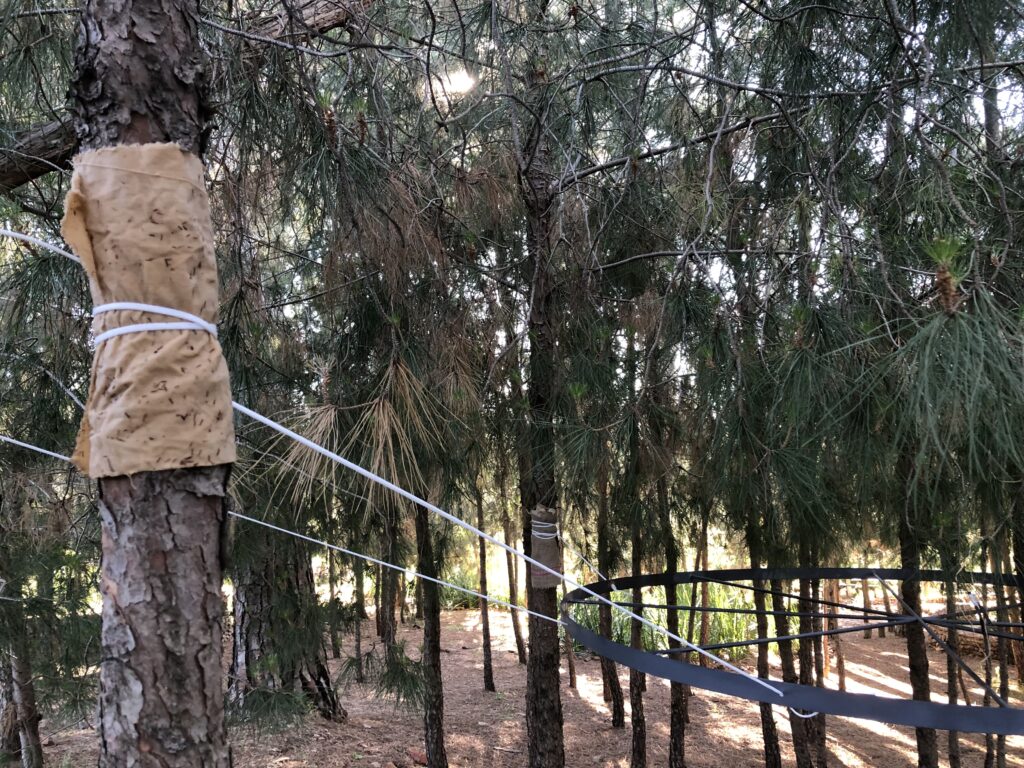
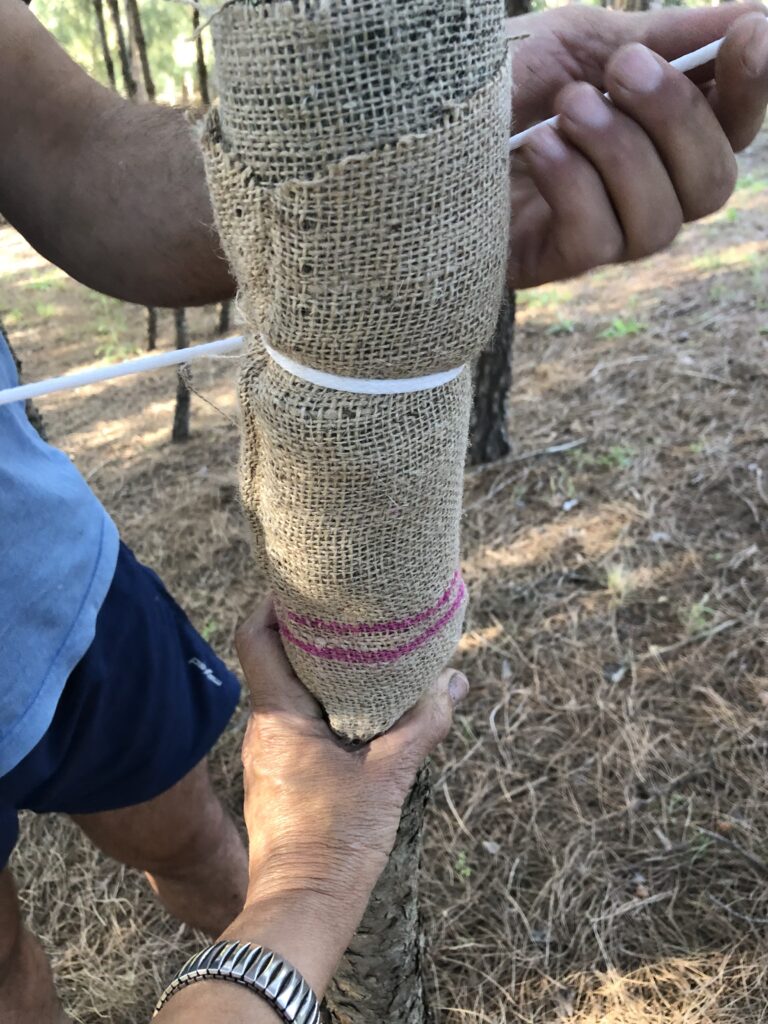
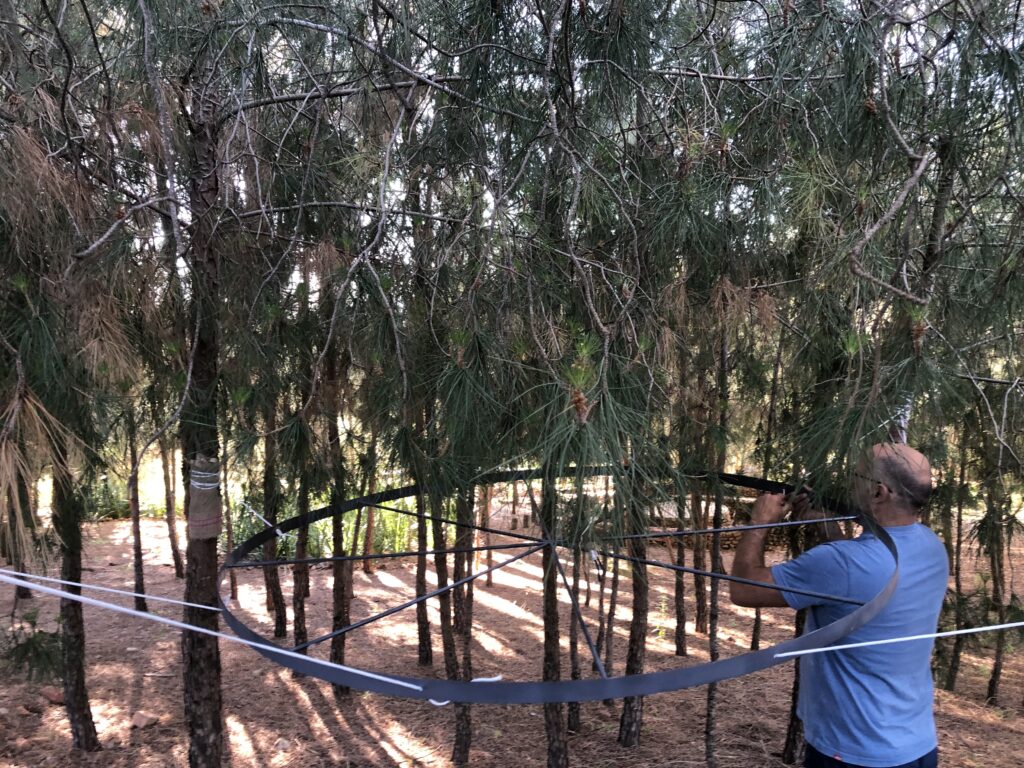
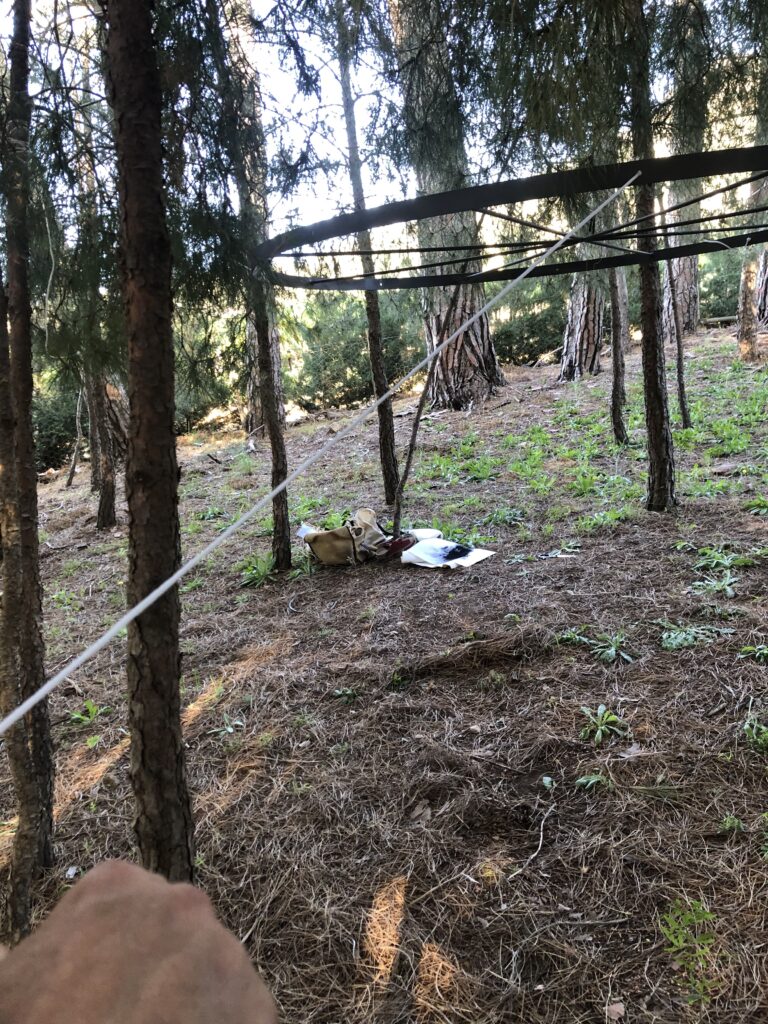
I fastened the drawing surfaces onto the steel frame by making small holes in it and tying it to the steel frame with thin wire.
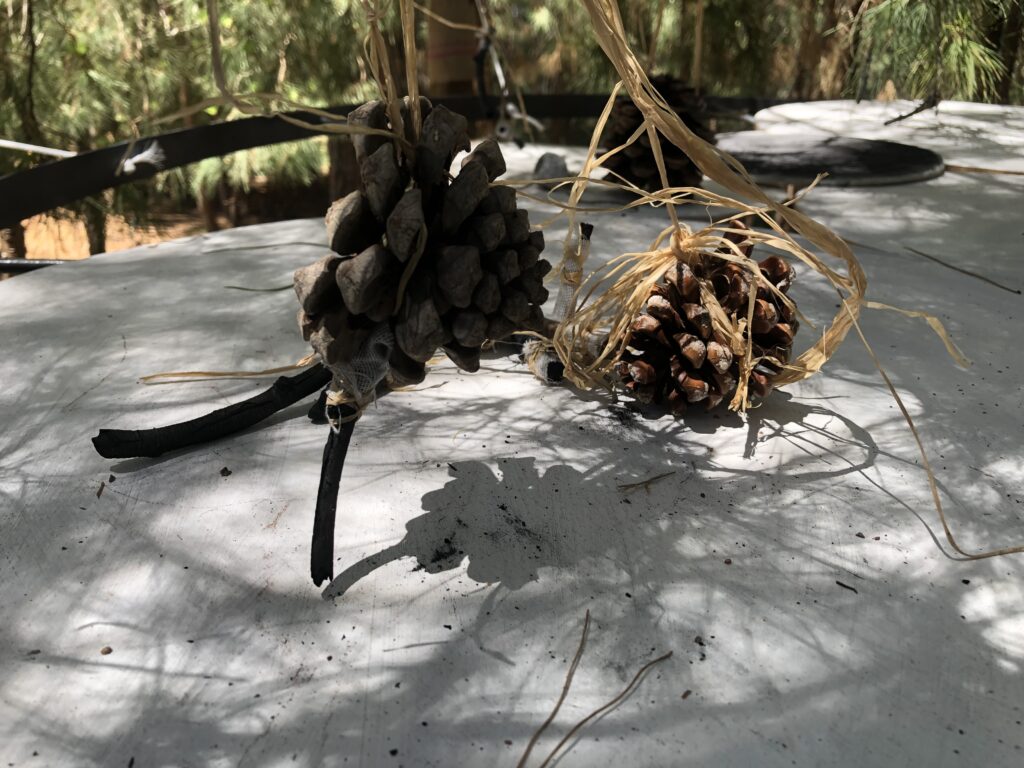
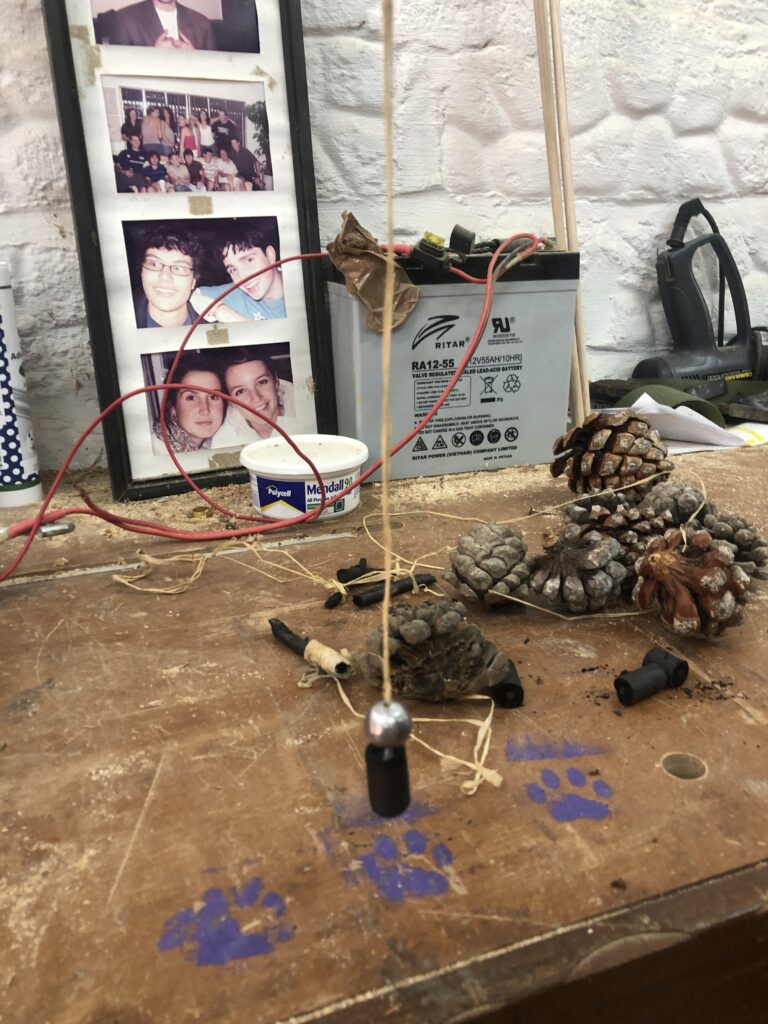
It seems the biggest challenge will be to get the charcoal hanging from the branches and touching the drawing surface effectively – need weights and will use the pine cones.
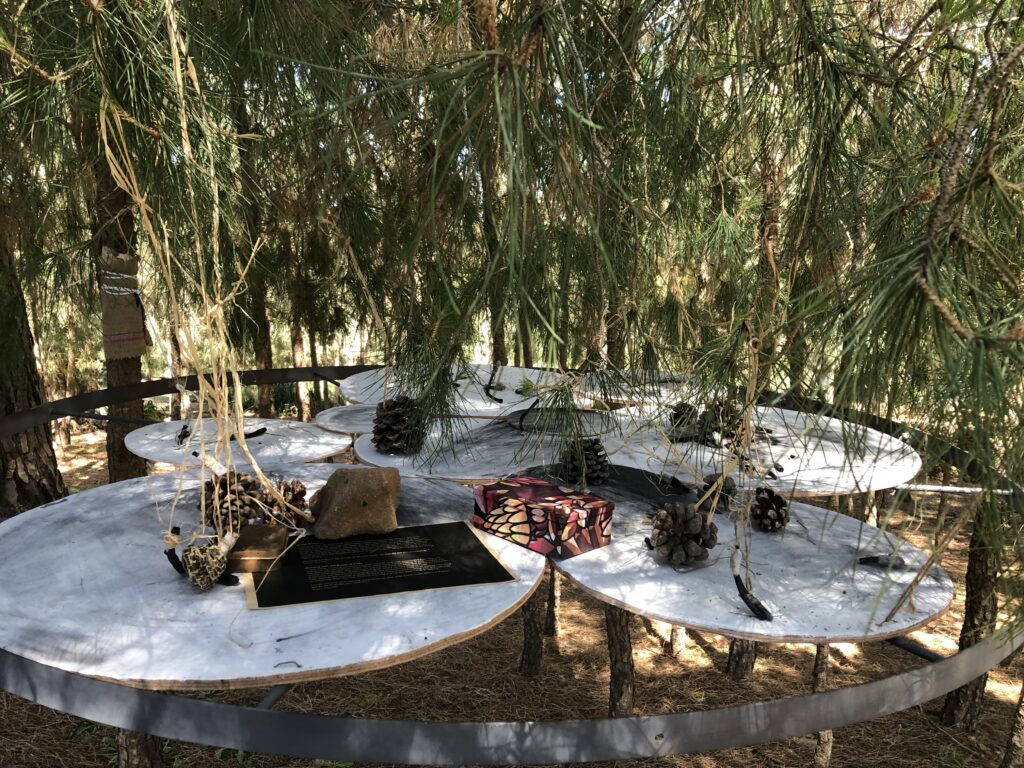
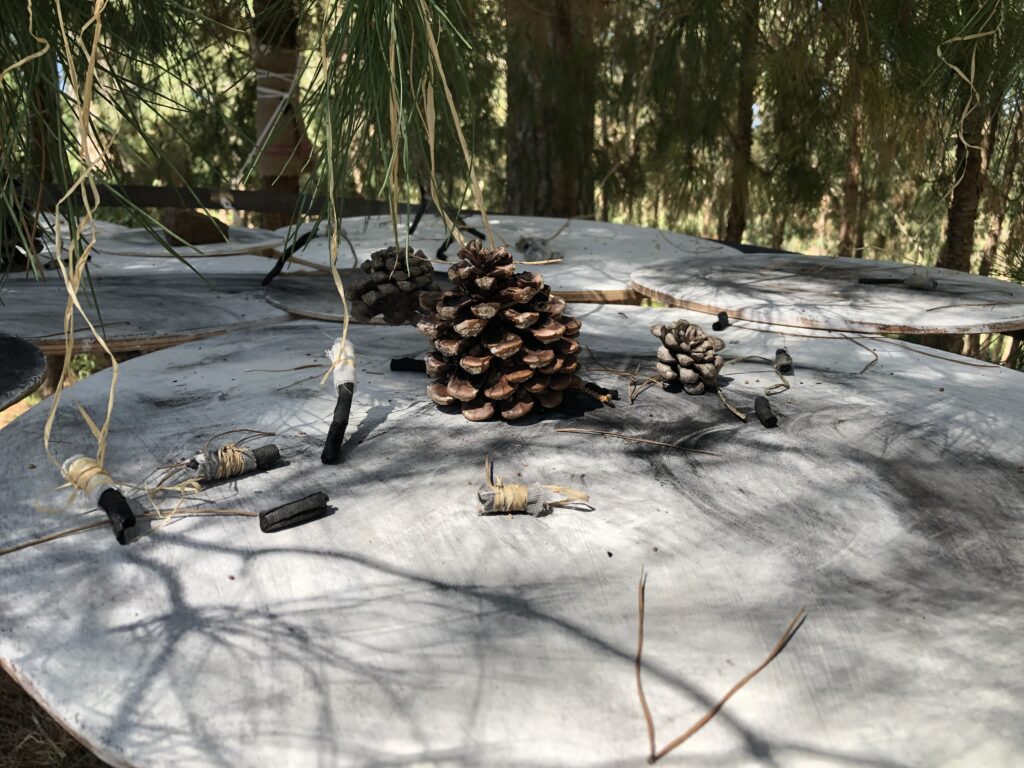
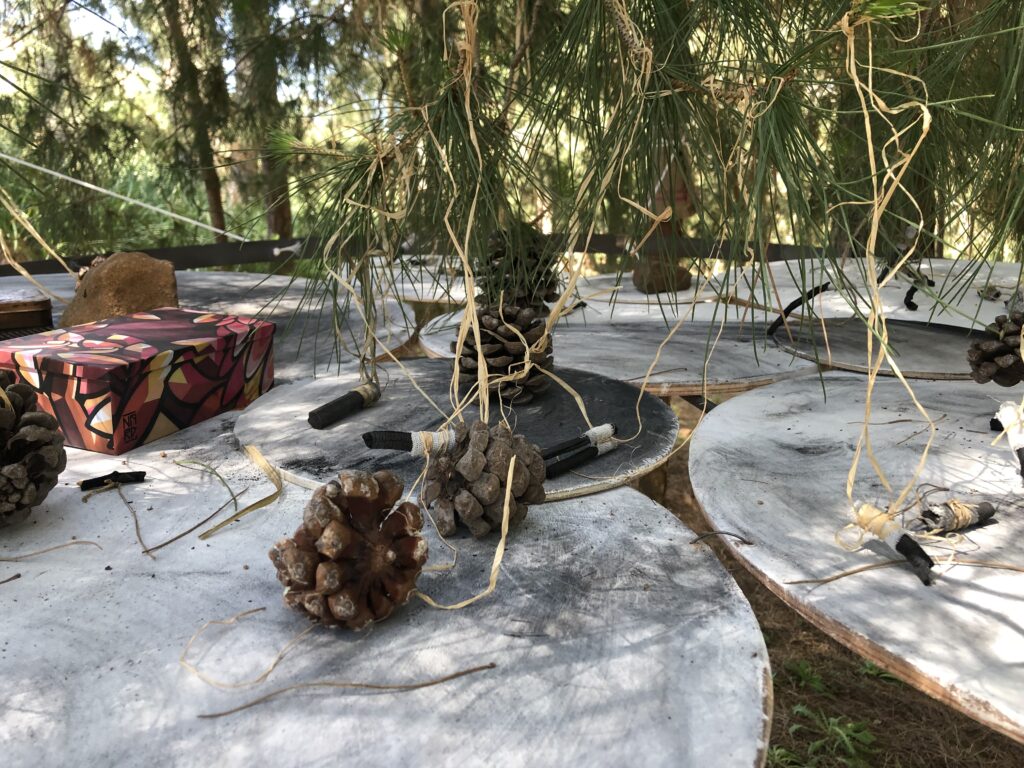
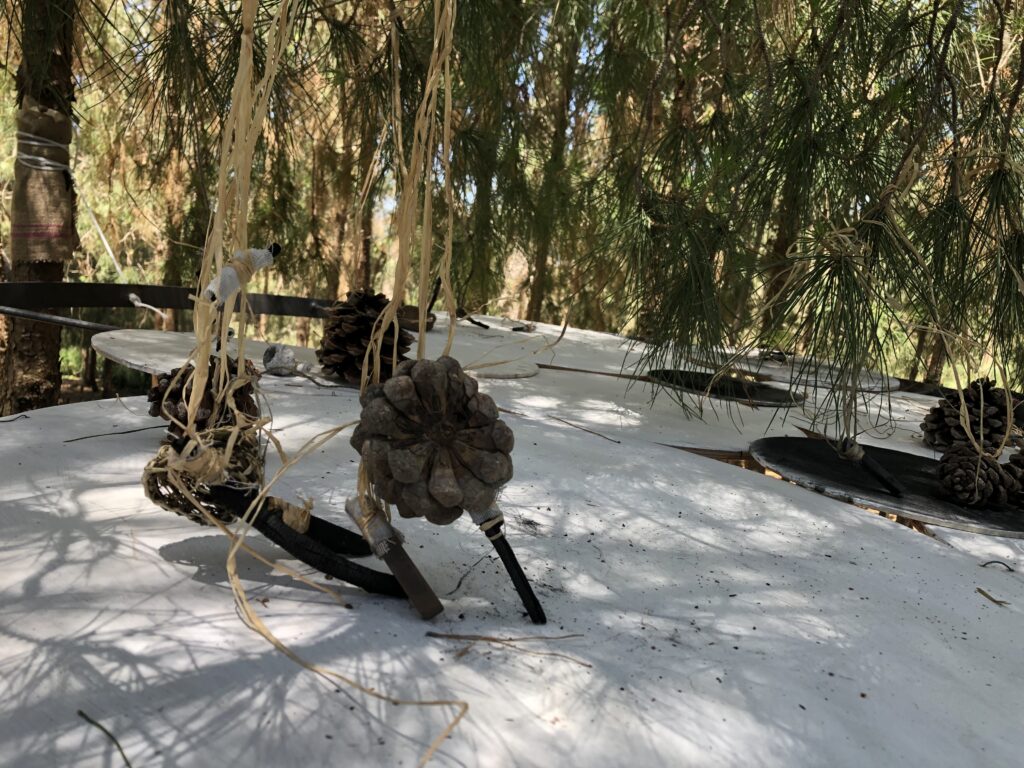
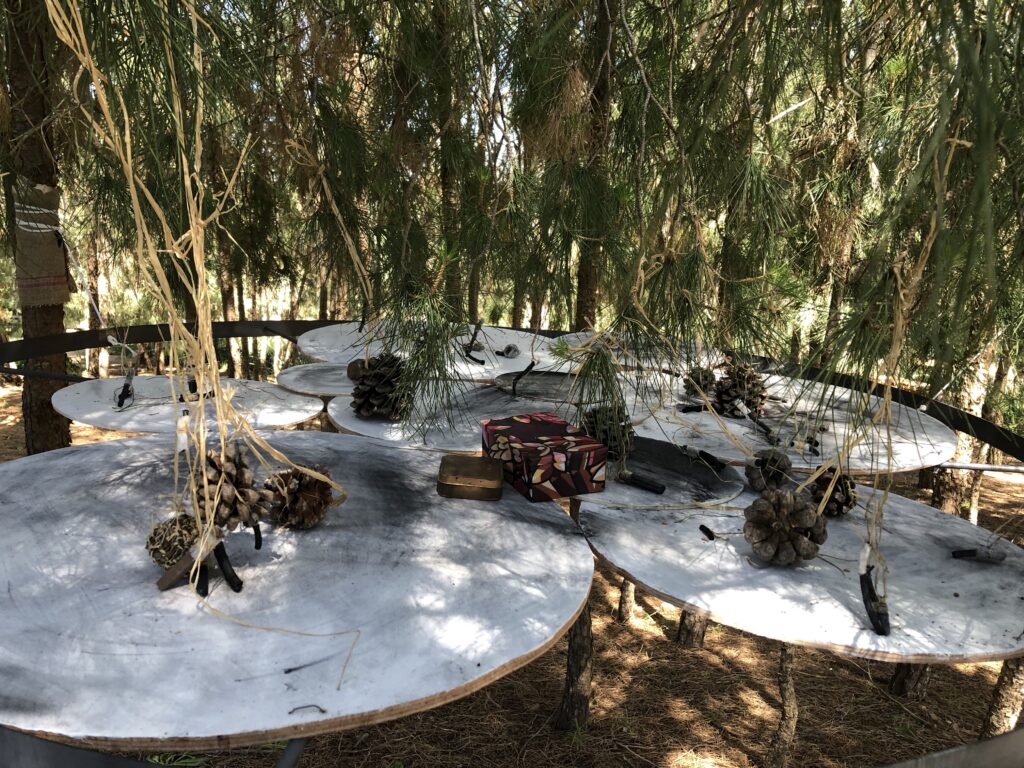
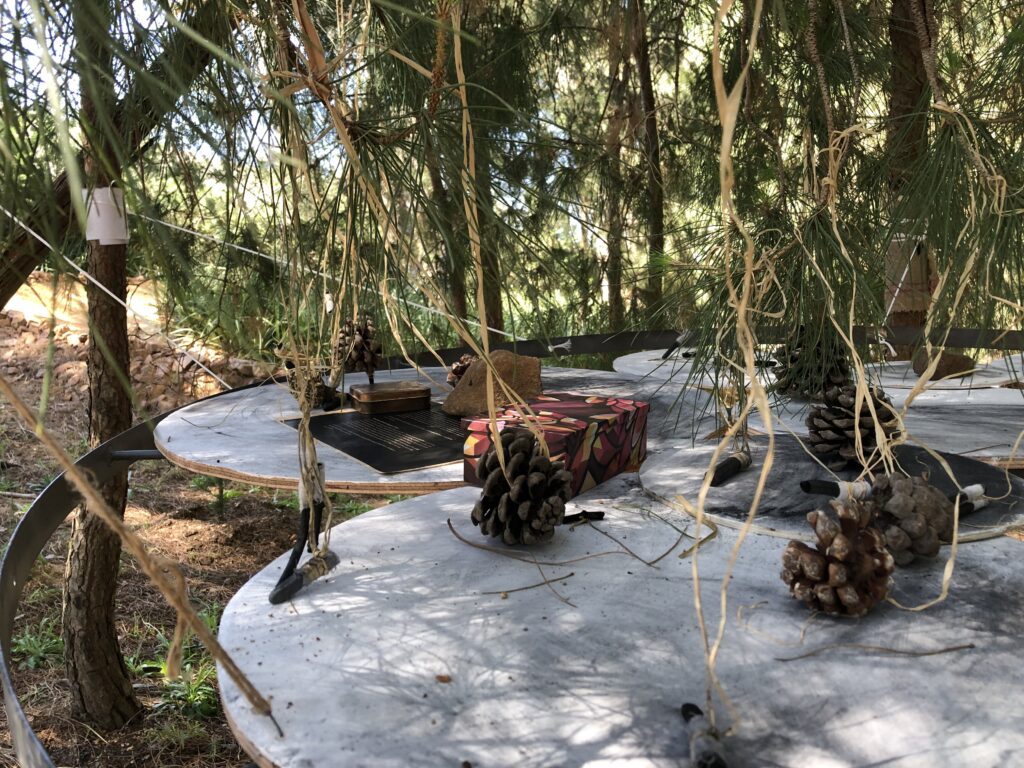
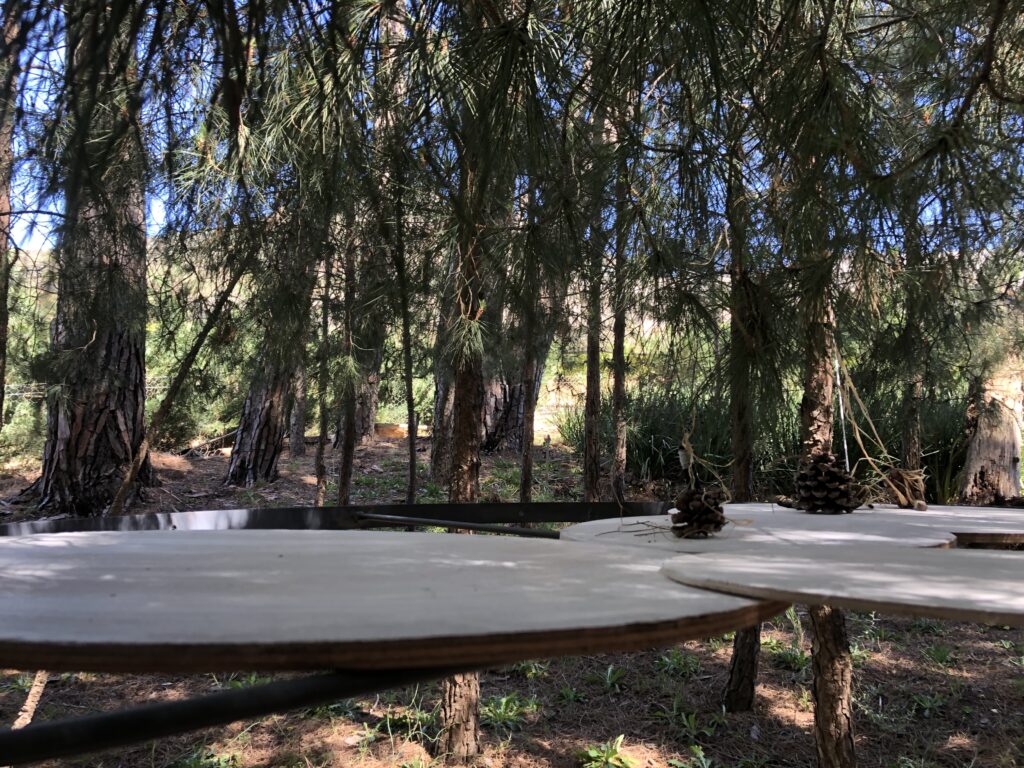
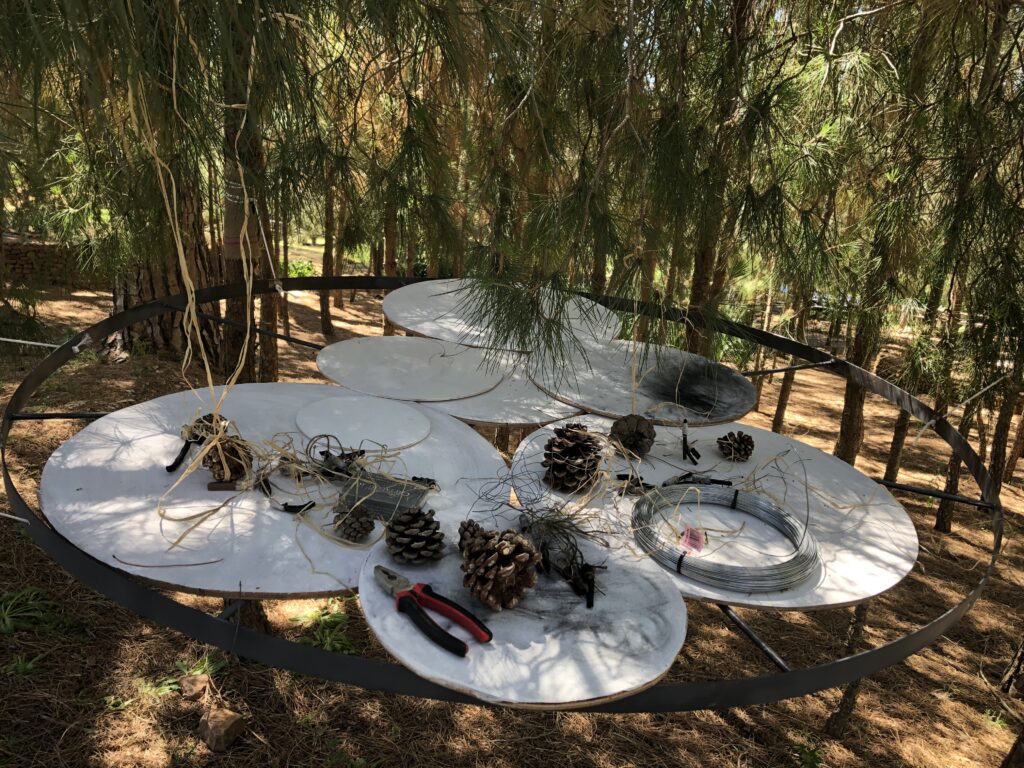
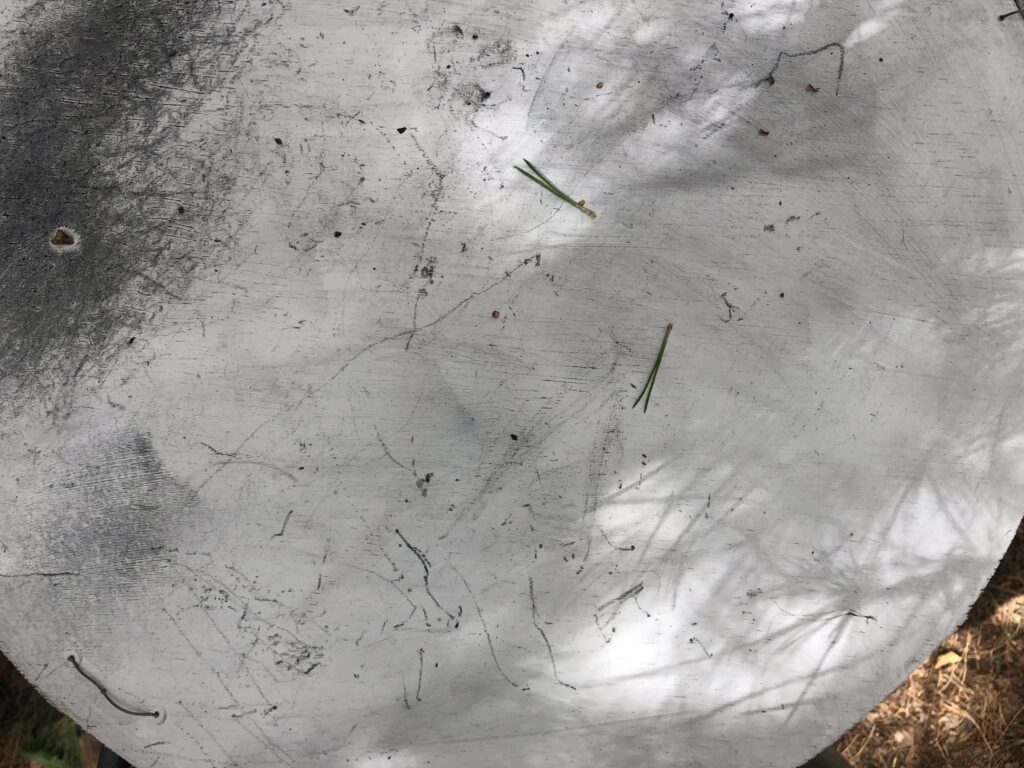
On 26/11/2025 when I arrived at the site, I learned that the sprinkler/irrigation system had reached the work – it was wet! New marks appeared on the work -drip trails, smears and water droplets. I will not fight it – it is a given from the site – it almost mimics rain droplets for me. I will accept the marks as part of the process of working in a non-natural forest where human interference happens.
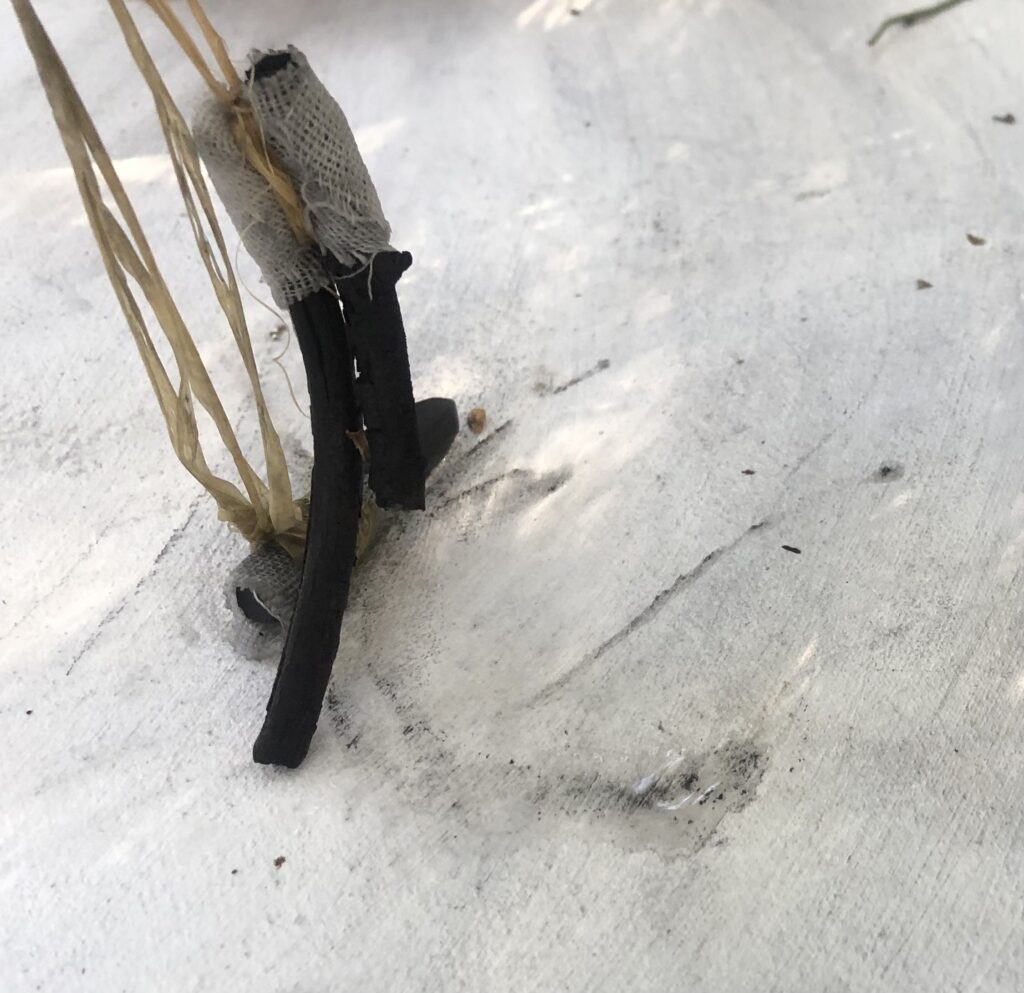
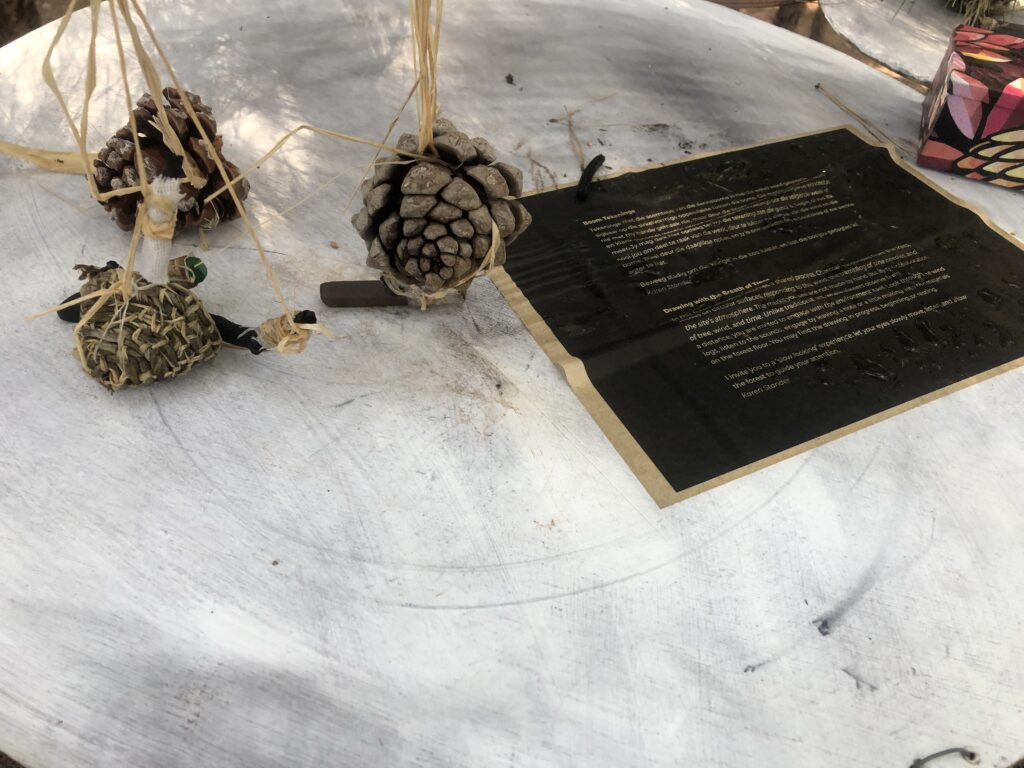
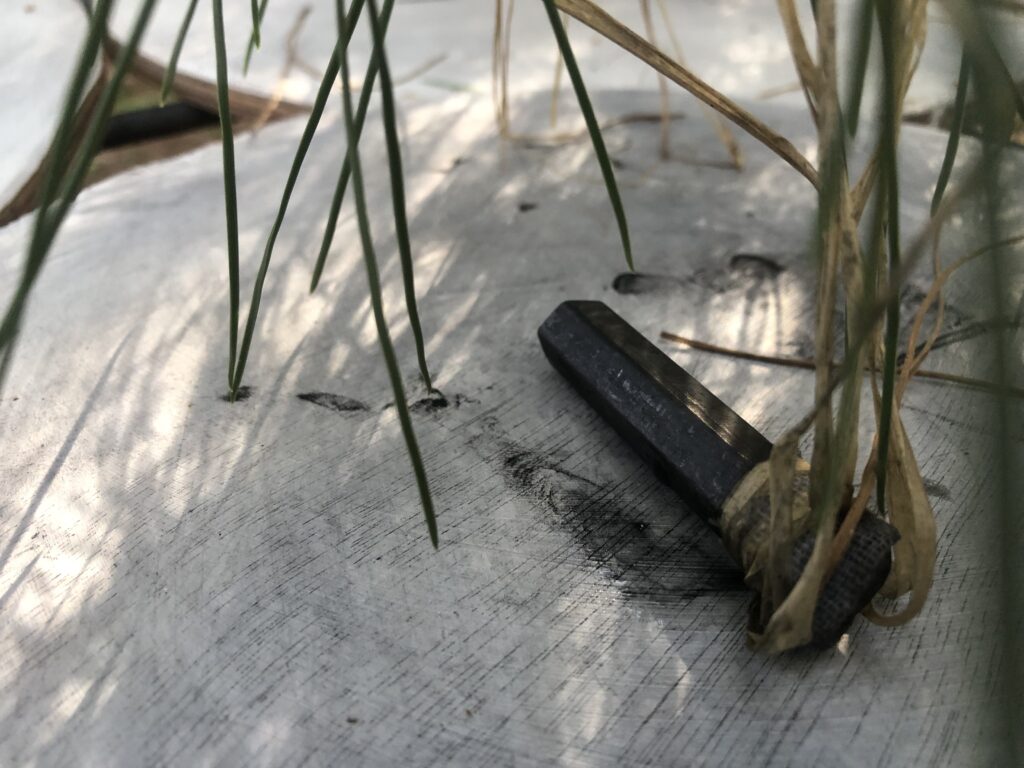
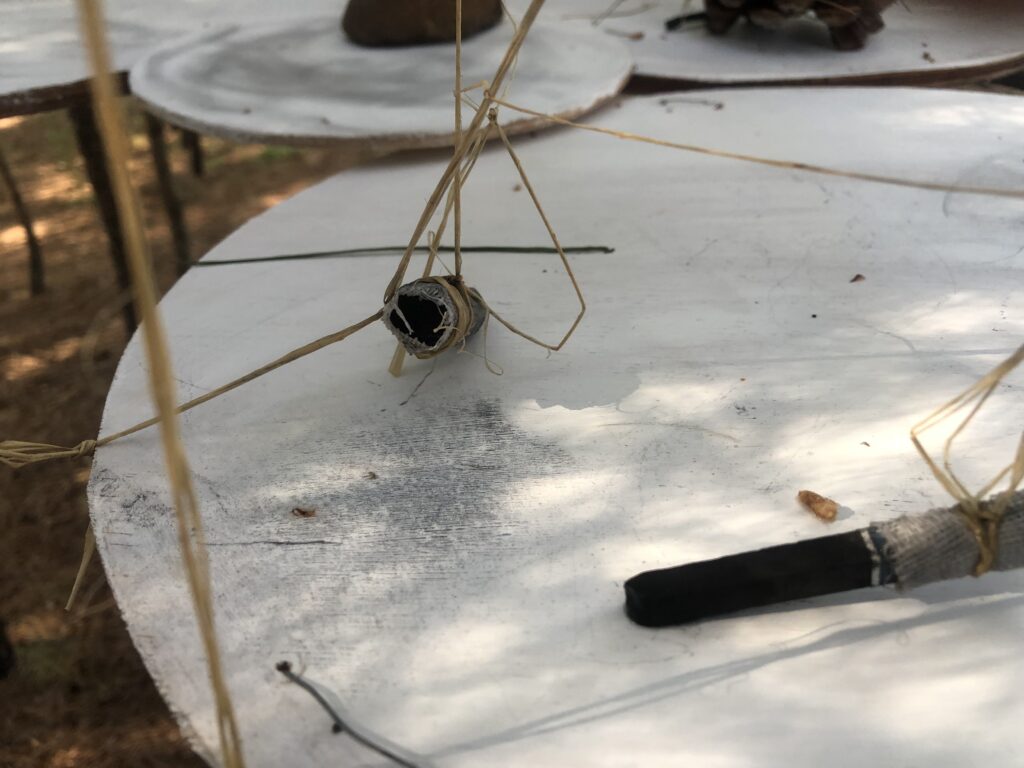
The drawings now hold traces of both air and water — the atmosphere and the farm’s rhythms.
Today, the work feels more porous, less controlled, and more deeply entangled with the place.
I visited the site again between 4:00 and 5:00 p.m. as the wind picked up, and I wanted to see what this was doing to the drawing tools and weights. The wind was strong and blew from the West – regular strong gusts pulled through the installation. I could hear the big trees moving and a few pine cones dropped with a loud sound to the forest floor. My drawing surfaces are steady and secure. I feel the charcoal is too light to make proper marks during these stronger wind gusts; lifting is an added concern.
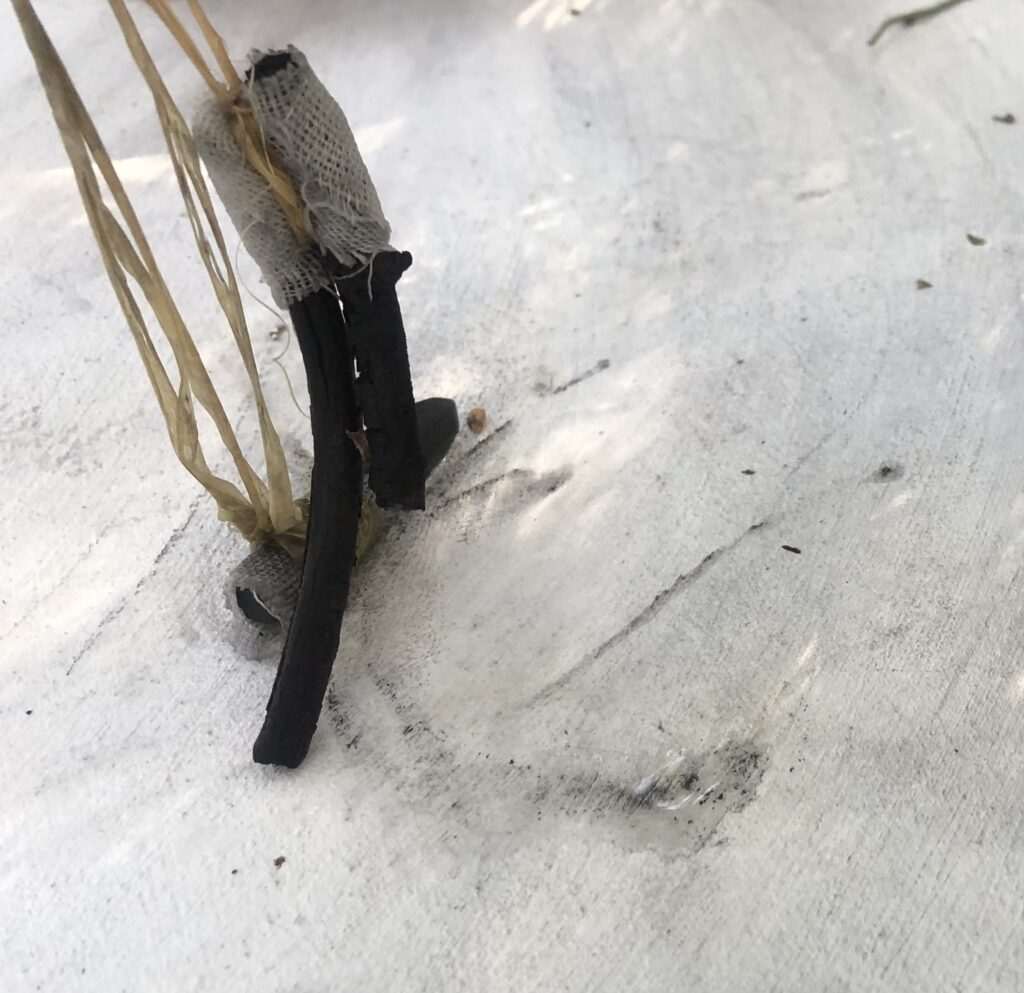
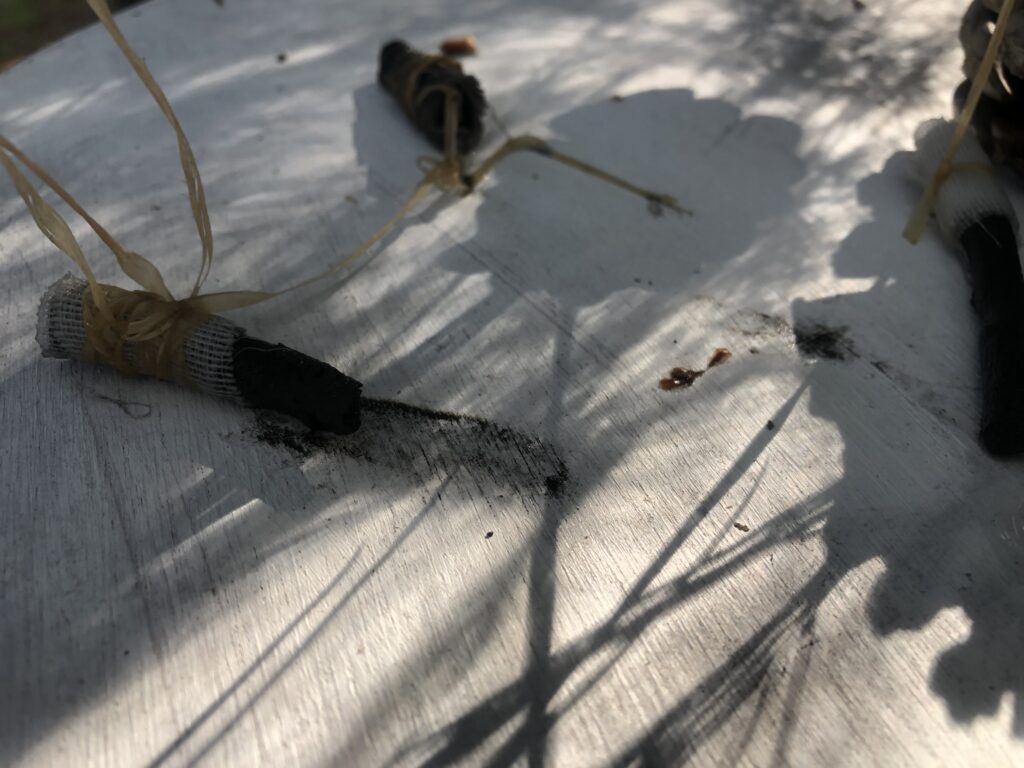
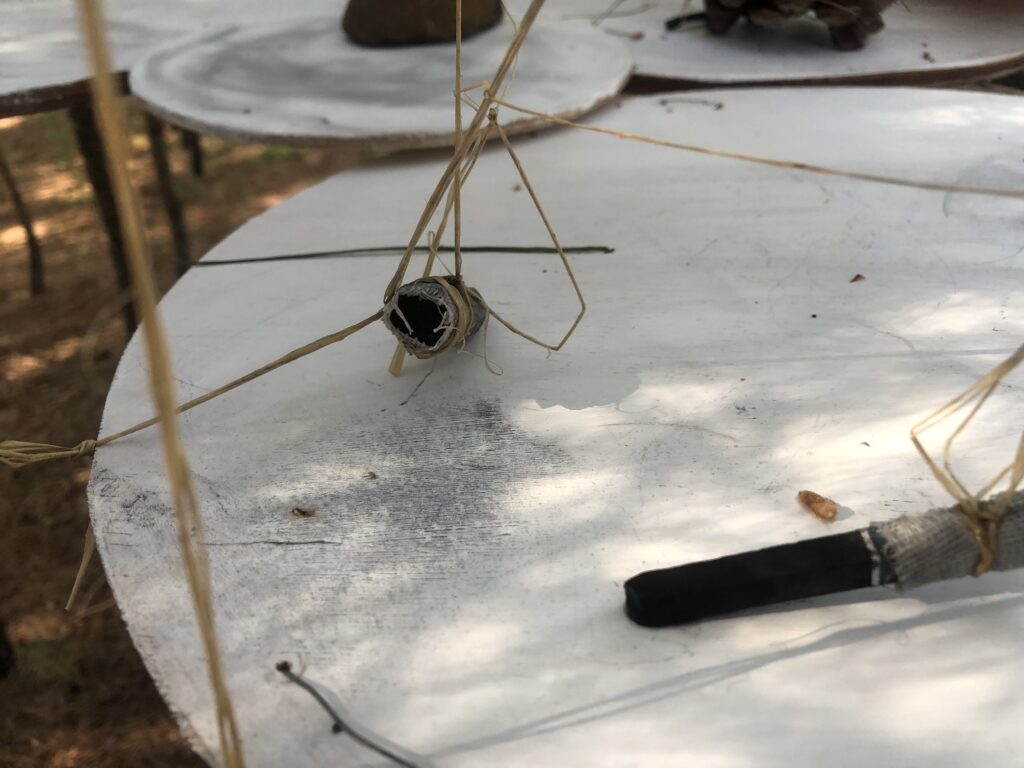
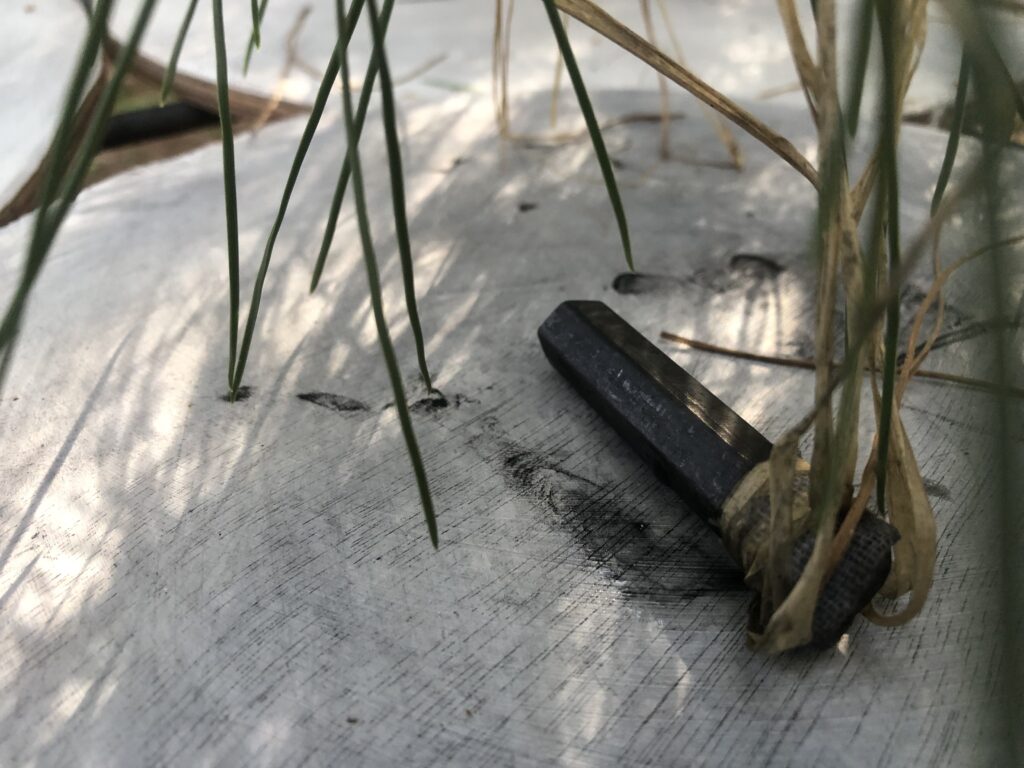
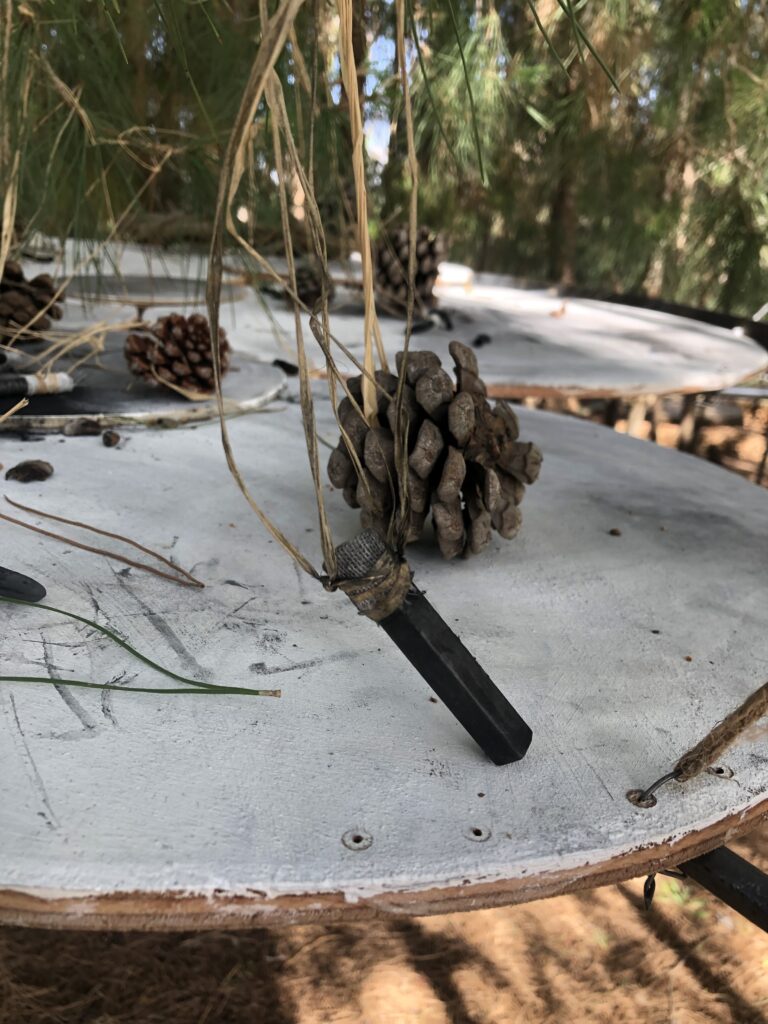
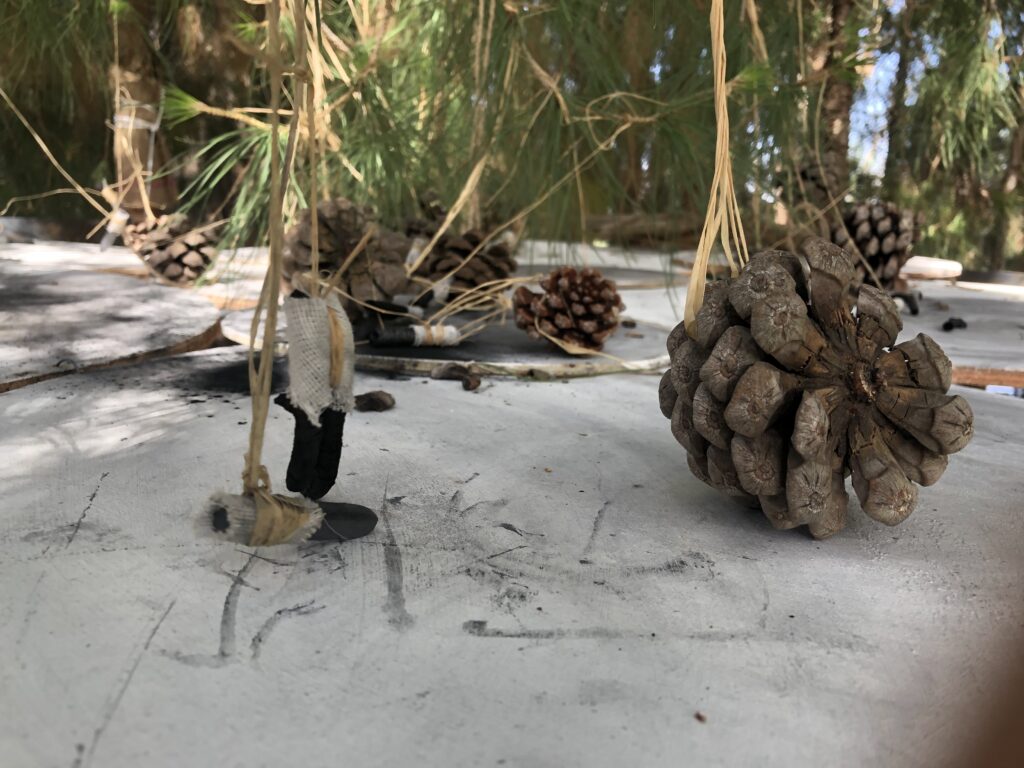
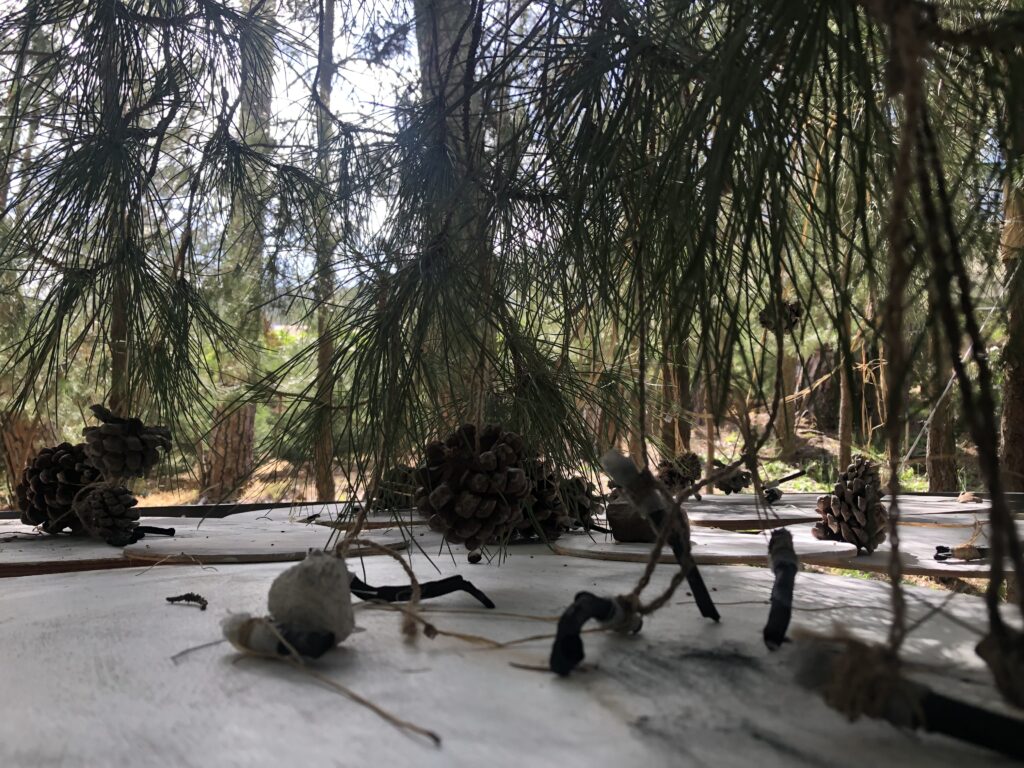
Today highlighted the difference between wind movement and surface pressure.
The system captured motion, but not enough weight to create sustained lines.
Tomorrow morning I will focus on introducing heavier charcoal tools, additional stabilisers, and refining line aesthetics. This installation is still finding its balance, and the wind remains an active collaborator and teacher.
27/11/2025
Today I was very aware of a noisy group of Black headed herons high in the pine trees – my google research showed the following: Black-headed Herons, along with other species like the Black Sparrowhawk, frequently use alien trees such as pine (Pinus spp.), poplar, and eucalyptus for their nesting sites. These trees often provide suitable structure and branch size for their bulky stick nests. The use of alien trees for nesting is a significant adaptation for these birds in the Western Cape’s altered environment. On the ‘mostlybirding. com site’ I read that the Black-headed Heron is a terrestial species, not necessarily found near wetlands as with other herons, and is one of the few birds that benefit from human alteration to the environment, such as irrigated areas, which suit their preference for damp pastureland.
28/11/2025
Adjustments to the way the steel frame hangs:
I replaced the white ropes that fasten the steel circle to the trees with black ropes and loosened the tension so that there is more movement when the wind blows. For now, the frame can sway but does not rotate freely
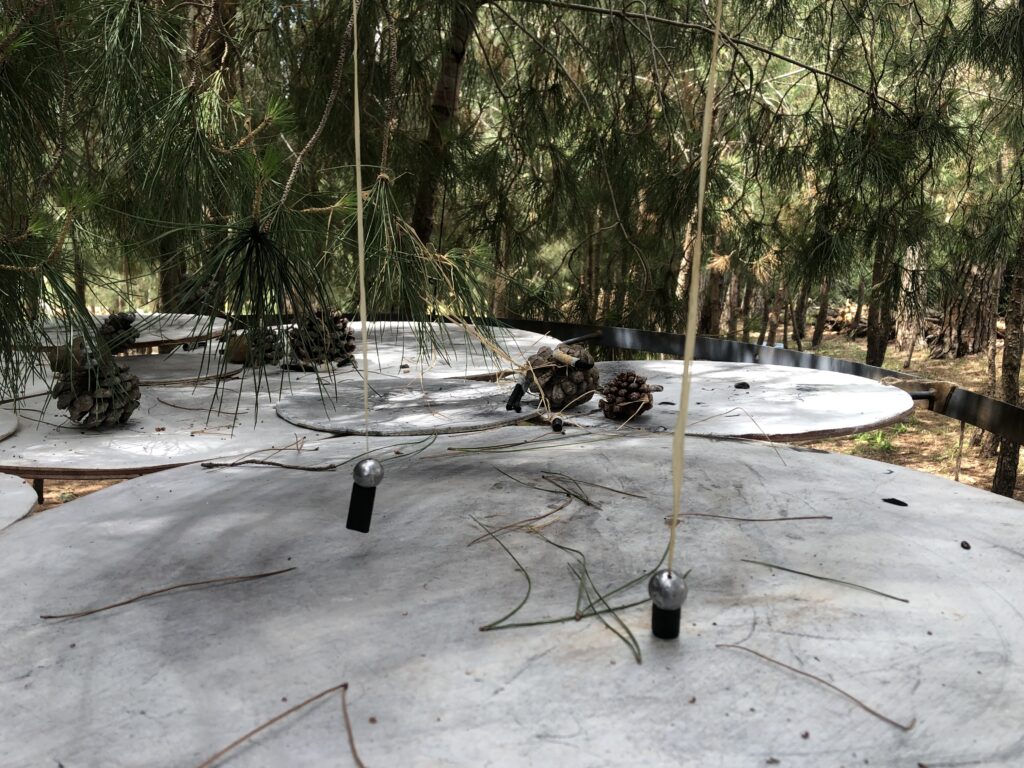
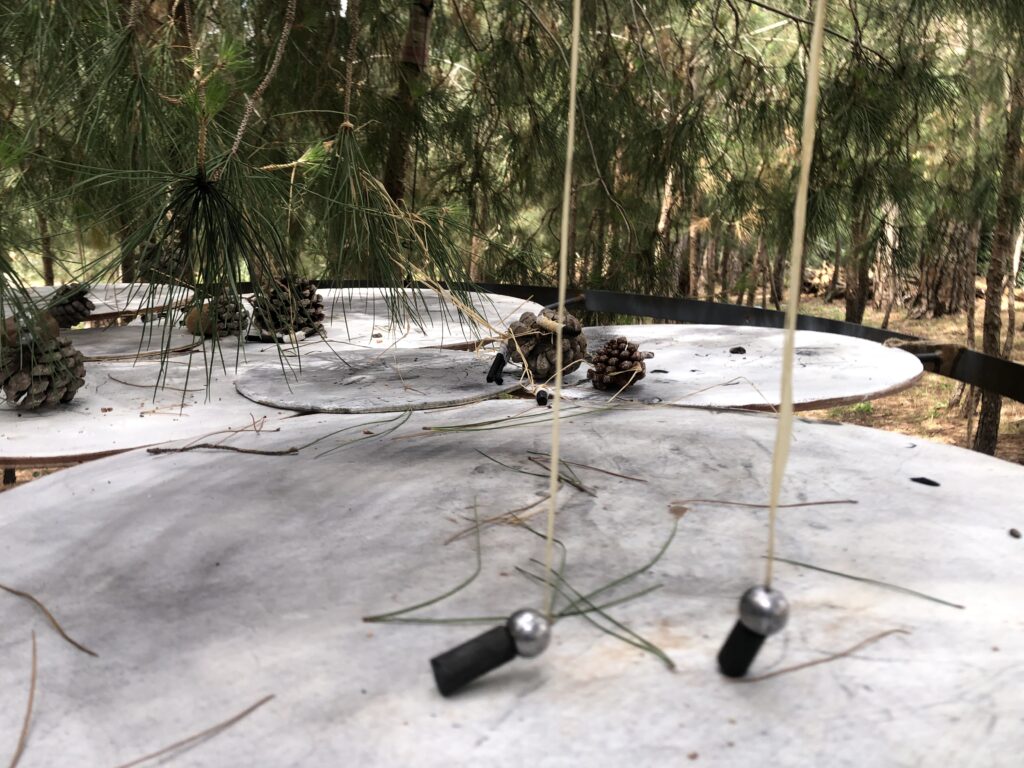
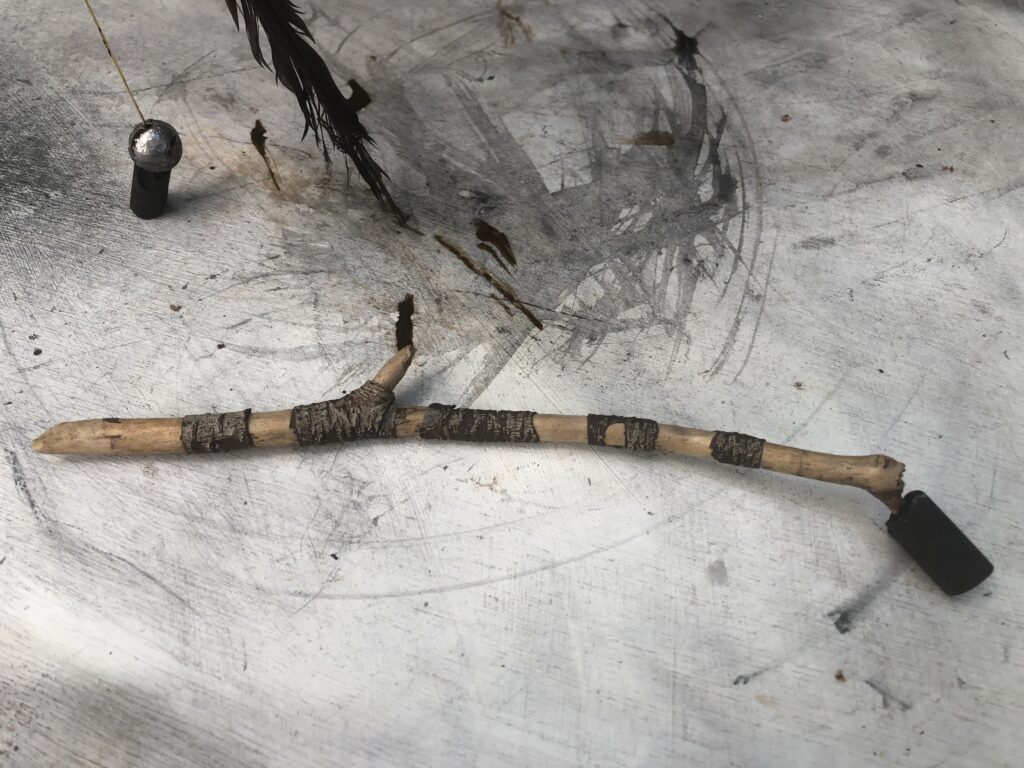
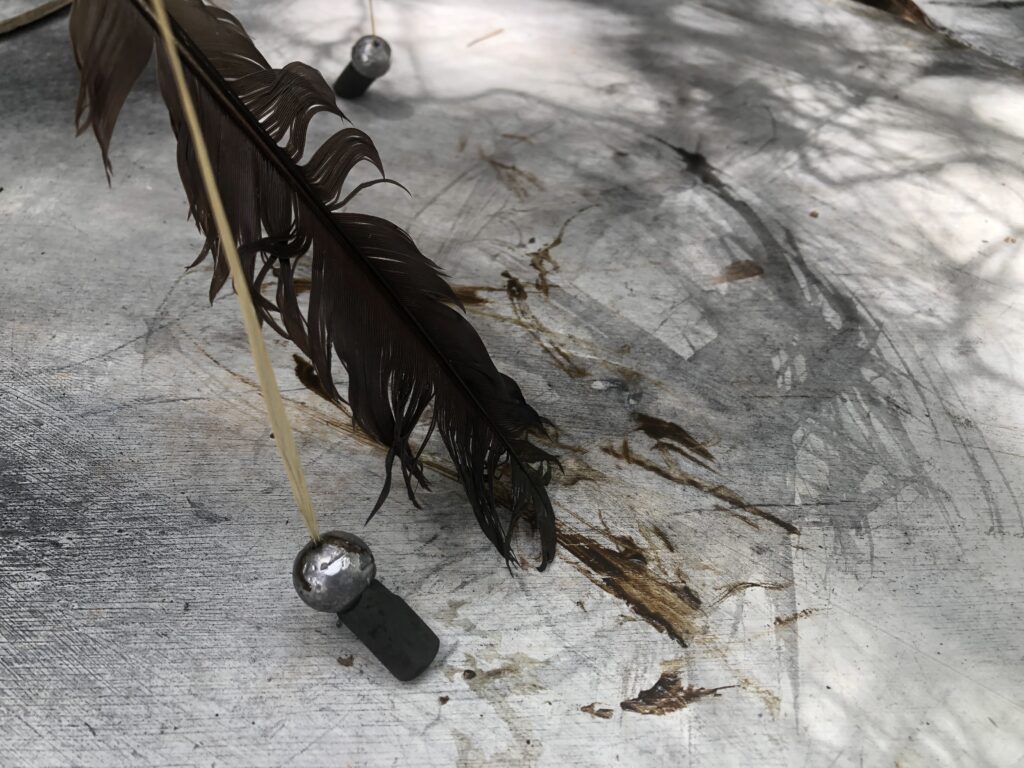
I bought little lead balls to add onto the charcoal for more continuous contact with the drawing surface. I will explore drilling holes into the pine cones to see if I could fit the charcoal into it and use it as a drawing tool – I do think this could address the weight issue. It becomes clear that this is a difficult task in the tree – as the branches are connected and it is difficult to get the balance correct. The last image here shows my dilemma – it was correct when one drawing tool was hanging, but when I added the next one, the balance was lost. I will remove the weight tomorrow and see how that works – I might have to use ‘lighter’ weights to balance this.
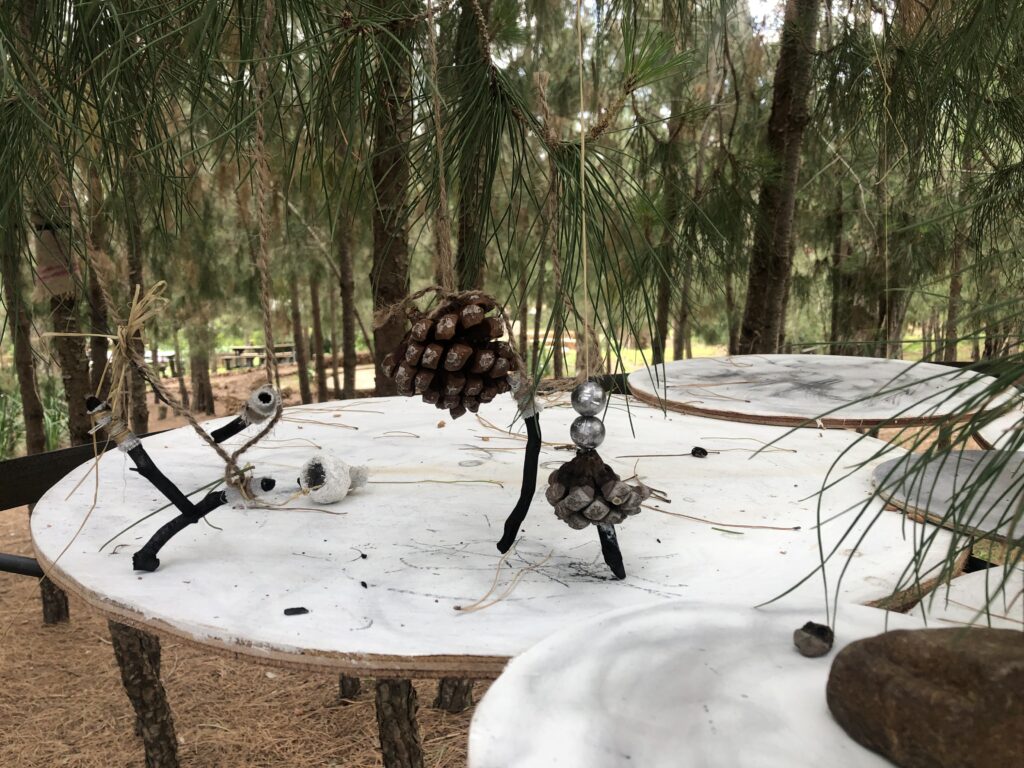
29 November 2025
This process shows exactly the sensitivity threshold I am working with. What you’re witnessing in the above image is the moment where the live branch becomes overloaded and begins to compensate, which fundamentally shifts the behaviour of the charcoal tool. This is valuable information, not a failure — it tells me precisely where the threshold of “breath-pressure” lies.
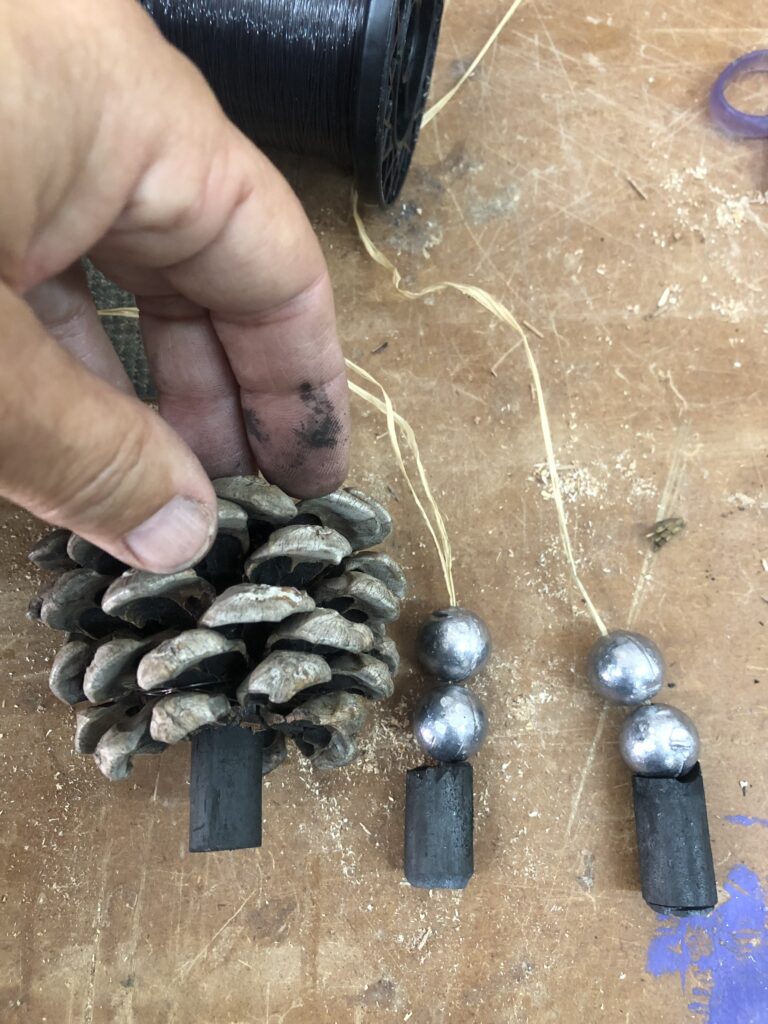
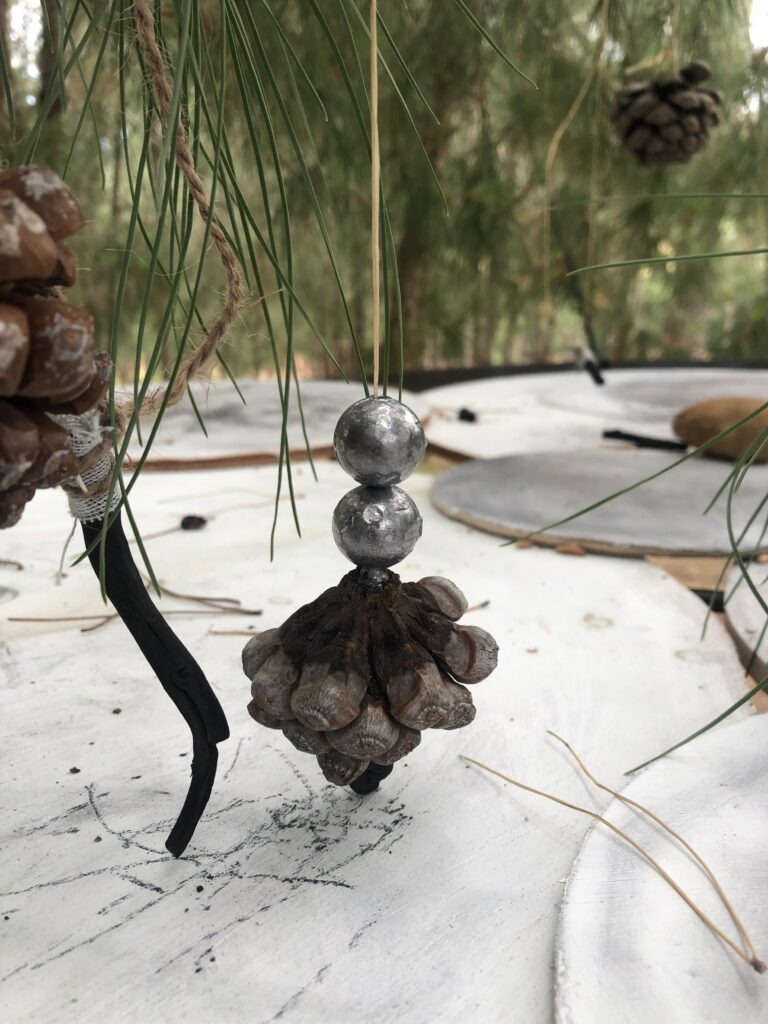
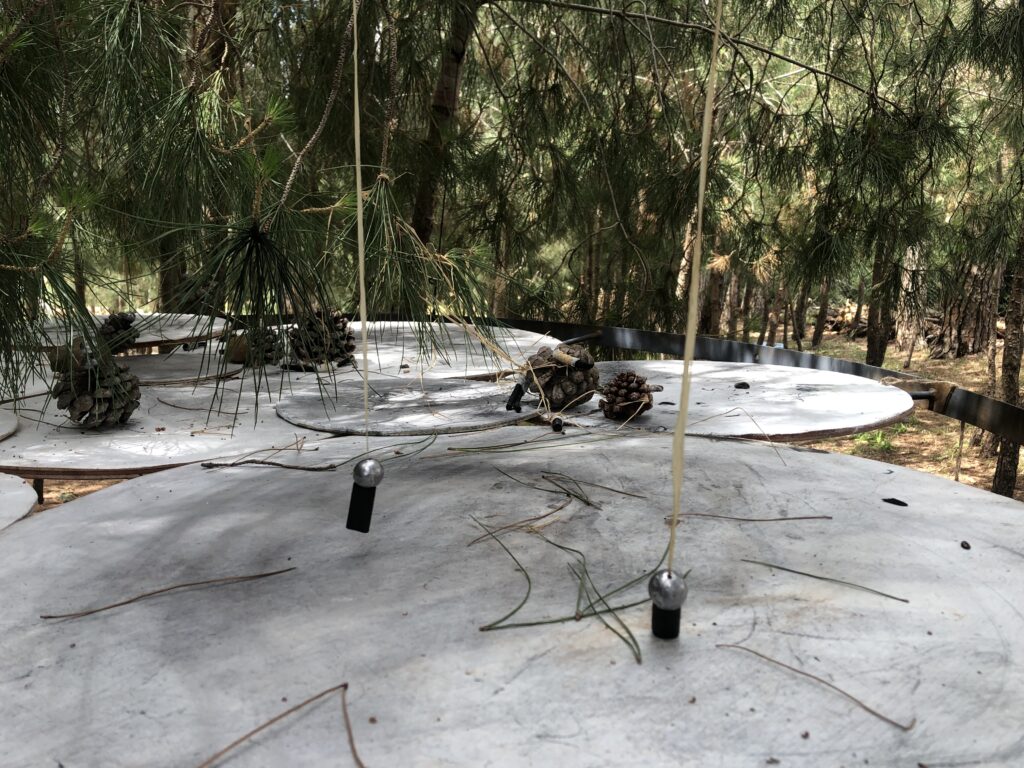
Finding the correct weight calibration, I might only need 1–2 tools that should carry weight; others should stay breath-light. I am more convinced that the work can become or be seen as graphic traces of meteorological forces. I am still trying to find a way for the tools to react to these forces so that I can capture these traces without too much interference.
30 November 2025
I adjusted more of the drawing tools and have a pull in working with the cones where I fit charcoal onto them. There are now fewer tools on the drawing surfaces as I am working on the movement and markmaking by considering the line and mark quality. I realise my ideal is to have responsive actions from each drawing tool: to have the branch almost breathe and rebound (stay flexible) instead of it becoming a load-bearing structure.
I love how this knowledge becomes visible in the drawings. I am experiencing that the charcoal tools have interesting ways of making contact with the drawing surface: I think I can say they hesitate, drag – almost forcing me to find a tactile vocabulary of wind’s touch on matter. This made me consider agency, rhythm and mood in the breath/wind drawings. An artist friend shared an article about the work of artist Akiyo Ueda. I was not familiar with the artist and found that his methods of working with wind extends this field of influence by offering a language for the emotional register of wind. The installations reveal the wind as a nuanced presence — shy, playful, hesitant, or bold — and invite us to feel the atmosphere as a relational force rather than a background condition. In my own work, the charcoal tools suspended between the pines behave similarly: they tremble, drag, touch, and withdraw, responding to both branch/breath and weather. Where Knowles offers a method, Saraceno a conceptual cosmology, Ingold a relational ontology, and Wohlleben a physiology of trees, Ueda offers the metaphorical nuance that helps me understand the wind as a companion. Through his influence, I recognise that the marks appearing on the suspended circles are not only records of motion, but gestures of temperament — the forest’s own subtle vocabulary of touch. (the word -susseration!!)
Thinking about ambivalence and impermanence as key conditions of resistance – read how artists are confronting monumentality – we are in a watershed moment. Book by Cat Dawson: a new generation of artists is shaping the memorial landscape.
The marks produced are temporary, unstable, and shaped by forces that cannot be controlled—wind, debris, weather, loss, and time. This method resists the colonial impulse to fix, classify, and manage the land. It acknowledges the uneasy, complicated legacy of working in a non-native forest while refusing to impose further permanence or ownership onto it.
In letting the pine trees draw—with charcoal they do not recognise, on surfaces that record breath rather than yield—my work disrupts the forest’s purpose. The installation becomes a quiet counter-practice: one that invites sensitivity to place rather than domination of it, one that foregrounds vulnerability instead of productivity, and one that honours the land’s shifting histories rather than obscuring them. Ambivalence becomes an ethical stance; impermanence becomes a refusal to contribute another layer of permanence to a landscape already shaped by colonial intervention.
Working in this pine forest has taught me to treat the site not as a backdrop, but as a living collaborator. The trees, the wind, the shifting light, the fallen needles, and even the daily changes in moisture all play an active part in shaping the drawings. Instead of directing the process, I follow it. Instead of imposing marks, I listen for what the environment offers.
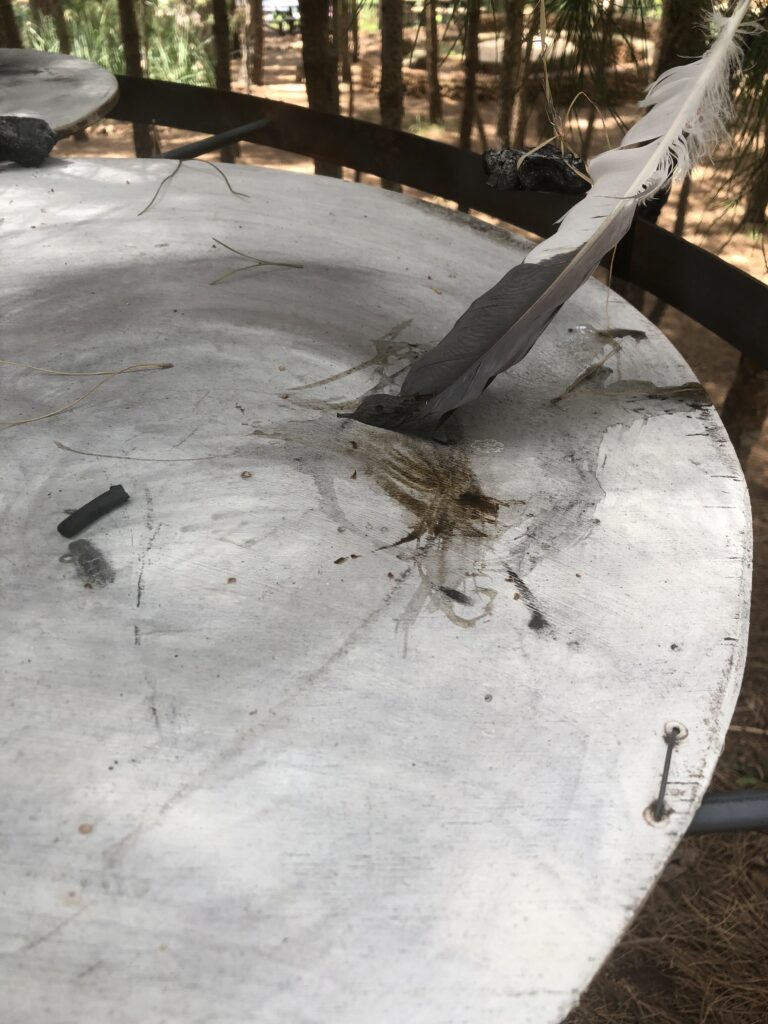
This installation grows from ecological sensitivity—an attention to the subtle movements and atmospheres of the forest. Every day brings a new trace: a charcoal mark created overnight, a feather brushed by a sudden gust, a pattern of fallen debris arranging itself across the surface. These changes remind me that the work is never fixed; it evolves with the breath of the site.
Care is at the centre of my approach. The materials are lightweight and non-invasive, the attachments gentle, and the interventions are minimal. I return to the forest daily not to control the work, but to tend to it—adjusting, observing, and learning from the unfolding conversation between the elements. The forest guides the pace, the form, and the character of the drawings.
In this way, the installation becomes a quiet collaboration with place: a practice of attentiveness, humility, and respect. It invites viewers to experience the forest as an active presence—one that draws, shifts, and participates—revealing a world where art is not made on the land, but with it. I enjoy how the sounds of nature become important – or should I say, came to the front or a way to experience attentiveness and connection to the landscape.
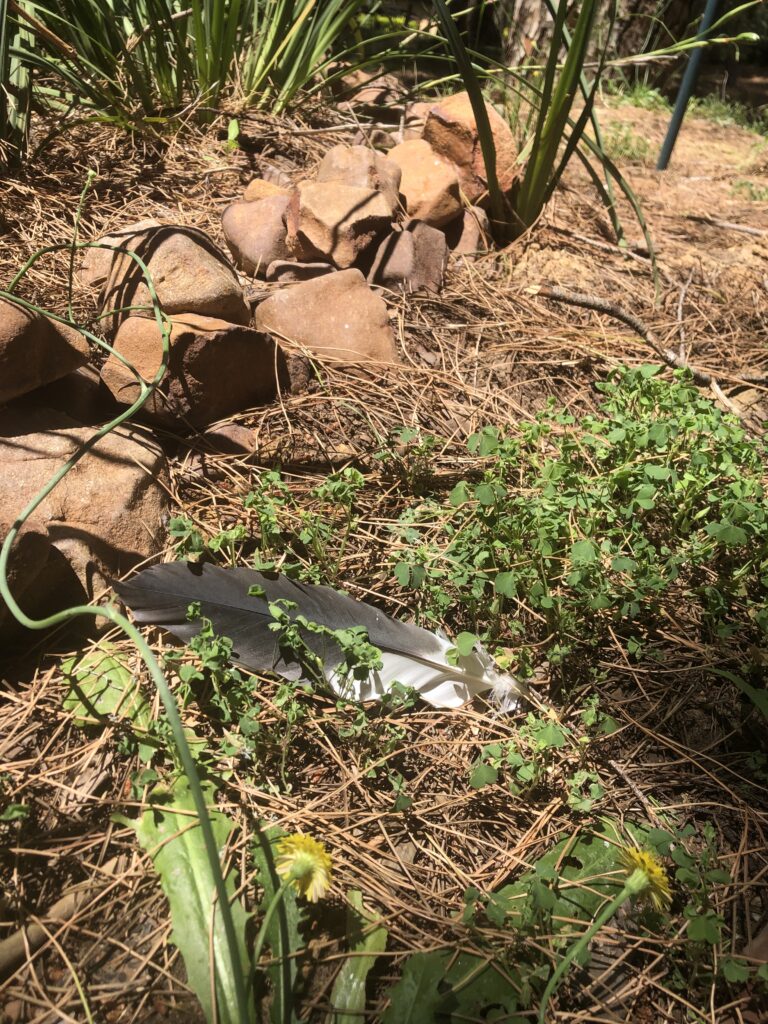
Tools I collected on the forest floor – some with adjustments like weights to hold them in position on the drawing surface
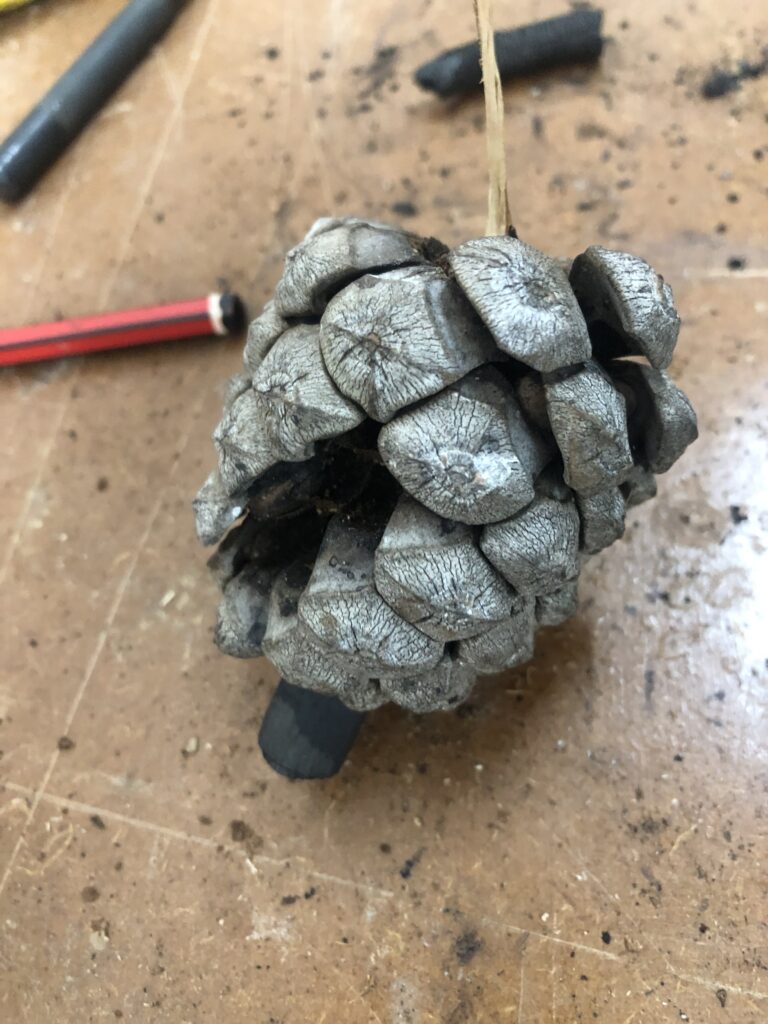
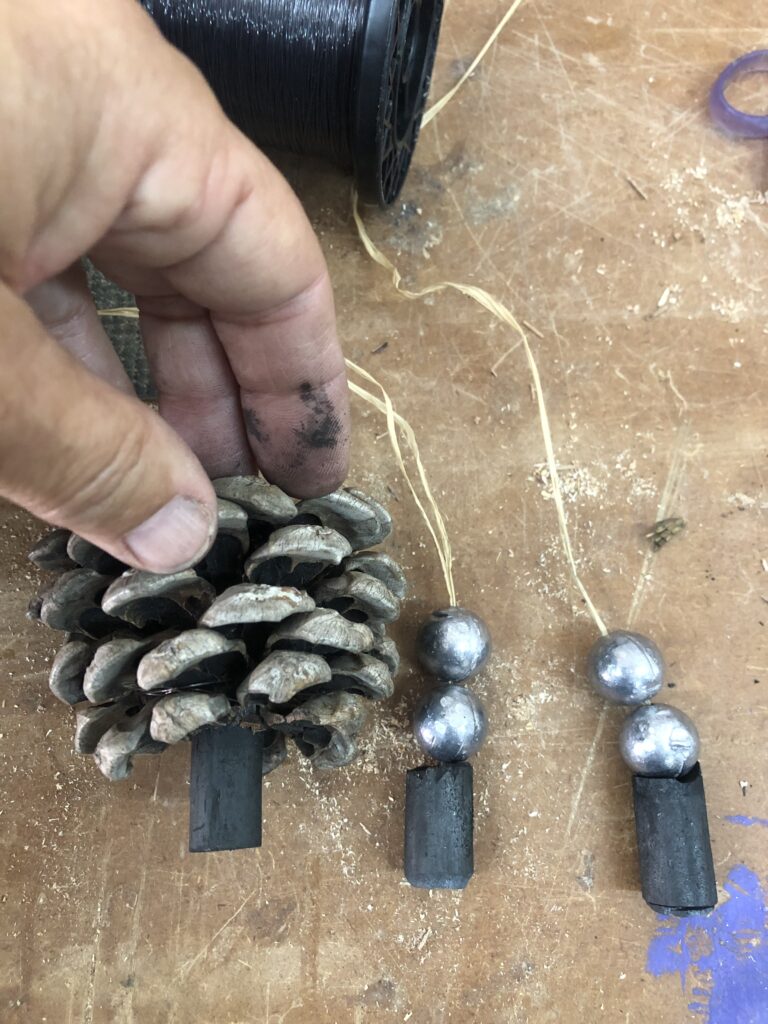
Other observations:
I found several rope-like scat deposits among fallen pine needles and cone litter, clustered within a 1.5 m radius. Material composition appears highly fibrous — mainly hair, plant fibres, and possibly pine needles. No visible bone fragments. Texture suggests a carnivore/omnivore with a largely rodent/insect diet, likely Cape Grey Mongoose or Large-Spotted Genet, both known to inhabit this ecological band of pine/renosterveld edge. These droppings are dry, intact, not scattered — estimated 12–24 hours old. One specimen was partially unravelled, showing a densely felted inner core. Another compressed into a compact “pellet,” likely from repeated gastric compression.
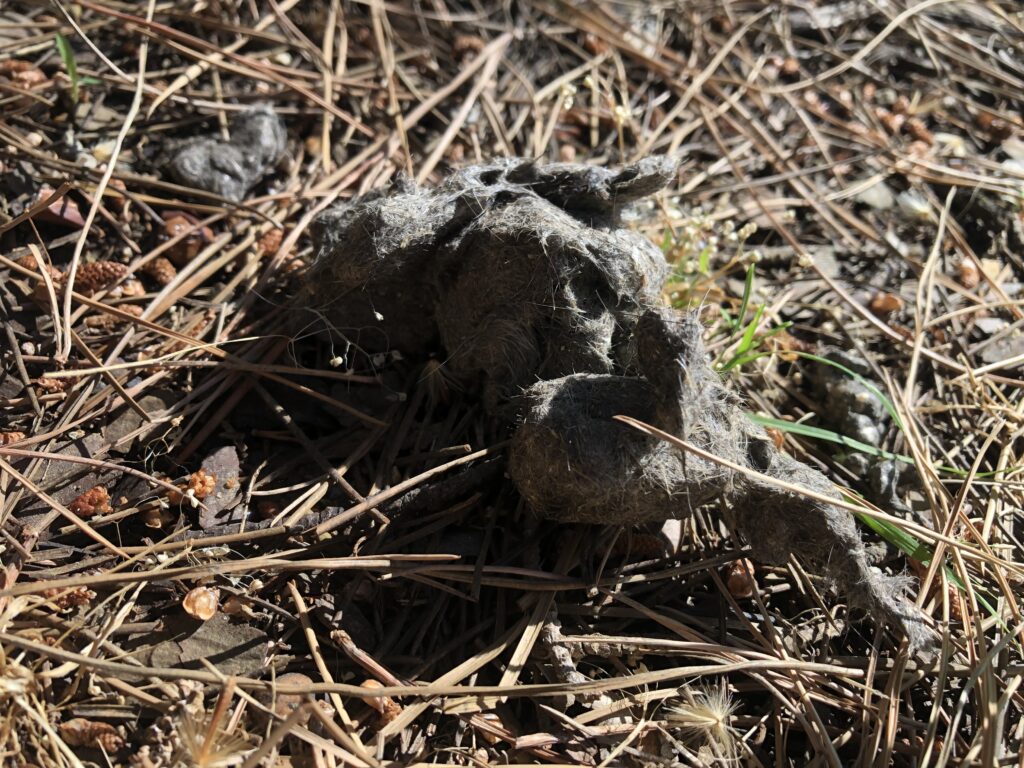
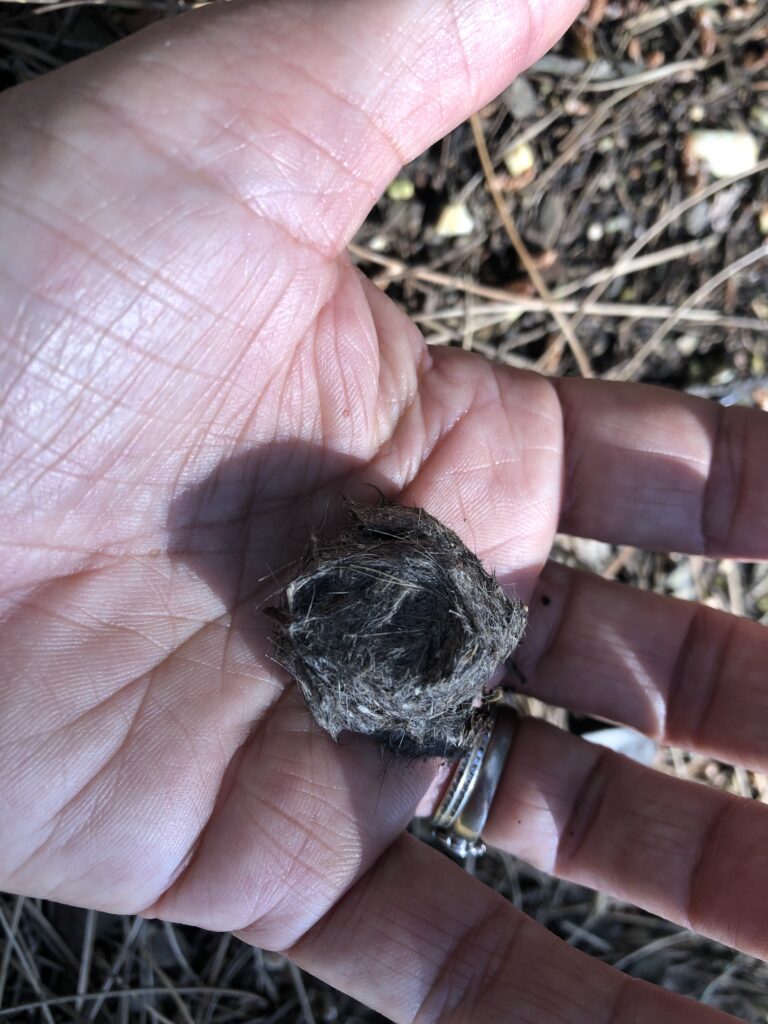
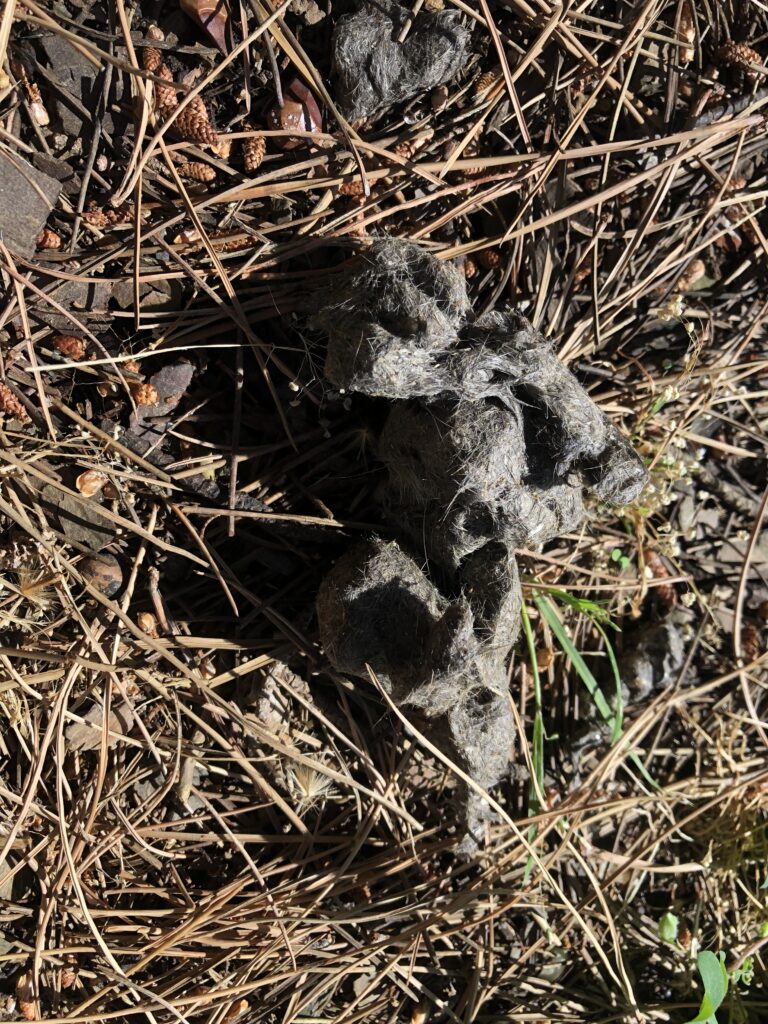
I set up a camera that can detect movement and will record the site during the evening for the next 24 hours.
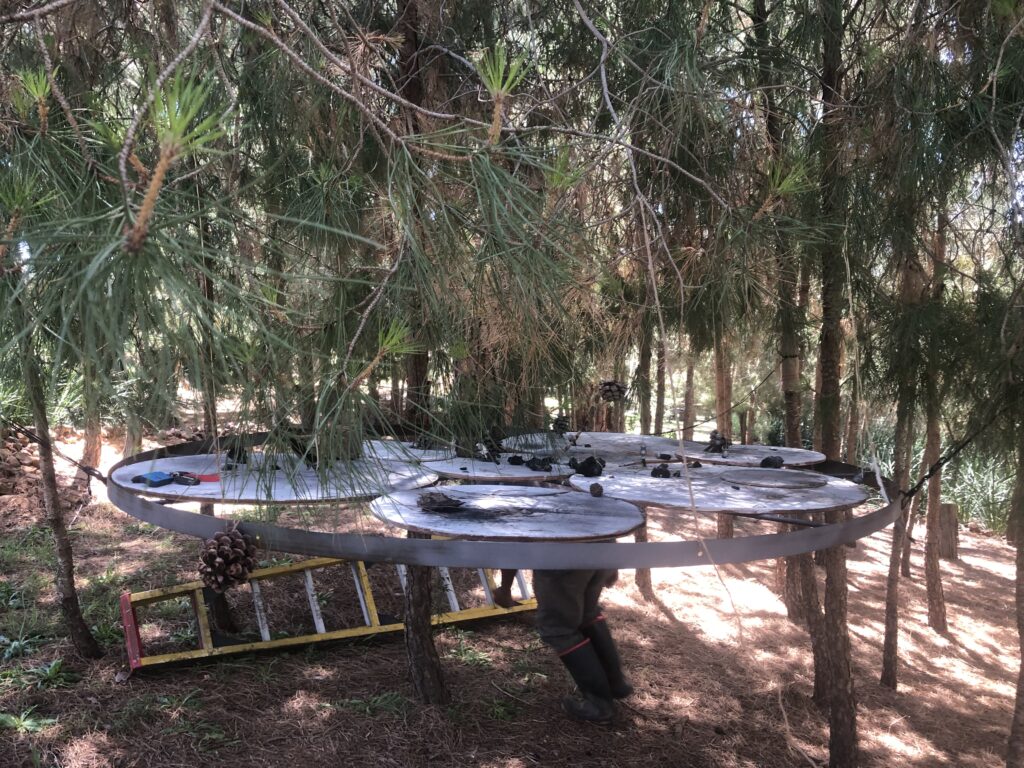
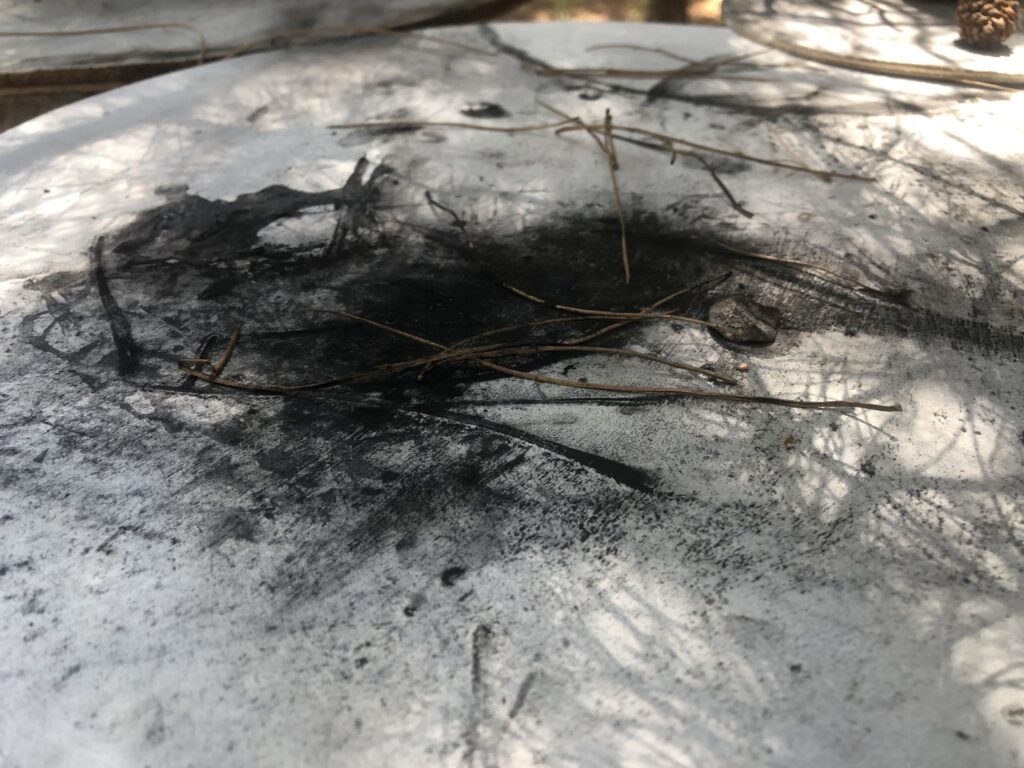
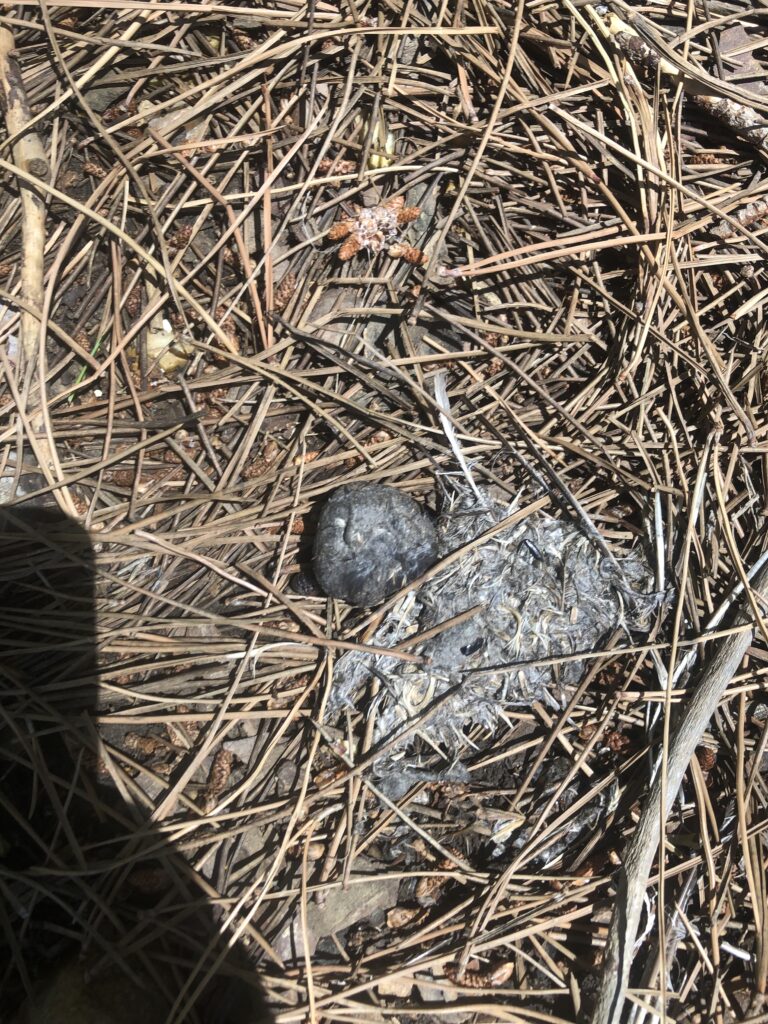
I ask myself if wind drawings are reactive drawings. I did look at the charcoal, the feathers and later the pine needles, and the wind as collaborators that mediate between subjects and objects, defining the practitioner’s position even as the practitioner attempts to define the work
Bora Ngara speaks of the quiet before the song — the moment when the body opens to the land, and the ear attunes to its hidden vibrations. Before the voice can carry a melody, the landscape must be listened to, its frequencies sensed and understood.
This work captures a ritual of silence — a quiet ceremony in which each line on the canvas becomes a moment of pause, a clearing of everything unnecessary to record the act of tuning. The work unfolds as a series of gestures, each one deliberate, each one present, building a rhythm that echoes the attentive, measured pace of connecting with the landscape.
Every mark is an impression of a single instant, yet repeated, they create a frequency — a living trace of presence — where the viewer can sense the passage of time and the attentive engagement required to listen to the land. The painting becomes a ceremonial space, where stillness and repetition open a path to attune oneself, and where the act of connection itself is the song.
Bora Ngara | Ceremony of Tuning
ocean-carried non-native pumice stones, driftwood charcoal and ocean water on raw cotton canvas
105 cm x 170 cm
2024