In early January 2026, I began a drawing about a river and life, at a moment when life was deeply hurting. My 95-year-old father had just passed away, a loss that sat heavily alongside the anniversary of the death of my youngest son three years prior. In the landscape of severe grief, I found myself returning to the words of Elif Shafak and Osho—contemplating how life and death are not opposing forces, but the two parallel banks of the same river.
Grief does not move in a straight line; it circles, returning to the same coordinates with a slightly altered weight. Modernity is poorly equipped for this; it demands closure, resolution, and immediate productivity. But grief demands duration, repetition, and a willingness to stay with the flow. To process this weight, my artistic practice became an act of pedestrian transit—a slow, literal walking of the line.
Working on a 2.7-meter roll of white paper and later a 2.8-meter expanse of fragile voile fabric, the act of drawing transformed into an embodied, ambulatory experience. I did not map this landscape from an aerial perspective; I walked the length of the material, over and over, moving my body across its surface. Using charcoal—the literal residue of burnt wood, a deposit of aftermath—I allowed my hands to smudge, erase, and re-touch the surface. Much like a river meanders, disappears underground, and re-emerges, my charcoal marks became a physical index of thoughts circulating, collapsing, and returning.
Fragments of my personal geography emerged through this kinetic meditation: the Sugarbush proteas from the fynbos veld where I walked with my grandfather as a child, and dried flowers gathered from the site where my son died—memory held as raw matter.
By transitioning my drawing process to a slippery, translucent fabric, I surrendered absolute control. I placed wild plant material beneath the voile, rubbing charcoal over it to let the land write its own contours into the piece. In doing so, I stopped asking, “How do I fix this?” and began to move with the place rather than merely through it. The drawing ceased to be an illustration of a river; it became the river itself.
As a piece of walking art, the journey is embedded both in the making and the viewing. The lower third of the work is densely detailed, anchoring the eye, inviting the viewer to slow their pace and mentally walk alongside the riverbank. I am less interested in grief as an object, and more interested in how it is felt through duration—in how long a body stays with a surface, returns to it, or wanders along its edge.
Ultimately, this work stands as a path walked in collaboration with land, loss, and memory. It is an exploration of what it means to let grief and beauty coexist without resolving one into the other, marking a persistent pulse of life that continues to flow quietly between the two banks.
Below are some notes and images of how this process developed
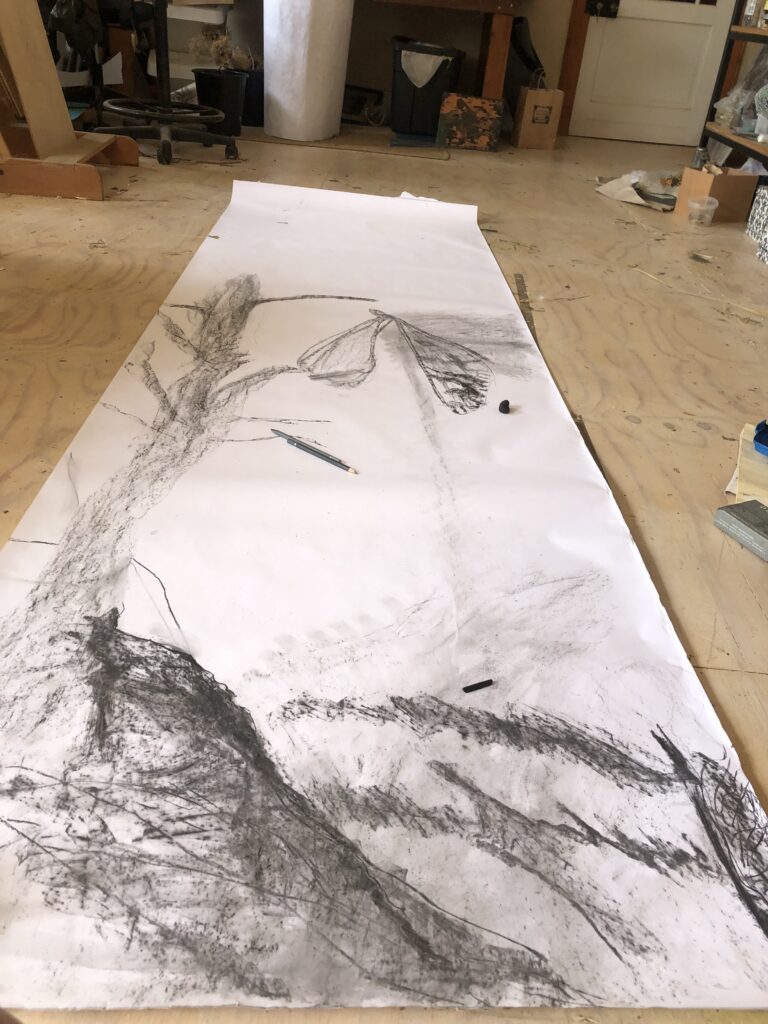
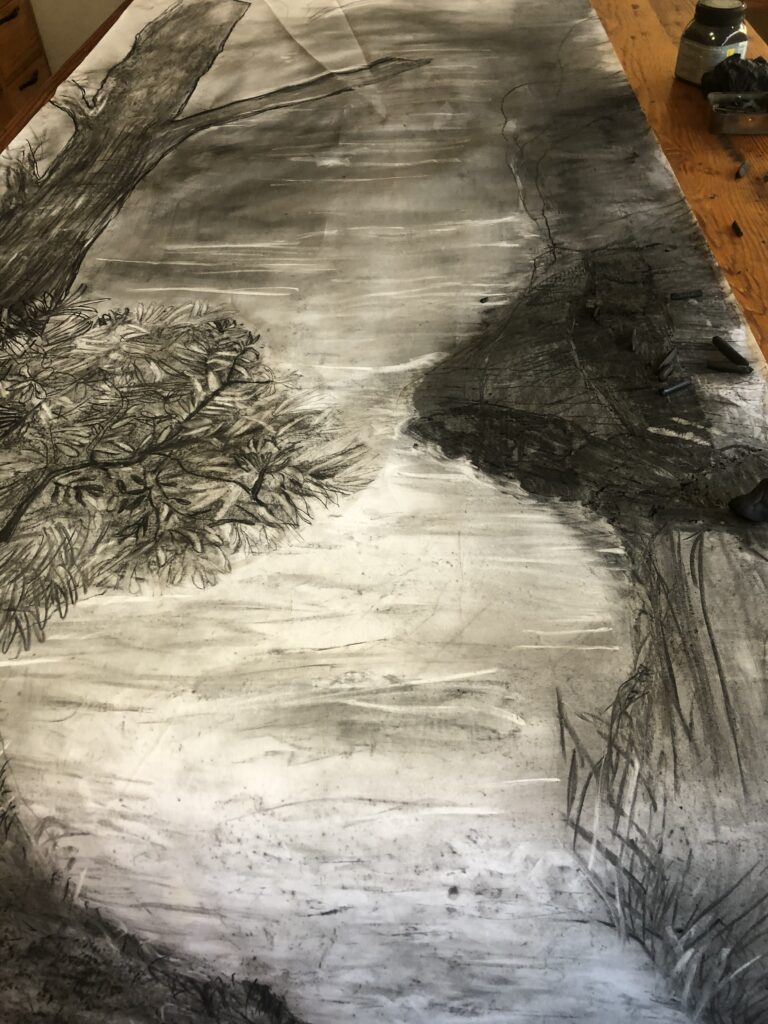
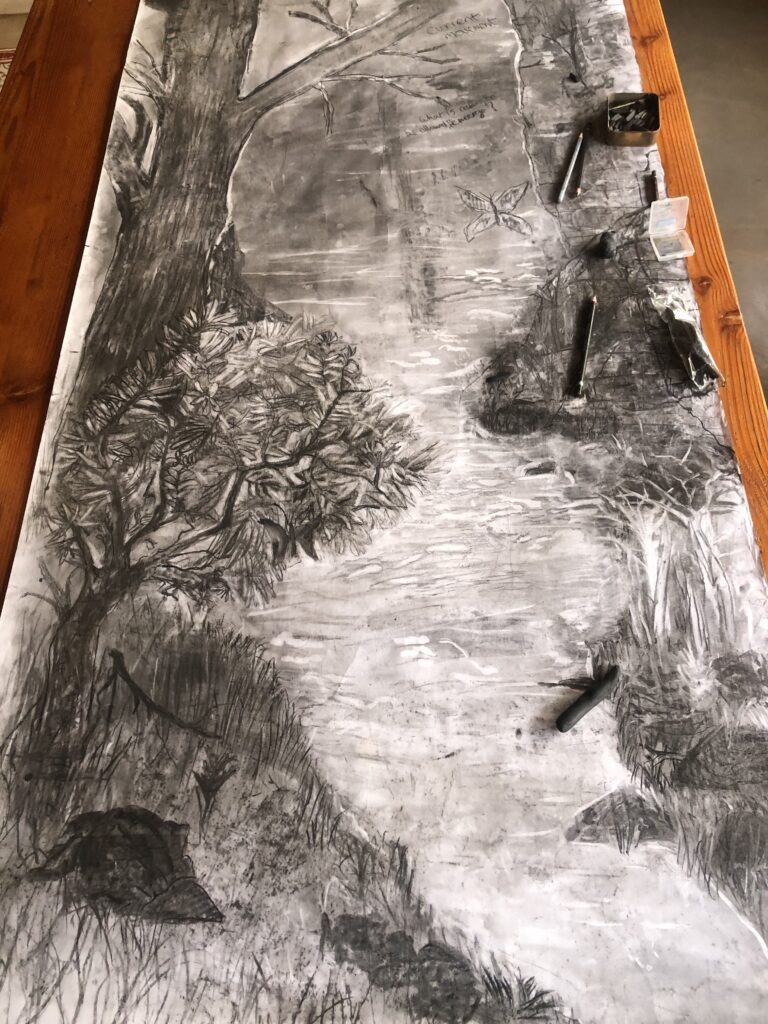
I have seen this work develop as an ongoing discussion about how I think about life and death. My making transformed as a condition of returning, repetition, and re-visiting. It is something grief has already placed inside of me. I learned that grief circles and returns to the same places with slightly altered weight. This took me to walking and that I love to take walks on my own.
What emerged in the drawing?
Place – a memory and safe space to go to
The river — not a border, but a carrier
Sugarbush protea — place of loss. I gathered and kept dried flowers from the site where my son died: memory held as matter
The cut tree — a life fully grown, then ended; not fallen, but chopped (human time, human decision)
The cliffs — time before and after us
The butterfly — transformation, lightness, return without weight
Below are views of the work as of 27 January 2026
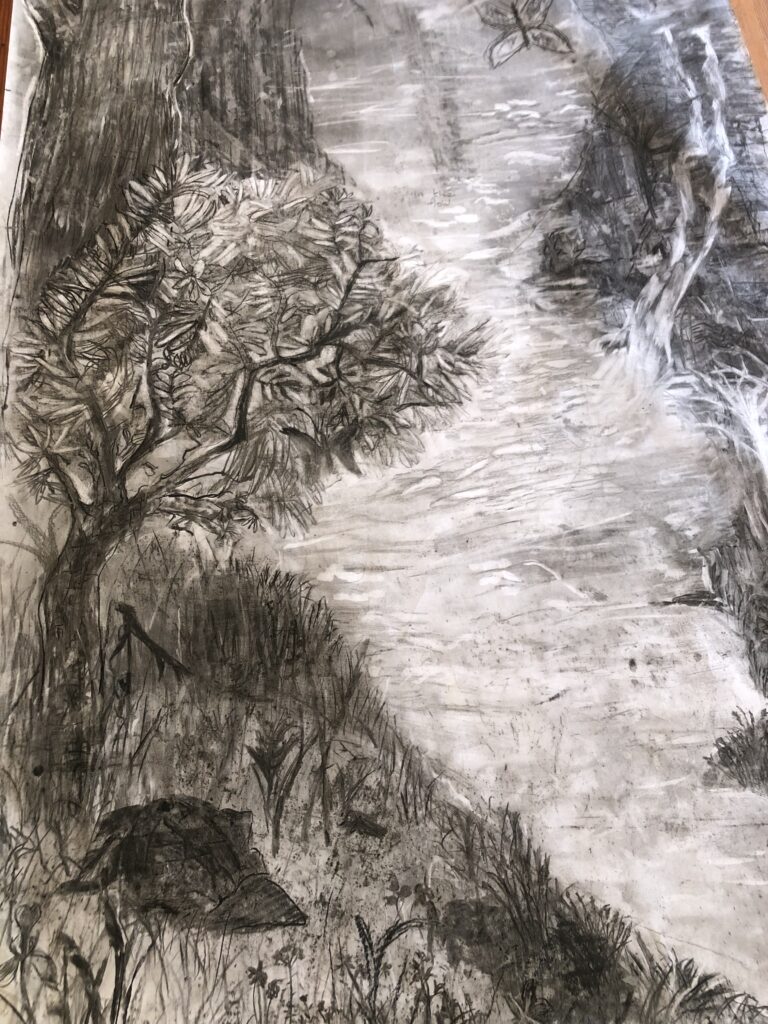
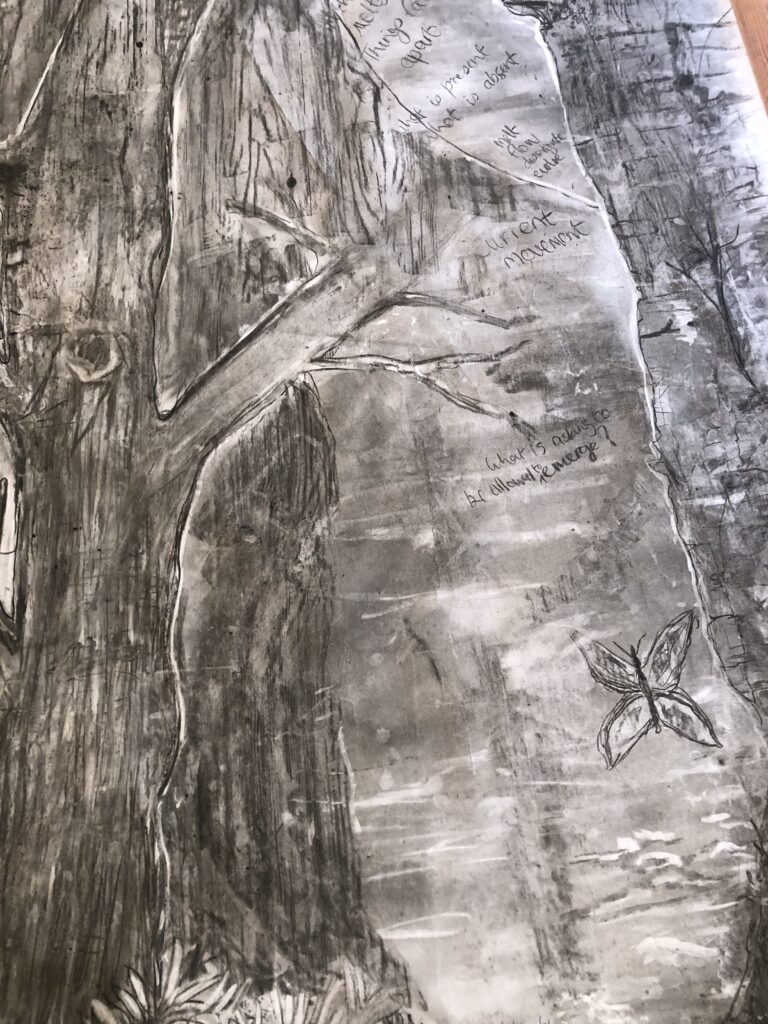
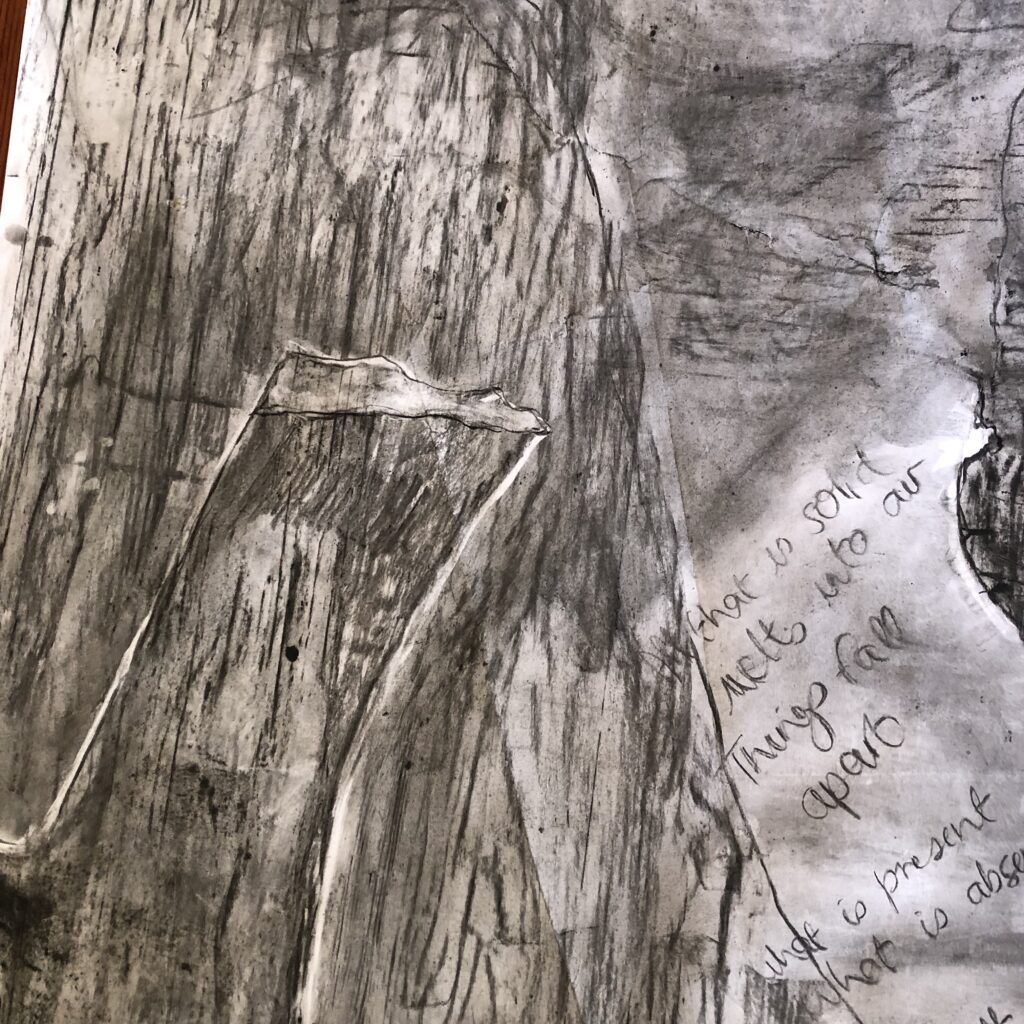
I started feeling that I became the river’s witness, next moment I am the river, or the river’s bank – this drawing is the place where this becomes visible. I learnt about grace and compassion – when I stopped asking, “How do I fix this?” and worked with care, awareness and tenderness. It asked to work slowly, to remember, to listen, and to hold. The lower third of the drawing is more detailed – so that this remains the most grounded, the most inhabited — almost like a place one returns to. Not because it explains anything, but because it remembers how to hold. My childhood memories are very much around walking with my grandfather in a fynbos veld amongst the proteas and rocks. My safe place is the thought of lying on my back on a rock in such an environment.
I became more aware of where my practice is moving to
I am interested in how memory lives in matter: in what is held, what is carried forward, and what is allowed to return to the earth. Themes of grief, care, and ecological interconnectedness guide my process. I can work and walk slowly and intuitively, treating making as a form of listening.
My practice seeks to honour the land where I walk, and those who came before me, while exploring how healing might emerge through quiet acts of walking, noticing, making and being with the world around me.
How my reading influenced the work
Looking back, I have more reading that influenced my more recent making – the rubbings, tree drawings and this work. A comment, taken from The Communist Manifesto (1848), where Marx writes “all that is solid melts into air” touches me – seeing how modernity has influenced the world comes to play in my mind. I am so aware of how ‘political’ everything has become. The Seed Keeper, a generational novel, tells how wounds are carried but also healed through reconnection with land and community, and I return to Ingold and the Correspondence of Lines.
Making becomes a way to ground, honour, and process. I think that Modernity is very bad at grief, as it wants:
- closure
- resolution
- productivity
But grief belongs to returning, duration and repetition. It takes more than time…
Ultimately, my work of the last few months has become propositions rather than statements. They ask:
What does it mean to move with a place rather than through it?
What does it mean to listen to materials?
What does it mean to let grief and beauty coexist without resolving one into the other?
What does it mean to make work that lives, changes, and even falls, as part of its natural cycle?
Things fall apart – they are made to fall apart.
In this sense, the works I have made are not endpoints. They are beginnings, invitations, and markers of a path walked in collaboration with land, memory, and the fragile but persistent pulse of life that continues between the two banks.
Some river thoughts I want to contemplate
Is there a river logic?
In the books I read recently, I was deeply under the impression of what happens when a river is forced to follow its old course after the landscape has changed and it:
- floods destructively
- erodes its banks
- loses oxygen
Then I consider a living river, it:
- meanders
- disappears underground
- re-emerges elsewhere
- creates oxbow lakes (old paths cut off, and like grief – it stays present)
The river, as in There are Rivers in the Sky tells us that history is a cycle, not a line – it is not repetition as sameness, but recurrence with transformation. A droplet of water is never the same water, yet the cycle persists.
This is a very different model of history from progress or decline.
In my drawing, this suggests:
- history as return
- memory as circulation
- trauma, care, love, and collapse as things that pass through bodies and places
This aligns quietly with the River of Life/Love — not metaphorically, but structurally.
In the lower part of the drawing, there are more details about the riverbank that anchor the drawing and invite the viewer to slow their gaze and walk alongside. (Here I am thinking in terms of viewer experience and how I would like the work to be shown) I need to consider my own emotions, and I do not want to move into a space of sentimentality – I feel it is not about the objects as much as how to stay with the flow in the surface – water, trees, rocks.
I remember reading Derrida on mourning – to him it is almost like conversations with the dead – to be repeated in memory. The river does not choose what it carries.
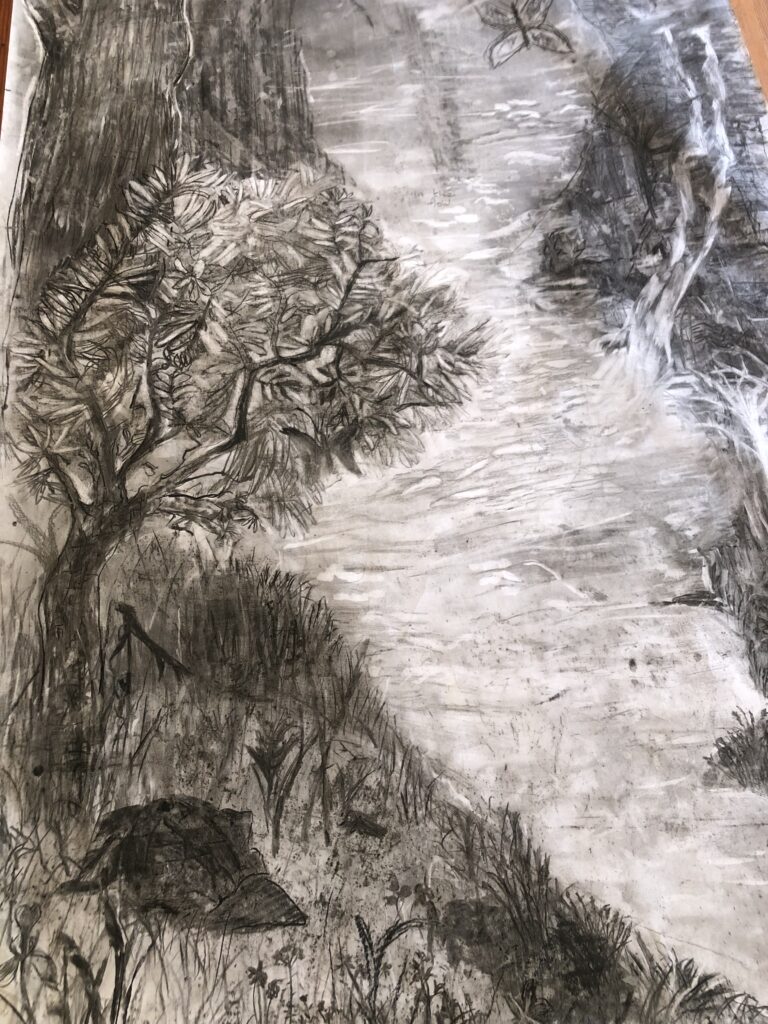
The river here is calm, almost resting, but not empty. The surface is worked, rubbed, re-touched — it carries time rather than motion. Grief does not reside in an object, though objects remain as traces.
I am interested in whether grief might instead be felt in duration—in how long a viewer stays with a surface, returns to it, or moves alongside it.
The banks on both sides are not symmetrical, yet they are in quiet conversation. The tree on the left represents loss, yet it is still alive. It has agency, weight, and presence. Below is an image of the tree – friends of my son visited the site recently and added a name plaque.
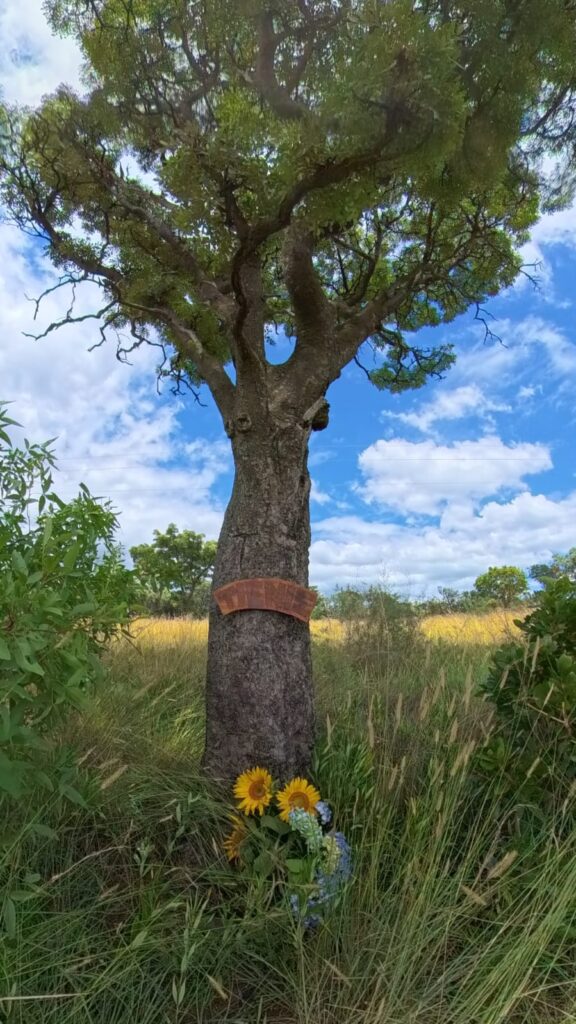
Grief is not placed in an object, although they excist as my ‘images of’, I hope to have it placed in how long a viewer stays with a surface. I have learned that history does not repeat itself as an event, but as movement — like water, touching bodies and ground before rising again.
The drawing is a journey of my body – how I dance with life and death.
I enjoy the work focusing on shadows and light. Charcoal is literally the residue of life — burnt wood, transformed matter. When I draw with it, I am not applying colour; I am trying to deposit aftermath. That links charcoal to time, to death, to persistence. The charcoal became how things/ideas settle, smudge, helped me to resist control and remember the pressure of my body. Much of the work is about the same thoughts returning and some that cannot be concluded, only revisited. In my making, the process was much about rubbing back, erasing and redrawing. I love how charcoal supports this. I wonder if I had worked on a sheer type of material, how that would influence the work? I consider ideas of layering the work with scrim or transparent paper/materials.
I also enjoyed the process of slowing down and staying with the mark – that feels true for what one’s body is doing when you draw. It asked no explanation, but to stay with darkness, incompleteness as well as to resist articulation.
This is almost a kind of obstinacy, or the refusal to replace lived presence with interpretation too quickly.
My making took me to a place where I am not expressing thoughts, but where thought becomes possible.
There are many written thoughts in the drawing, which I have not intentionally obscured by mark-making. I am considering sitting with one specific recurring word or phrase and tracing how it behaves in charcoal.
Developing the work
I started with a new insight: Not the river as the subject. River as an interior current. It talks to me about my feelings – care, concern, memories, grief, guilt, pain, love, dreams, hope
I then made a drawing on soft fabric, a voile or organza found fabric. I had a few sheets in my studio and could explore the drawing further, wanting to be looser and less figurative – work with mark-making and expressive marks. This part of my process is to focus on being present and having a more embodied experience whilst drawing.
The slipperiness of the fabric asks me to stay with the material. I also focused on not having an aerial viewpoint in mind as I worked into the fabric. It was a process of walking the length of the material which is about 2.8m long. I also started working wider – across the surface of the fabric. To see I had some white paper under the work and loved how the charcoal residue stayed behind, offering me another way to work into the material. I used to plant material to create marks – by placing it under the material and rubbing into it. I feel there is less control in my drawing process. I have turned the drawing upside down by the end of image 4 below. I feel breathing is very much part of this process – I will leave areas open, less marks.
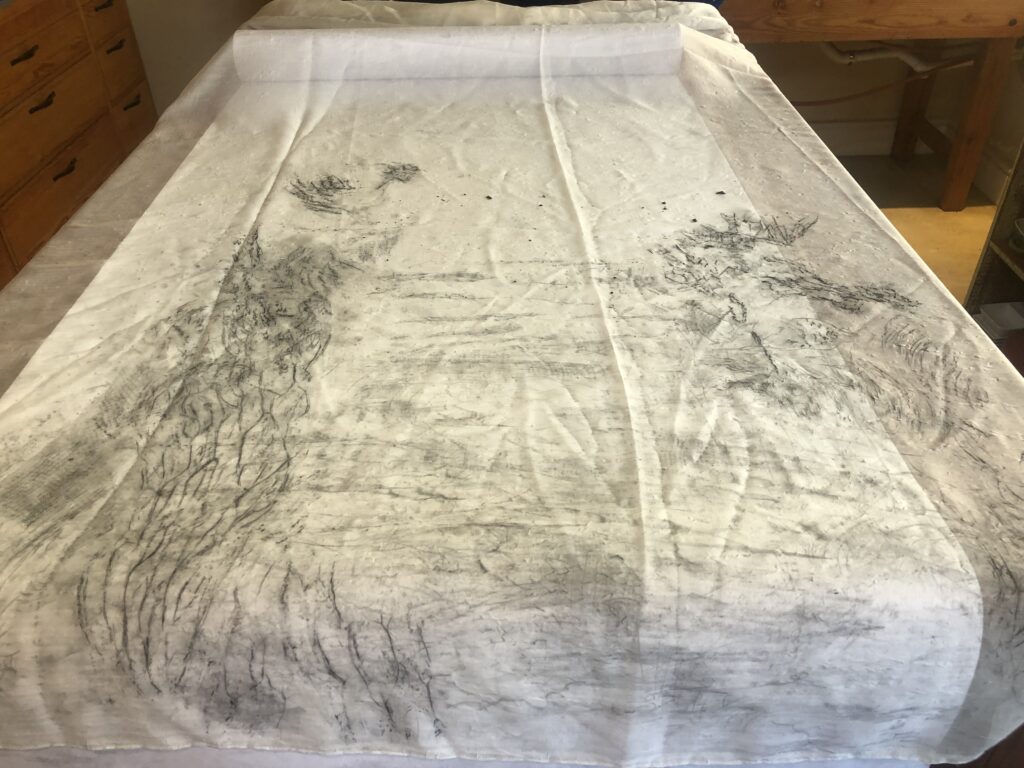
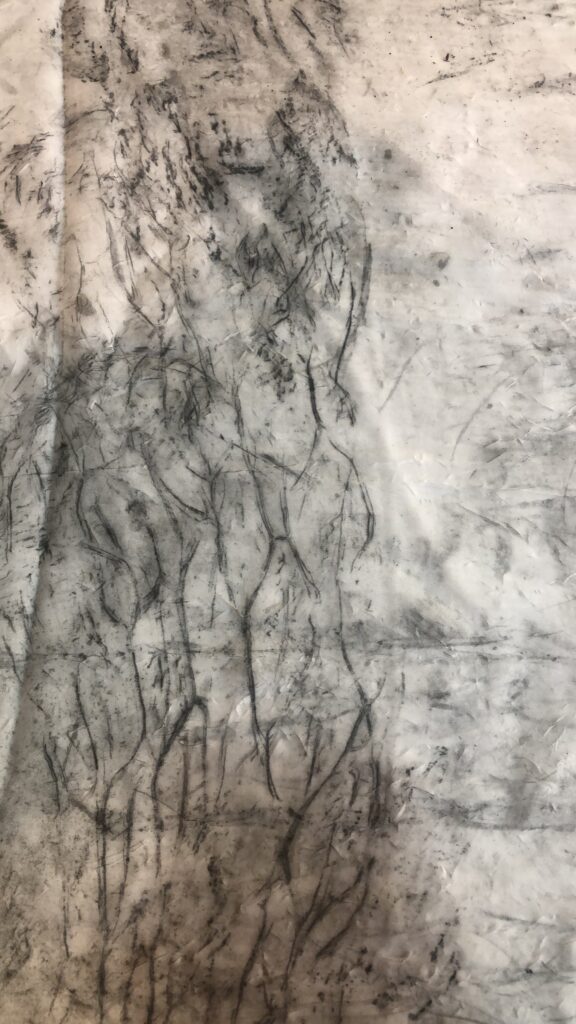
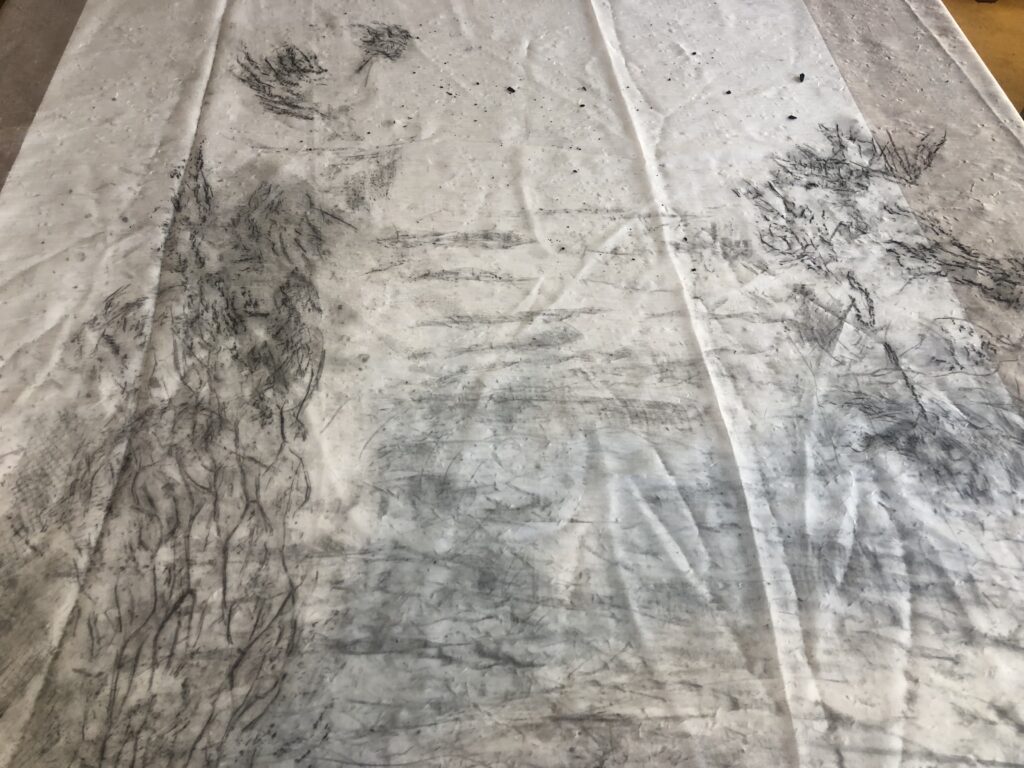
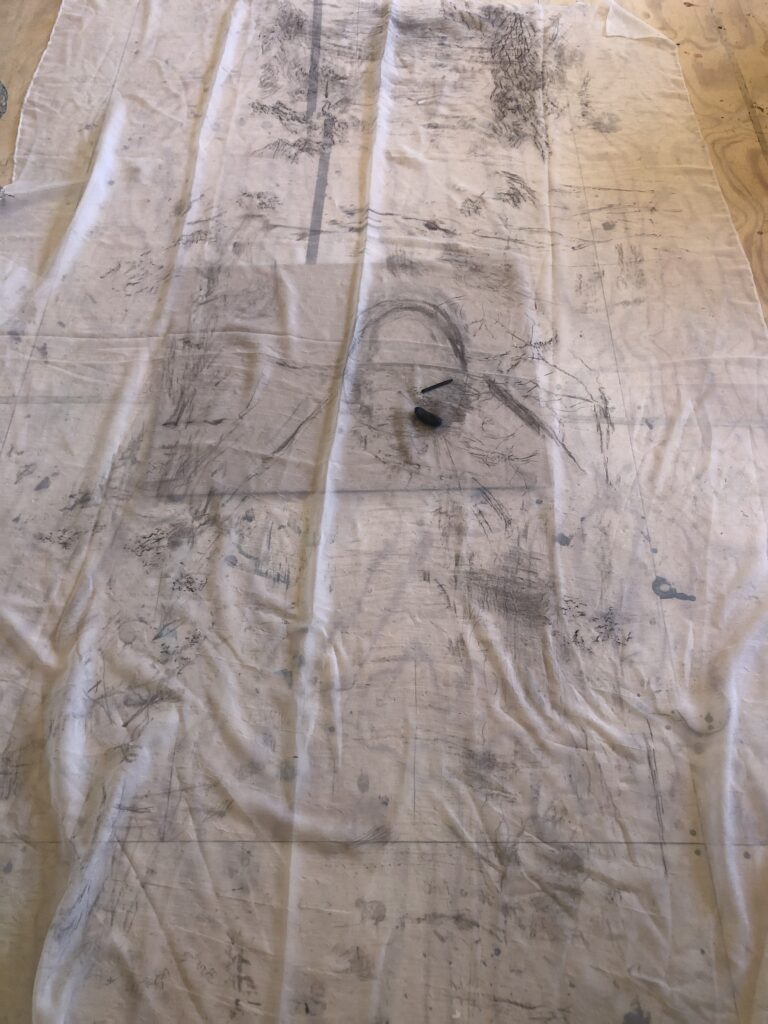
I constantly fight against being illustrative and need to make use of softening lines and marks – I cannot erase. I added white paint marks (permanent on the work, and I cannot erase them, it keeps me in the process) and is repeatingly asking one question: When you stand in front of it, do you feel more inside it, or more outside looking?
I want to draw the flow of the river – an experience. My making needs to be more about listening – otherwise the work will tighten. (In the language of the river, it would say: “the river arrives” – and I am learning now the river is not going somewhere, it is where it is, fully itself.)
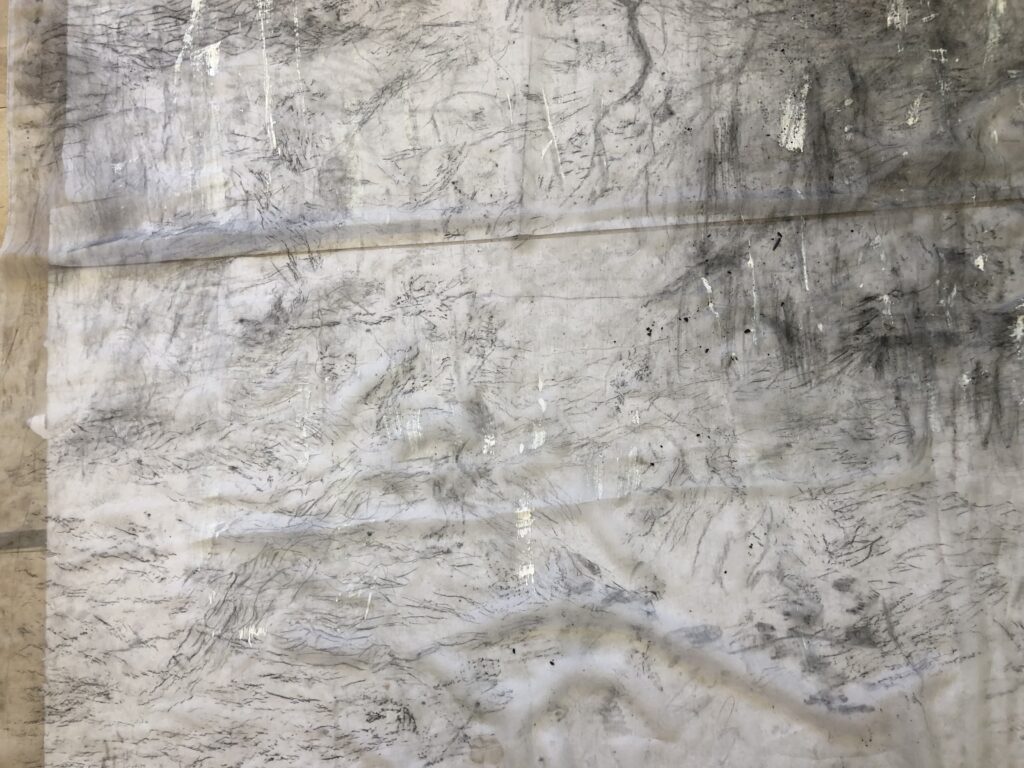
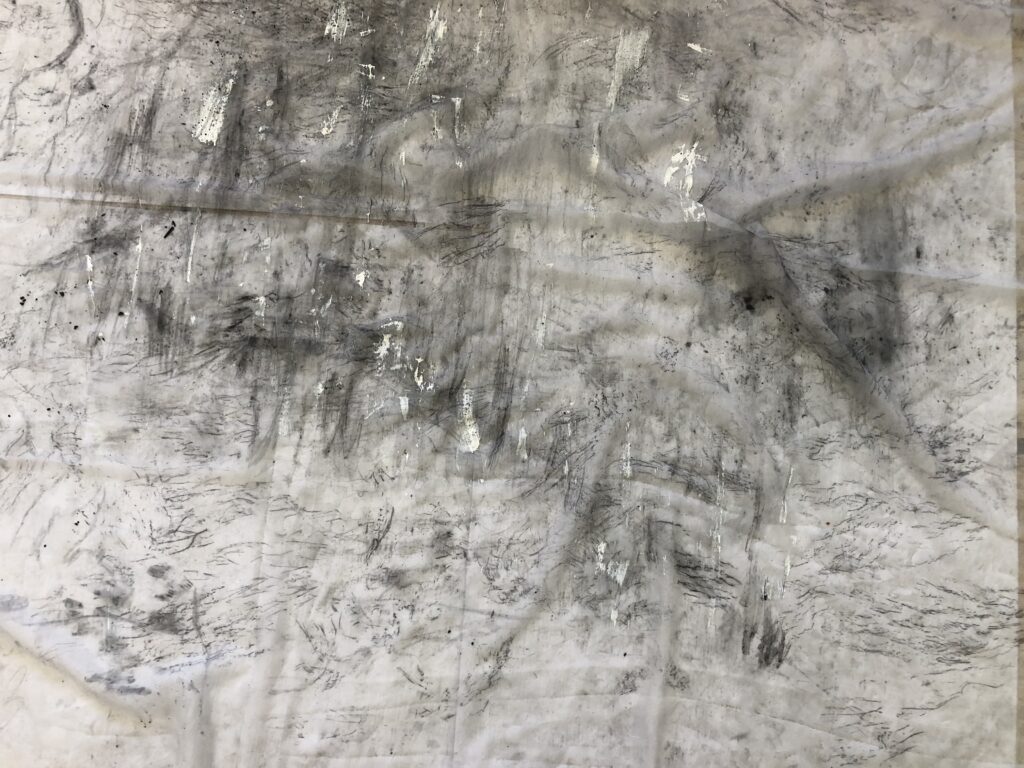
At this stage, I am afraid to lose the openness of the work, and I am struggling to negotiate with form, but I do think:
The scale is working.
The fabric’s fragility is working.
The residue is working.
The body movement is visible.
To remember: While the amount of water on Earth remains broadly constant, here in the Swartland we are seeing changes in our seasons of summer and winters: droughts and floods, heatwaves, windstorms, early rain in winter