My walks have taken me to consider if I can deconstruct how we collect, interpret, and display nature.
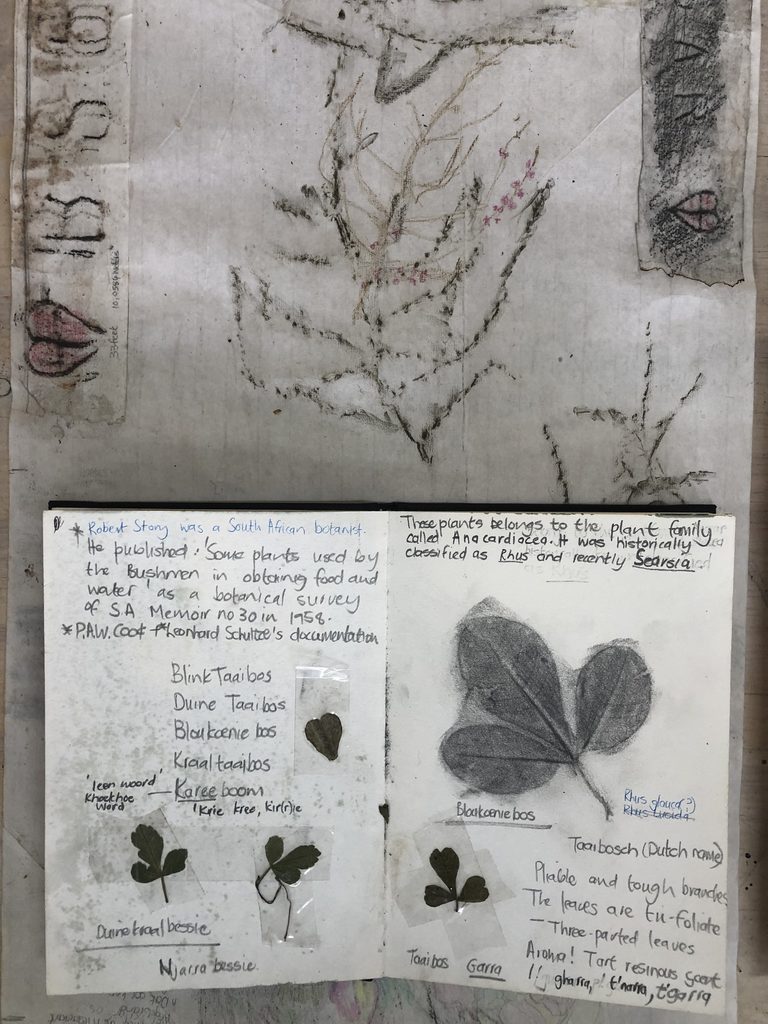
Here, where I live in the Western Cape, area is renowned for its unique plant life, specifically Swartland Shale Renosterveld. Renosterveld occurs naturally on fertile, clay-rich soils derived from shale and granite. Historically, this vegetation supported large herds of grazing mammals—such as quagga, bontebok, and black rhinoceros—alongside their predators. Now comes the human effect: Because its shale soil is fertile and flat, over 95% of the renosterveld has been converted into agricultural land. The Swartland became established as a wheat-growing area around the mid-1700s. So the renosterveld has become one of the most critically endangered vegetation types in South Africa. It is also important to note that Renosterveld is known for its extraordinary diversity of geophytes, and many of these bulbs are local endemics. Consider the Bobbejaantjie, the common name for plants in the genus Babiana (family Iridaceae). Both names refer to baboons, which dig up the underground corms to eat. The botanical name is itself drawn from local knowledge of the plant. The corms were also eaten by indigenous peoples prior to colonial ‘discovery’ of these plants. (I really enjoy the wonder of my wander – to marvel and Sankbe still with the non-human, the other)
(On the SANBI website, I found the following: Derivation of name and historical aspects: The genus name Babiana is derived from the Dutch baviaantje, meaning little baboon, and alludes to observations made by early colonists at the Cape of Good Hope, who noticed that baboons were very partial to the corms of this genus. Not surprisingly, the corms of most Babiana species are generally deep-seated and often occur in hard, stony ground, or deeply wedged between boulders of rocky outcrops in order to minimise the depredations of wild animals like baboons and mole rats.)
Did these plants have to become famous in the West before people could understand and care for them? One answer says yes: naming, listing and mapping are what allow a biome like renosterveld to be defended in law and in funding, and a plant nobody has written down is easy to plough under. The other answer says that fame arrived through extraction, and that people in this landscape were already tending and naming these plants long before a collector pressed one flat and gave it a Latin name.
So here in the Swartland taaibos, renosterbos, bobbejaantjie, koeniebos, gwarrie, poprosie and melblommetjie are not famous plants, and I am not trying to make them so; I am trying to give them slow attention without turning them into either a specimen or a star. For now, I want to keep both answers in the room and see what the pins, the labels and the walking do with them. I started my walks around April 2026, and as the seasons changed, the trees, shrubs, flowering plants and grasses along the route appeared; since summer started, some of the plants went dormant. The grasses are now much longer and drier.
The Swartland botanical record was built by European collectors while the land itself was being taken, ploughed and, as I know from my research, people were removed from it. My walking along the railway line gave me a counter-method: I collect by walking, not by expedition. I see this as a corridor of nature I can focus on whilst walking.
For my next body of work I would like to present the plants I have met along the disused rail line, and in doing so question the instruments of the colonial naturalist.
I have been experimenting with entomological pins and specimen mounting, but in these experiments the pins hold the plants above the board rather than flattening and fixing them to it. A dried tolbos arches in space; a taaibos leaf hovers on its stem. The specimen is suspended and unfinished, not killed, pressed and classified.
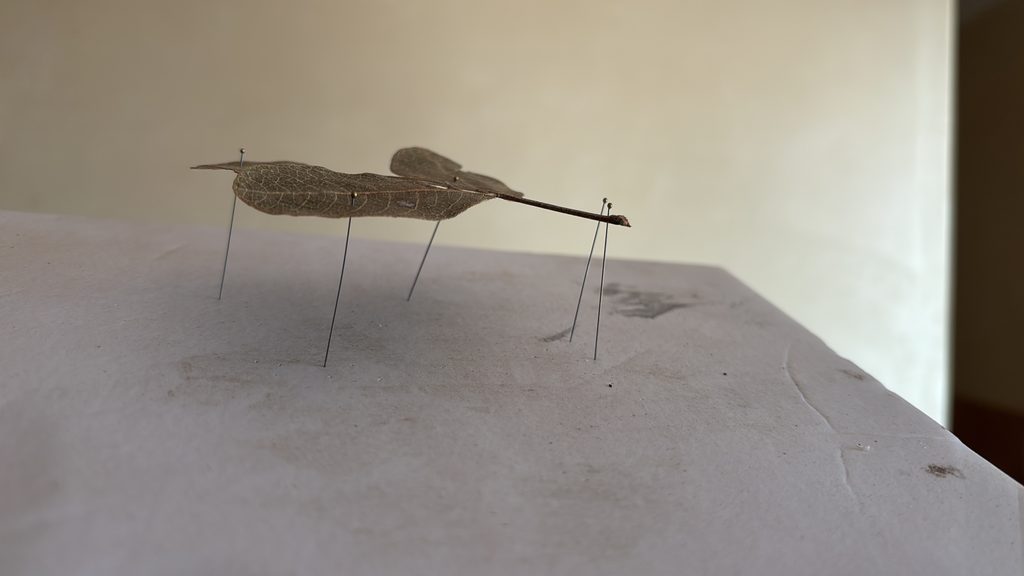
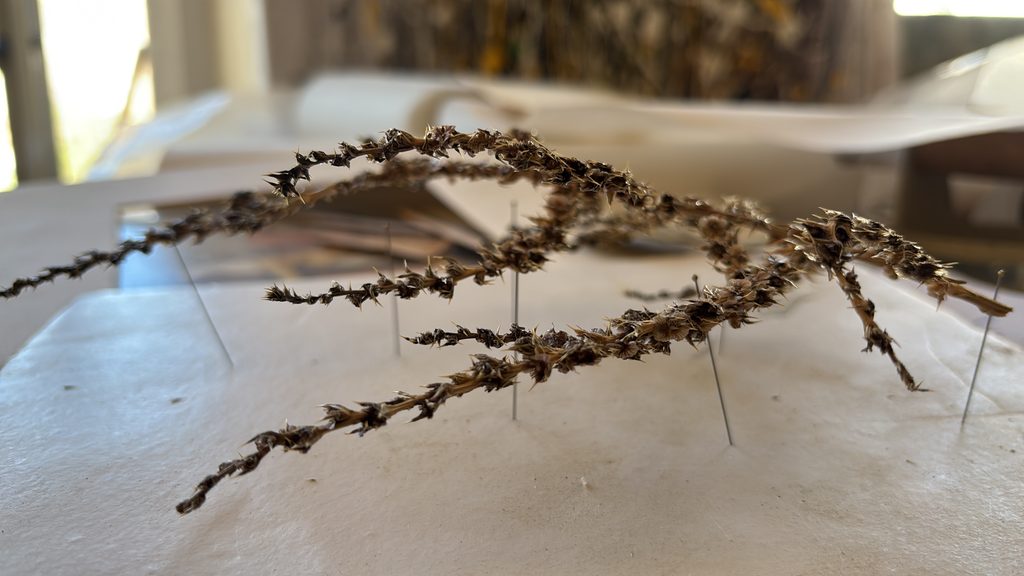
This small shift is the seed of the project. I am also considering heavier nails alongside the fine pins, and clay imprints of plants made in situ, so that I can keep a record of a plant without taking it. The imprints echo those on my Walk the Line scroll. I am developing a label for each work that replaces the herbarium’s data with the walk itself: where I found the plant, what I took and what I left, and who knows it by what name.
To organise my thoughts I used Claude Ai to build a working document, and this is what I will be using.
Plants along the rail: working notes
A working document for exploring the pinned-specimen and clay-imprint project. Edit freely; strike out whatever isn’t decided.
The question
Can I present the plants I meet along the rail line without repeating the naturalist’s habits of killing, flattening, fixing and classifying them? Two linked questions sit underneath: did plants have to become famous in the West before they could be understood and cared for, and whose knowledge counts when a plant is named?
What I’m trying
- Pins: fine entomological pins hold the plant above the board instead of fixing it to it (tolbos arching in space, taaibos leaf hovering on its stem).
- Nails: heavier building nails alongside the fine pins, perhaps forged or recommended by my blacksmith friend. Test rust, weight and the marks left on the board.
- Clay imprints: impressions made in situ, so I can record a plant without taking it. Local clay, possibly with plain paper pulp. Decide fired, unfired, or one of each.
Collecting ethic (draft)
- I collect by walking.
- I take only what has already fallen or died, no more than one stem or leaf from any place.
- I do not take from rare or protected plants.
- I record what I leave behind as carefully as what I take.
- Where a name was given to me, I say by whom. Where I do not know one, I say that too.
Label template
- Known as: [name I know it by] / [Khoekhoe or San name, with who shared it and their permission] / [Latin name, last, or omitted]
- Found: [stretch of the line, in my own words]
- Walked by: [date, time of day, conditions]
- Taken / left: [what I took] / [what remained and where]
- Held by: [pins / nails / clay], made by [maker], from [source]
- What it was doing: [one sentence about the plant]
- Returns to: [where the material goes after the exhibition]
Names to think about
- Bobbejaantjie: the common name for plants in the genus Babiana (Iridaceae). Both names refer to baboons digging up the corms, so the scientific name itself carries local knowledge. Verify the etymology before printing.
- Taaibos and tolbos are Afrikaans names; look for earlier Khoekhoe or San names.
To try
- One nail and one pin on a scrap board with plant material, left for a few weeks.
- A clay imprint of a taaibos leaf (strong veins); a lighter touch for tolbos.
- A fired and an unfired imprint of the same plant, labelled as such.
- Photograph unfired imprints before returning them to the ground.
To ask local potter
- Which local clays hold fine detail, and any lime or salts to watch for if returning clay to the ground.
- How it shrinks and cracks; whether paper pulp helps.
- Firing a few imprints, and at what temperature.
- Where the clay is gathered, and how he would like to be credited.
To check
- Rules on collecting, even fallen material, in Renosterveld, and landowner permission.
- Whether any materials (sealants, glazes, commercial air-dry clay) are unsuitable for returning to the ground.
Reading to follow up (verify details before citing)
- Mark Dion, on critiques of natural history collecting.
- Maria Thereza Alves, Seeds of Change.
- Londa Schiebinger, Plants and Empire.
- The Bleek and Lloyd archive, for Khoekhoe and San sources.
Notes
[Space for what I find as I work.]
Reading notes (from my own document)
What the colonial collecting model does
It flattens the object into two dimensions, extracts the plant from place and relationship, replaces local names and knowledge with a Latin binomial and the collector’s name, and files it in an institution far from where it grew.
Ways I consider the challenge
- Reverse the collector’s data. Keep some herbarium fields but change what they record: the walk, weather, wind, hour, who walked with me, what the plant is doing. Or write the label as a short text of my own, so the writing is the counter-taxonomy.
- Names and voices. Taaibos and tolbos are Afrikaans names; behind them are Khoekhoe and San names and uses. Learn these from Andries, community elders, ethnobotanical sources, and the Oukloof and Riebeek West community. Consider giving the local name first place and the Latin name second, or leaving it out, with permission and credit. My own botanical expertise is part of the system I am questioning, and the work should say so.
- Take less, take differently. Only fallen or already-dead material, one leaf or stem, nothing threatened or protected, and a record of where I left the rest. Tolbos detaches and travels, so collecting it follows the plant’s own logic.
- Resist fixing. Keep the pin-suspension; let the shadow on the board be part of the piece; add a pencil trace of the shadow or a mapped line of where it was found; let material drop seed or crumble. My scroll connects with this.
- Return, don’t archive. Clear some areas where invaders grow; visit the site of Oukloof and walk it; dream of an interpretive panel telling what happened there in 1965.
- Link to place and history. Tie each specimen to a stretch of line, an erf, or a site of removal, so the plant becomes a witness. This connects directly to Walk the Line.
The question I’m sitting with
Am I challenging the herbarium by making a counter-herbarium, or by showing that no collection can hold the plant? The first gives an archive with a different ethic; the second leans toward my suspended, impermanent forms. At the moment I am moving toward the second.
Maria Thereza Alves, Seeds of Change
- Ballast was scooped from the ground at the port of origin, so it carried dormant seeds of plants from there; dumped in a new port, they sprouted at once or lay dormant for centuries.
- Ballast flora are living historical archives, tracing hidden routes of commerce, extraction, colonialism and the slave trade.
- By germinating ballast seeds in floating gardens in port cities (Bristol, Marseille, New York), she challenges assumptions about what is indigenous.
- From her essay on New York (JSTOR): Mastnak asks for place-based relations between plants; Tesdell argues that wildness, native-ness and agro-climatic suitability are scientifically constituted with, not apart from, colonial conquest; Lukatsch says soil has a walking history.
- Together: categories such as native, wild and invasive are not purely objective, and any patch of ground is a living archive of colonial and human history.
The ballast on my own line
The ballast for the Hermon-Porterville line came from a pit at Riebeek West, where gravel and pebbles were exposed in a cutting. According to the journal article I found (journals.co.za, page 13), the South African Railways opened a dedicated ballast pit there, eight labour gangs excavated and loaded it into ballast trucks, and the formation was built largely from locally cut Malmesbury shale topped with Riebeek West gravel. The article gives 172,000 cubic yards excavated along the route.
Points to check
- Ballast flora (a suggestion): since the line sits on Riebeek West gravel and local shale, look at which plants grow in the ballast and cuttings. This could link directly to Alves and to the question of what counts as native.
- Invaders: clearing invasive plants as a way of giving back sits in tension with Tesdell’s point about how native and invasive are defined. Decide whether to name that tension.
- Quotes from the Alves essay: add page numbers and mark them clearly as quotes.
- 172,000 cubic yards: check the page and units against the article before citing.
- Reference list: Himid, Paterson, Muyanga and Muholi were rough pointers from my earlier conversation with Claude and are not strong fits for plants; keep them only if you have your own reason. Nigel Crawhall may not be an ethnobotany source, so check before citing. The Bleek and Lloyd archive and Schiebinger remain good starting points.
- Oukloof panel: raise the idea with the Oukloof committee before developing it.
Mark Dion, Roundup
This work connects with me. On Roundup, Dion writes:
“Nature seems not to be found in the everyday, unless magnified. By shifting our focus, we can be reminded that we are inalienably part of an ecology—we are constructed by and construct the world around us.”
[Add the source and page or URL before using this publicly.]
Why it matters for this project
- The work reveals the minute creatures that live inside the museum. The collecting system tries to keep life out of its cabinets, yet the museum is itself an ecology.
- Entomological pins exist because insects attack specimens. My pins use the collector’s own instrument, but hold the plant open to air, wind and decay instead of sealing it away.
- Dion questions the institution mainly through its own forms (cabinets, displays). I work from the field, on the walk, and try to loosen those forms rather than reproduce them.
Questions to explore
- What lives in or on a herbarium specimen that the collecting system treats as a threat? Could my work let it in?
- Where does my work sit: a critique delivered from inside the cabinet, or an attempt to take the specimen out of it?
- Which of Dion’s pieces on fieldwork and displaying collected finds should I look at next?
Dion: holding a mirror to the present
From my reading: Dion explicitly avoids designing speculative green utopias. He is interested in holding up a mirror to his viewers. He says that he is not really interested in nature, but interested in ideas about nature., about where these ideas comes from, historically He sees his work about that: Projects like the Neukom Vivarium, which houses a large, decaying nurse log inside a custom greenhouse in Seattle, show how difficult and expensive it is to replicate complex living ecosystems artificially once they are destroyed. [https://www.youtube.com/watch?v=bujPPF26ipM&t=257s]. I must agree with Dion, this is a living art work he created here.
What I can take from this
- A nurse log is decay that feeds new life. My plan to let pinned material drop seed or crumble, and to return clay imprints to the ground, belongs to the same cycle: decay is part of the work, not damage to it.
- The Vivarium shows the cost of keeping a living system indoors. A herbarium cabinet makes a similar trade, preserving the specimen by removing the life from it. My imprints and suspended specimens try to avoid that trade by leaving the plant in place.
- Renosterveld is critically endangered. Dion’s point about how hard it is to rebuild a destroyed ecosystem is a reminder that the plants along the line are worth keeping where they grow.
Question
- Do I want my work to hold a mirror to the present, as Dion does, or to propose a different way of relating to plants? Can it do both without becoming a utopia?
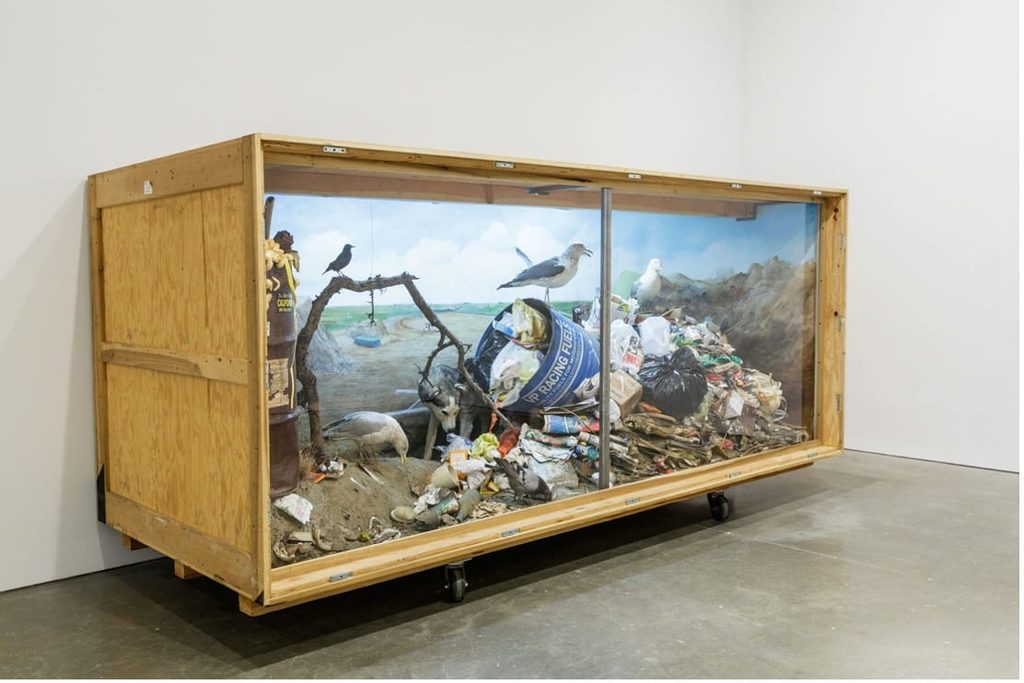
I also looked at how he looked at Renaissance painterby saying they worked inside theology’s frame. I agree, most of them illustrated it, and a few bent it from within. So in effect drawing and painting played the same role for science for centuries. Botanical illustration is the herbarium’s own sister medium, and its goal was usually the typical specimen: the clean, complete, idealised plant that stands for the whole species.
That gives my drawing a clear alternative. I could draw the particular plant in front of me, with its damage, its curl and its decay, and make no attempt at the type. A drawing of a single dying taaibos leaf argues quietly against the ideal specimen.
Dion sussgest the artist being a foil
In theatre, a foil is a character who shows the main one more clearly by contrast. It isn’t an opponent. I do not have to attack science or the museum to be a foil, since slowness, attention to one thing, and a refusal to classify already is what I do. I do not intend to take on institutional power directly.
Ways drawing and painting could enter the project
- Drawing from life along the line. One plant, one drawing, on a walk. It takes without taking, as the clay imprints do, and it can sit beside the pinned plant as another kind of record.
- Tracing the shadows. The pinned specimens cast shadows on the board, and drawing around them in pencil would record the plant at that moment.
- A painted backdrop. Dion’s Landfill has a painted landscape behind the objects. I could paint the horizon of the cabinet with the olive grove at one end and the factory at the other, instead of using photographs. That puts painting in the centre of the installation.
- Paint from the ground. Shale, clay and ash from the line could become pigment, so the paintings are made of the place they show. That ties to my earlier work with shale and incision. I would want to keep any digging small and to disturbed ground, in line with my collecting ethic.
- The container. A cabinet is a container, I have painted containers before. The new work could be a way of returning to that theme with new content.
Moments I treasure
These are the moments from my walks that I still treasure, written as they came to me. I will continue to add to them, and change the words.
The old olive tree grove where I walked, and the lonely tree I call the silent protester.
The bulbs from early winter to spring.
The small animals and birds, the sounds, the traces and spoor, and the sightings that happened when I was alone and could witness this space.
Why the corridor idea sits strongly with me
These moments came to me along the line, as a corridor. I want to keep that sense of a corridor in the work. [Write more here, what I saw, heard or felt, and when.]
Ideas to carry into the work (suggestions, to keep or discard)
Add a line to each label: Seen or heard on this walk: so each plant is tied to a moment of attention, not only to a place.
Sound: birds, wind and footsteps played quietly near the glass.
A cabinet long enough to be walked along, echoing the corridor.
The silent protester near the centre of the piece, as a drawing or imprint, without taking anything from the tree.