In my reading on trains in Africa and artists who have used this narrative, I found Ibrahim Mahama, a Ghanaian-born artist. In the Artpil, 2025 (online publication) I read the following and also used their images:
“Mahama’s exhibition at Kunsthalle Wien develops his research on the history of the Ghanaian railway network.
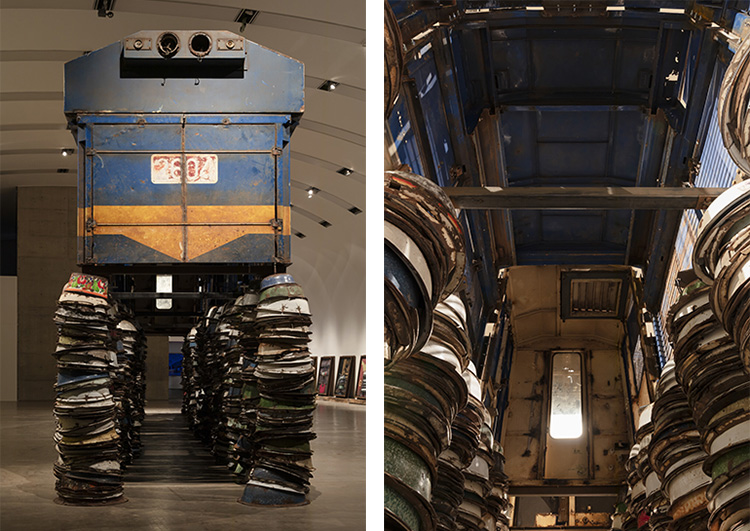
Rails, Weight and Extraction:
The railway as a system, not a backdrop
Ibrahim Mahama’s Zilijifa at Kunsthalle Wien (July to November 2025) builds on his research into Ghana’s railway network. The network was first created under British colonial rule in the 1890s, and the show fulfils his long-held wish to deconstruct, transport and exhibit a full-size diesel locomotive. The locomotive is one of several British- and German-built trains he has acquired since 2022. kunsthallewien
The curatorial framing treats the railway as both a symbol and a mechanism. The institution describes it as a symbol of and a system for colonial and capitalist extraction, built literally on the backs of Ghanaian people. That last phrase is the key to the work, because Mahama makes it physical. myartguides
Bearing weight
The locomotive does not sit on a plinth. It rests on thousands of enamelled iron headpans, the everyday vessels used in Ghana to carry goods, which Mahama gathered by exchanging new pans for used ones. Their dents and rust record years of use. Alongside the sculpture hang more than a hundred spinal X-rays, and together the pans and the images tie the decay of the railway to the strain on the bodies that carried its goods. Berlin Art Link describes the work as a “monument to those who still carry its weight.” The exhibition also includes video of the headpan trade in Ghanaian markets, so the vessels are shown in use as well as in the gallery.
Abandonment matters as much as extraction. The locomotive was bought from scrap metal dealers, and the show presents it as a hollowed-out, rusted relic of the railway’s post-independence decay. The line served extraction while it was profitable, and was then left to rot once it was not. Mahama works with the ruin because the ruin is the evidence. africanscolumn
Mahama is part of a longer conversation, and these are three threads I decided to follow:
- Ousmane Sembène (Senegal). His 1960 novel God’s Bits of Wood is a foundational railway narrative. It recounts the 1947–48 labour struggle on the Dakar–Niger line in French West Africa, and the railway becomes a site of solidarity as well as colonial authority. Where Mahama shows the railway’s weight on bodies, Sembène shows workers stopping it. bonart
- Sammy Baloji (DR Congo). His work is not only about railways, but it covers the same ground of extraction infrastructure. He examines the industrial heritage of Katanga and follows how minerals and political ideologies moved through channels carved out by export and colonisation. In one well-known series he superimposes archival black-and-white images of migrant mine workers over photographs of the now-abandoned industrial landscape. Like Mahama, he lets the colonial archive and the contemporary ruin speak to each other. sharjahartglobalvoices
- Research and curatorial context. The AfricaMuseum in Tervuren has hosted a programme in which researchers and artists offer alternative views of railway transport in Africa, covering lines that are still in service, abandoned or being restored. This is a useful pointer to the scholarship around the topic. africamuseum
I became clear that Sembène, Baloji and Mahama move through time in different ways. Sembène writes from the colonial moment, Baloji overlays archive and ruin, and Mahama brings the physical remains of the system into the gallery. All three read the railway as a record of who carried what, for whom.
Mahama brings the locomotive into the gallery. My own work begins where the locomotive no longer runs.
Near Riebeek West there is a decommissioned rail line, a corridor I have been walking for months. It is quiet now, but it still shapes the land around it. The railway was built to move goods out of the Swartland, and the same line also disturbed the veld around it. Less than 5% of the original renosterveld remains intact, and the line has long worked as both shelter and disturbance for what grows beside it.
My response is a walking practice. The central work is a scroll of Xuan paper, 10.56 metres long, which is the length of a single rail. I carried it along the line on repeated walks and made charcoal and pencil rubbings of grasses, seed, indigenous renosterveld plants, the markings inside the rails and animal spoor. I chose rubbing over drawing so that the material would enter the work without my representing it. Wind, dust and grit cut and tore the paper in places, and the scroll shows that. The marks mostly follow the order of the walk, though sometimes something caught my eye and I lost my place on the long sheet.
Where Mahama’s headpans make the weight of the railway visible, I’m drawn to what it left behind. The tolbos (tumbleweed) is a displaced commodity of that history: uprooted land, disturbed soil, drift. It cannot move on its own. It needs wind or a push, and as it travels it gathers whatever the path offers, which I cannot control. Later this month I will push one along the line in a performance, “Tolbos on a Line,” and make charcoal drawings with it at three stops along the way. In my studio I pin a specimen to archival paper with entomological pins, a nod to how botanists collect and hold plants from far away, and to the extractive habits of the railway itself.
Mahama has spoken about materials keeping their histories active and changing, and that idea sits with me. The scroll tears and the tolbos falls apart, and I’d rather keep them that way than stabilise them. I am not trying to resolve this history. I am a witness to a line that nature is slowly reclaiming, while more voices now speak about it. At the old station, the infrastructure is quickly becoming ruins of the memory of what was. A few families live in the old ‘station houses,’ and others have moved into the buildings next to the line – I presume these were the administrative buildings like a ticket office, waiting rooms, etc. Here is no basic services for these families – no running water, ablutions, electricity and refuse removal. It is extended families and as I learn more by talks with them I gather that they have family who work on farm in the valley and that they work as seasonal workers on the surrounding farms. Some of the older kids (3 girls) do go to school. They travel on a bus, as most of the farm kids around do. They go to Weltevreden School. On the website of schoolsdigest.co.za it states: Weltevreden Ngk Primêre Skool, situated at the Weltevrede Farm, a running milk farm in Riebeeck-Wes, operates as a public primary school. It further states that Weltevreden Ngk Primêre Skool is a public school designated as Quintile 1 as a no-fee institution; there are no tuition fees for students attending this school. This quintile-level school is eligible to receive up to R1,602 per learner from the Department of Education to cover operational expenses and educational resources. I read that Quintile 1 serves the poorest 20% of learners and the most disadvantaged communities (typically rural or deep township areas). The “NGK” in the school’s name stands for the Nederduitse Gereformeerde Kerk (Dutch Reformed Church).
Historically across South Africa, particularly in the Western Cape, the Dutch Reformed Church established hundreds of these “church-farm schools” during the 20th century. They were built on private agricultural land with the permission of farm owners to provide basic literacy, numeracy, and religious education to the children of local farmworkers who otherwise could not access schools in the towns.
Over the decades, these institutions evolved into public schools operating on private property through formal agreements with the state. Today, Weltevreden NGK Primêr functions entirely under the Western Cape Education Department but retains its historical church-linked name and rural farm setting.