13 March 2026
My first visit to the site after our holiday was early January and I found that it fell onto the forest floor. My dad passed on that day, and I have not visited the site since. I did not have the motivation or inspiration, and asked myself if this was about a threshold between one phase of a practice and the next. And, interestingly, the situation resonates strongly with the ideas I have already been exploring: collapse, disappearance, partial visibility, and time.
Returning to the site is no longer about fixing the fallen work. It is about seeing what the work has become and to reopen the conversation I had with the work.
My curiosity asks if it may actually be the work continuing without me that I need to confront. But I feel I need to visit the site before I really make these assumptions. I am learning that the fact that my work is process-based and relational rather than product-driven does not necessarily mean that something is going wrong. In fact, the feeling of avoidance could be part of how a work changes phase. I almost feel as if I have come to stand in front of a choice which I am not ready to make, and that I should remove this need to feel I have to make a choice.
I am learning that when the process comes first, conceptually, it slows me down. I need to touch my materials and move from there. My idea is to visit the site out of curiosity, not out of responsibility. I can return and permit myself to an observation visit. I need to deal with the fact that the work still matters to me – how to continue is the question.
I am going back to see what the work became.
Not to repair it.
Not to justify it.
Not to finish it.
Just to see, without tools or a plan. I will take my notebook and a pen.
Just stand there and observe and document what I see. (Take photos)
Thoughts around the structure
Gravity has returned the structure to the ground, and the work has moved through a full cycle:
forest floor → suspended field → forest floor again
That arc resonates with themes already strong in my practice:
- nests forming and collapsing
- shadows appearing and disappearing
- traces rather than permanent structures
- time acting on material
Site return
My return to the site was met with some shock, as the structure was removed from the forest floor. The gardeners informed me that they had moved it out of concern for the safety of the circles on the steel structure. It seems that children have played in the area and have done some damage. I was so touched by their concern and the way they placed the circle and enclosed it with plant material – almost like a new nest for the work. This concern and care were much appreciated – almost a way to protect the work. One of the circles have been damaged, it is broken, but the idea of repair was immediately in my mind. Some of the works have scribbles of kids interacting with it – that is great!
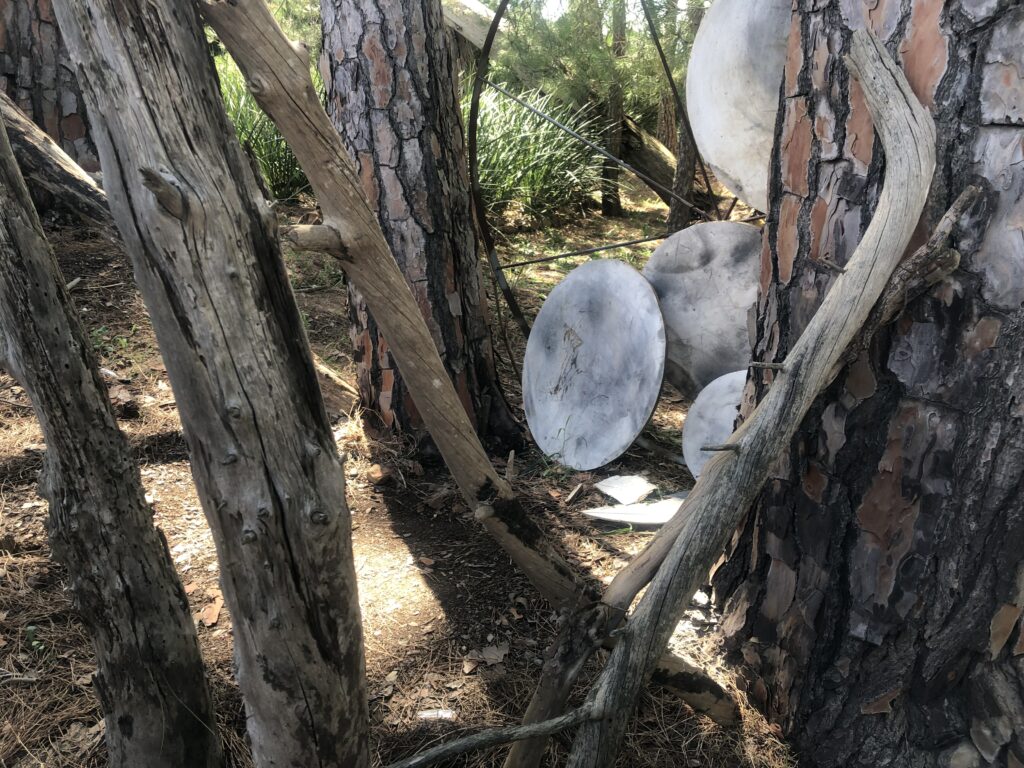
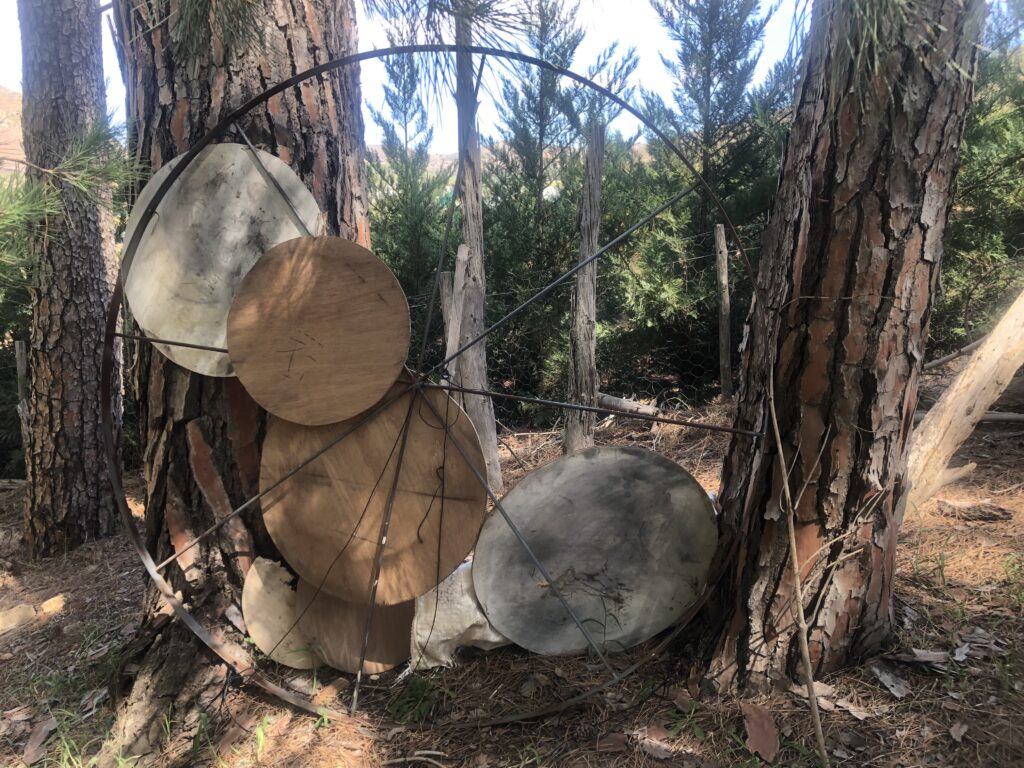
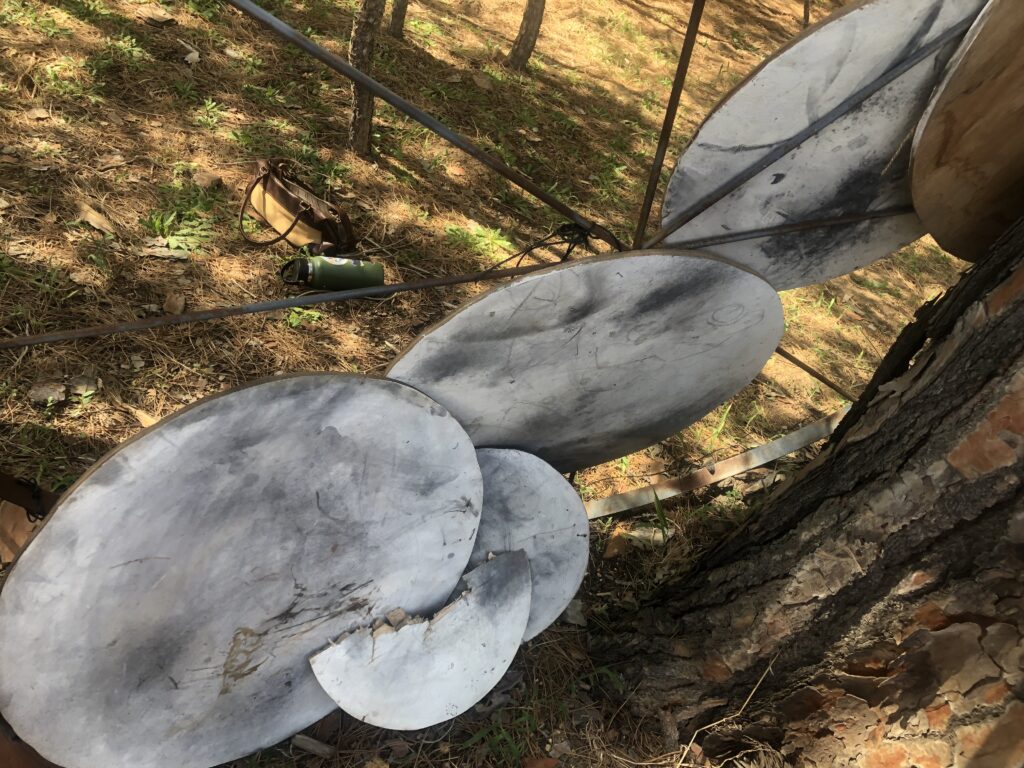
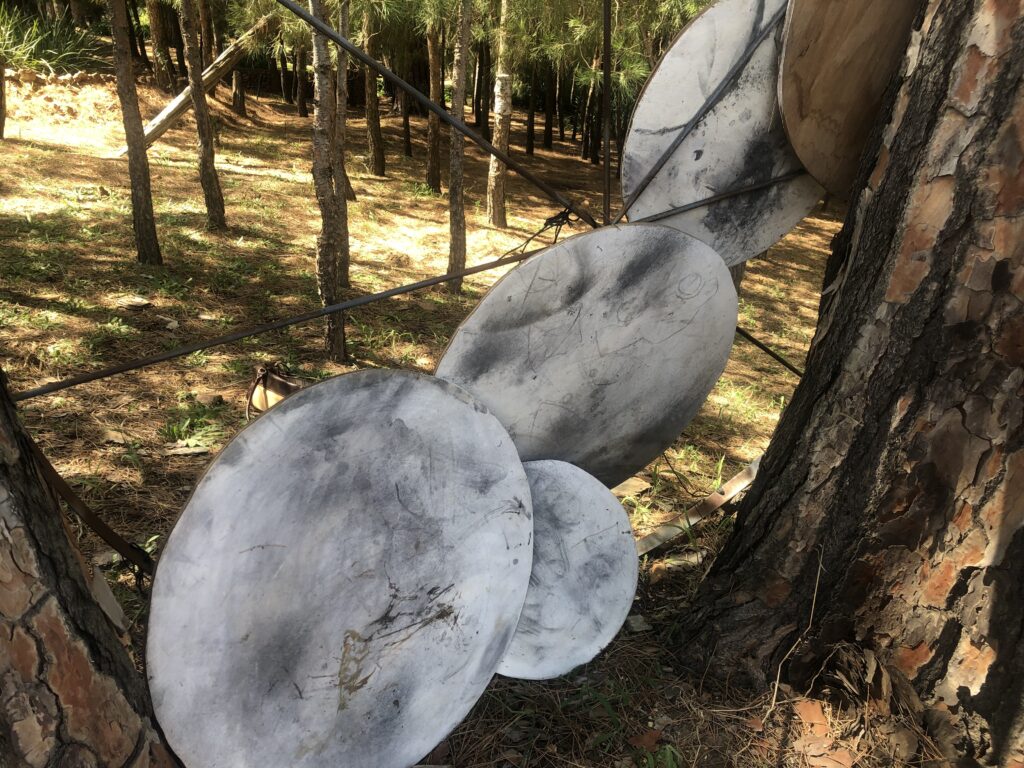
The time spent at the site this afternoon was healing in many ways. I had the urge to gather materials -fallen pine needles, pieces of bark, and make something. I just sat and observed. I spent some time around the little public seating area close by – the fallen debris on the ‘table’ made me ask if I could try to work with cyanno type print – use this space and really upscale a print. I gathered the wooden circles and took them to the studio. I need to deal with the steal structure.
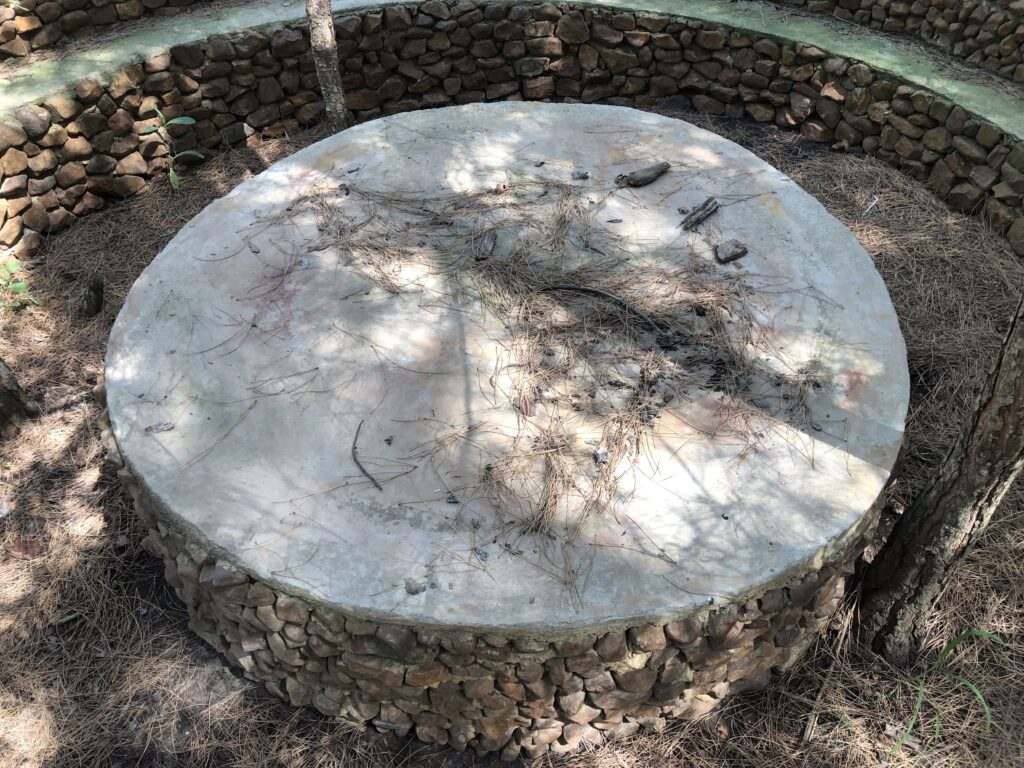
In many ways, I feel my relationship with this space has changed – I feel strong about being in the space, observing, listening, sitting down in silence and exploring to have work grow out of this experience – like a response.
Does this mean I can start a site practice, which is not about placing one artwork in a location? It will be about returning, observing, listening, and letting work grow out of an ongoing relationship with that place. I envision the place becoming something like a long-term collaborator.
My first intervention or work will be to place the steel circle onto the forest floor and ensure it is safe and sturdy. To me, it will be about the circle becoming a very minimal structure that quietly invites interaction, and it is actually part of an important tradition in contemporary art. This deliberate placement will allow people, weather, and time to complete the work.
The steel circle will naturally frame attention, and the spaces in between can become small zones that invite arrangement. Forest materials will be readily available to explore this invitation.
Children and visitors naturally experiment with materials.
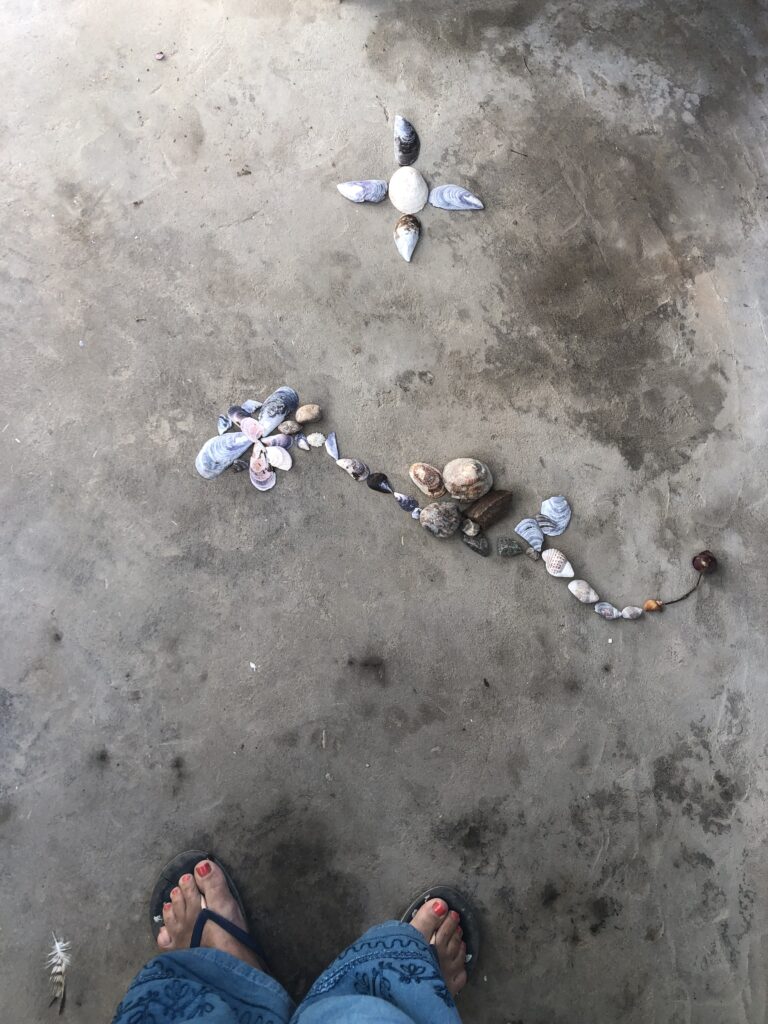
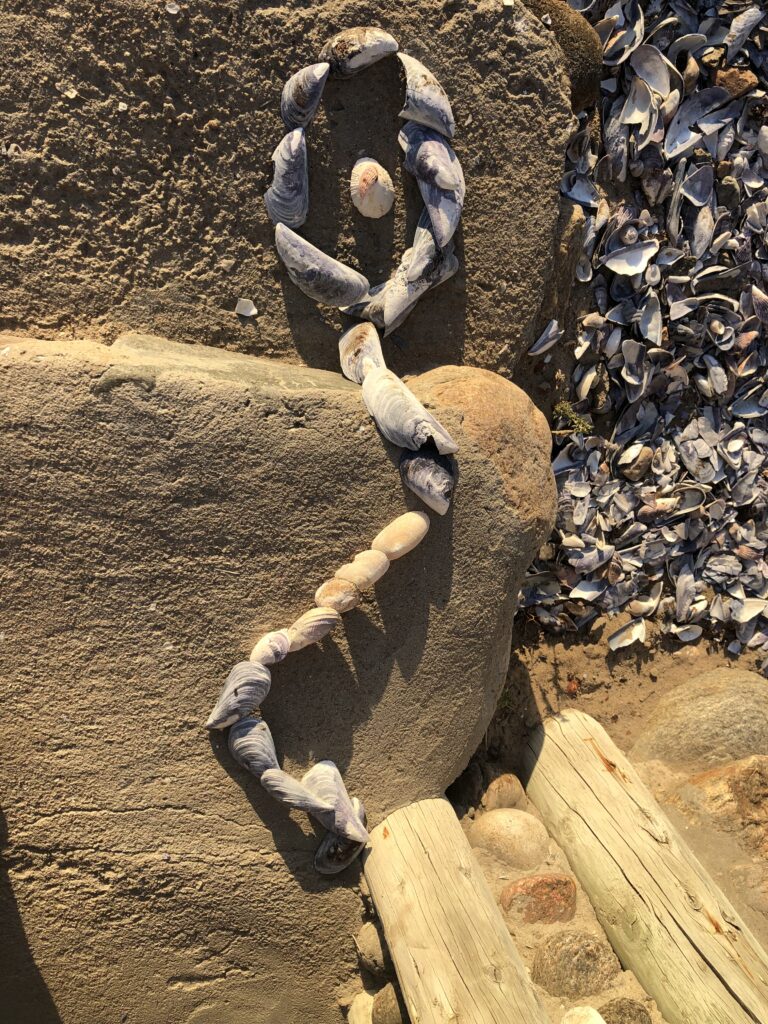
This reminds me of our playful holiday time at the coast, where we used found shells, made a small gesture with them on the toilet floor, and it became a space for an ‘open work’.
REFLECTING NOTES AT WHERE I AM: Sunday 15 March 2026
At this stage of my thinking, I have to mention that I have been looking at drawing courses advertised by the Berlin Art Institute where goal is to : expand drawing beyond the self, marks will arise through body, place, materials, and relations. This implies that drawing becomes a method of inquiry and it has a relationship with the world, drawing is a process rather than a product. From my reading on their site, it is clear that they encourage artists to work in ways that generate experiences rather than explanations.
I agree with many writers/artists that when you engage with a site, you are not entering a neutral space. Dagmara calls this a “forum for resistance”. To her, it is about the “thingness” of materials she describes. I can look at the charcoal, the pine needles, the steel circle and what is revealed when these objects stop working for the human subject or when they are stripped of their assumed functional value. Can I bring it to when the steel circle fell? (Response: Dagmara Genda – AKA artist-run, accessed on March 15, 2026, https://archives.akaartistrun.com/portfolio-item/les-choses-sont-contre-nous-exhibition-essay-by-dagmara-genda/. For her, this “materialism of relations” suggests that the artist does not impose form upon the world but enters into a negotiation with “quasi-objects”. A quasi-object can be the charcoal stick in a wind drawing, which mediates between subjects and objects, defining the practitioner’s position even as the practitioner attempts to define the work.
Other thoughts I read around her workshops and ideas around are about “Where is art’s home? Is it a gallery, a museum? Is it a project space or a private collection? Maybe a living room? She states that the exhibition settings we know today are not as self-evident as they seem. The white cube gallery is only (recent) – a post-World-War-II development and the museum has gone through many phases since its first public appearance in the late 1700s—and it’s still changing. Though institutions have a certain authority in legitimising particular practices as art, it is the underlying, subversive currents in semi-private spaces that challenge the status quo in every generation.
Domesticity has often been diminished for its assumedly “feminine” connotations, but it is perhaps the first place that art is made. These private spaces have been used as exhibition venues to evade censorship, as was the case in the U.S.S.R. Curators have launched careers out of their kitchens, others have made abandoned homes into giant sculptures or used them as venues, yet others have designed homes for their afterlives or used domestic objects as their medium. The private living space has been used, time and time again, to challenge institutional gatekeeping and to engender a different, more intimate way, of approaching and looking at art.
The course, called “The Home of Art and Art in the Home”, was created to introduce participants to historical and contemporary examples of domestic spaces, both lived and abandoned, used as art and for art. Additionally, in a series of hands-on aesthetic challenges, they suggested that participants will use their own homes as stage sets, artworks, and exhibition venues.
Concerning the steel circle, which is already on the site, I am thinking it should be reimagined as a “stage set” or an “exhibition venue” in the spirit of the course I mentioned above. By placing the durational scrolls within this circle, I blur the line between “public and private”. The work becomes an “indirect invitation to visitors” who play, relax, and eat on the farm.
I also think it important to look at story telling, where myths and imaginations comes to play – as one could be at risk of losing touch with an essential part of our humanity and a way to connect to others. I agree that stories are vital to how we connect to some of the most influential artists of the past and present. The question then is not so much if, but how we want to tell stories.
Seismic Design Parameters: Using scientific protocols for “wind and seismic design” as a conceptual framework for the drawings.44 The marks on the scroll are treated as “performance-based seismic design,” intended to determine if a “desired performance level” (of attention or awe) has been met.45
Spatial Drawing with Tape and Wire: Using “wire and tape” to mark out the boundaries of the circle, similar to the “Out of Line” exercises.1
Collaborative Marks: Inviting visitors to add their own “traces” to the scrolls, turning the drawing into a “form of communication” and “group interaction”.7
- Methods of drawing with which we will experiment are spatial drawing, drawing words, collaborative drawing, drawing with prosthetics, drawing under constraint, and more…
- Participants will experiment with different types of materials including brush and ink, various collage techniques, thread, wire and tape, graphite, charcoal, and coloured pencils.
- Daily lectures are designed to expand the idea of drawing and present examples of artists’ practices..
- Group discussions will invigorate debate and encourage participation
- International participants from a variety of backgrounds will also have the opportunity to learn from each other and build lasting connections.
I created a small practice to follow for at least the next two weeks. I asked AI to help me focus on the idea of drawing as a response. The idea is that each session shifts the source of the drawing and that my scroll becomes the accumulating field of traces.
- The Environment Draws
- Movement as mark body
- Drawing with the pine forest
- Others – beyond the self
- Reflection/synthesis
1 — Reactive Drawing
Aim
Learn to draw as a response to what happens around me.
Location
Pine forest site.
Practice
Walk slowly through the site and pause where something catches my attention.
Examples:
- sound of wind
- light moving through branches
- voices from the picnic area
- texture of the forest floor
Each time I pause, I will make a small mark or rubbing on my scroll.
Do not plan the drawing.
Think of the scroll as a seismograph of the landscape.
Reflection question
What changed when the drawing came from the environment rather than from intention?
2 — Body Drawing
Aim
Use the body as the drawing tool.
Location
The labyrinth.
Practice
Attach a scroll or paper as well as drawing tools to my body.
Possibilities:
- drag paper behind you
- let the ground make marks
Walk the labyrinth slowly.
Notice:
- rhythm of steps
- pauses
- curves of the path
Let the marks record movement and time.
Reflection question
How does the body “draw” differently from the hand?
3 — Material Drawing
Aim
Let materials become the drawing tools.
Location
Steel circle on the forest floor.
Practice
Gather natural materials:
- pine needles
- bark
- stones
- cones
Use the circle’s four sections as small drawing fields.
Experiment:
- arrange materials
- photograph
- make rubbings
- create cyanotype prints
Do not think of this as sculpture.
Think of it as drawing in space.
Reflection question
What happens when drawing is made through placement rather than lines?
4 — Collaborative Drawing
Aim
Allow others to influence the work.
Location
Public areas near the circle or tables.
Practice
Leave the circle quietly arranged.
Observe what happens.
Children or visitors may:
- move objects
- add stones
- rearrange materials
Record changes in your scroll.
You might:
- draw the new arrangement
- make a rubbing of it
- write a note about the interaction
Reflection question
How does the drawing change when others participate unknowingly?
5 — Reflection and Integration
Aim
Bring the week’s experiences together.
Location
Studio or quiet place near the site.
Practice
Unroll the scroll.
Observe:
- marks from walking
- rubbings
- environmental traces
- body drawings
- collaborative moments
Add a final layer:
- charcoal lines
- fragments of writing
- reflections on listening and walking
The scroll becomes a map of the week.
Reflection question
Where did the drawing feel most alive?