I want to exhibit the coastal rubbings, which I made in December 2025 at a members’ exhibition during March 2026.
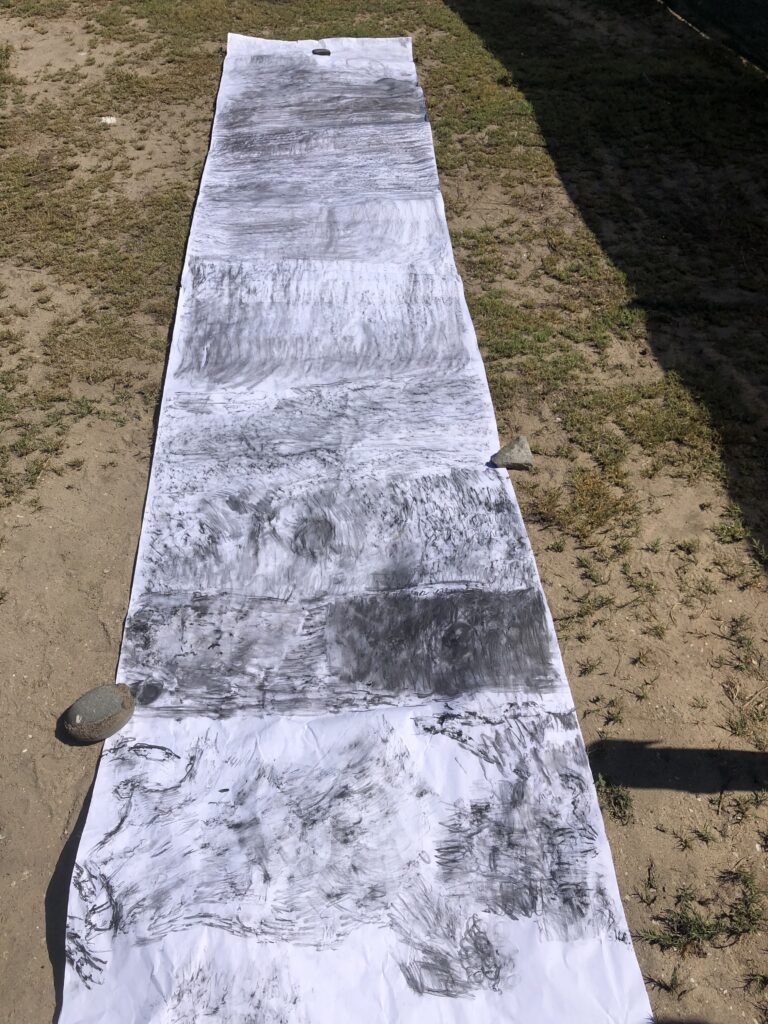
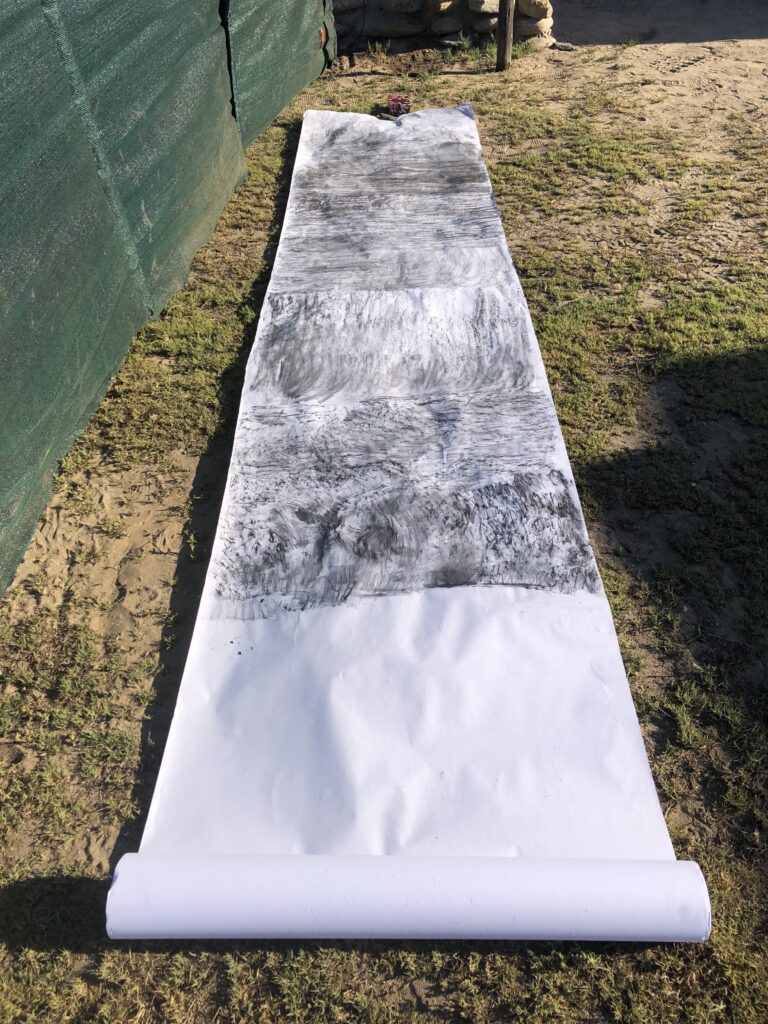
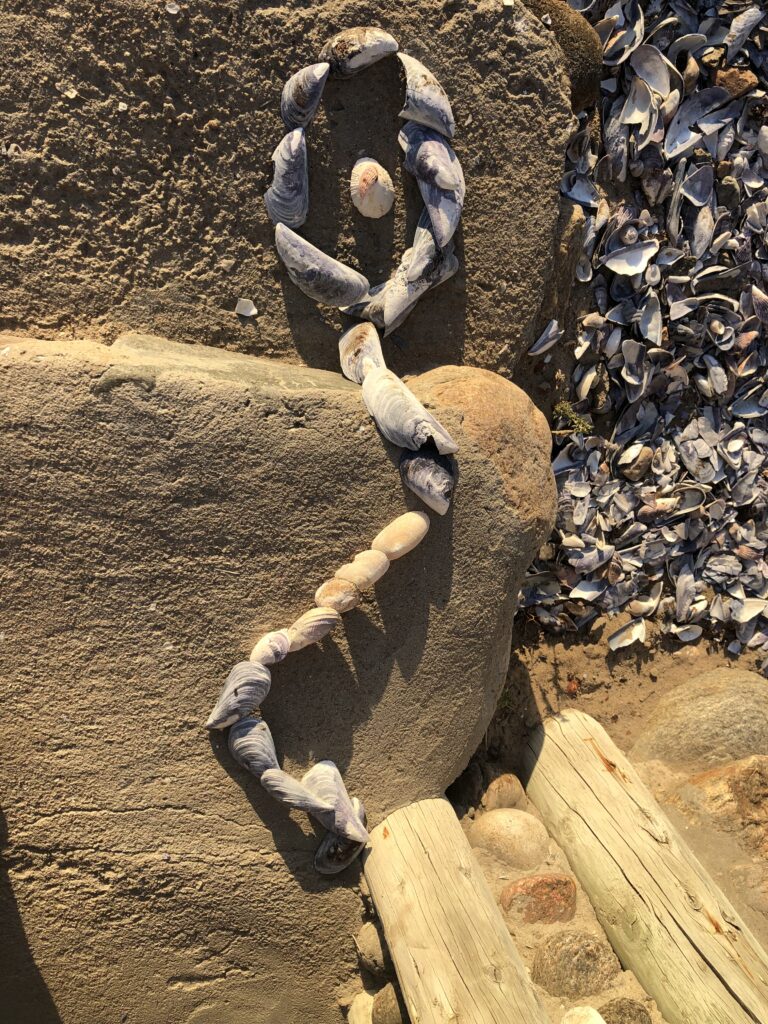
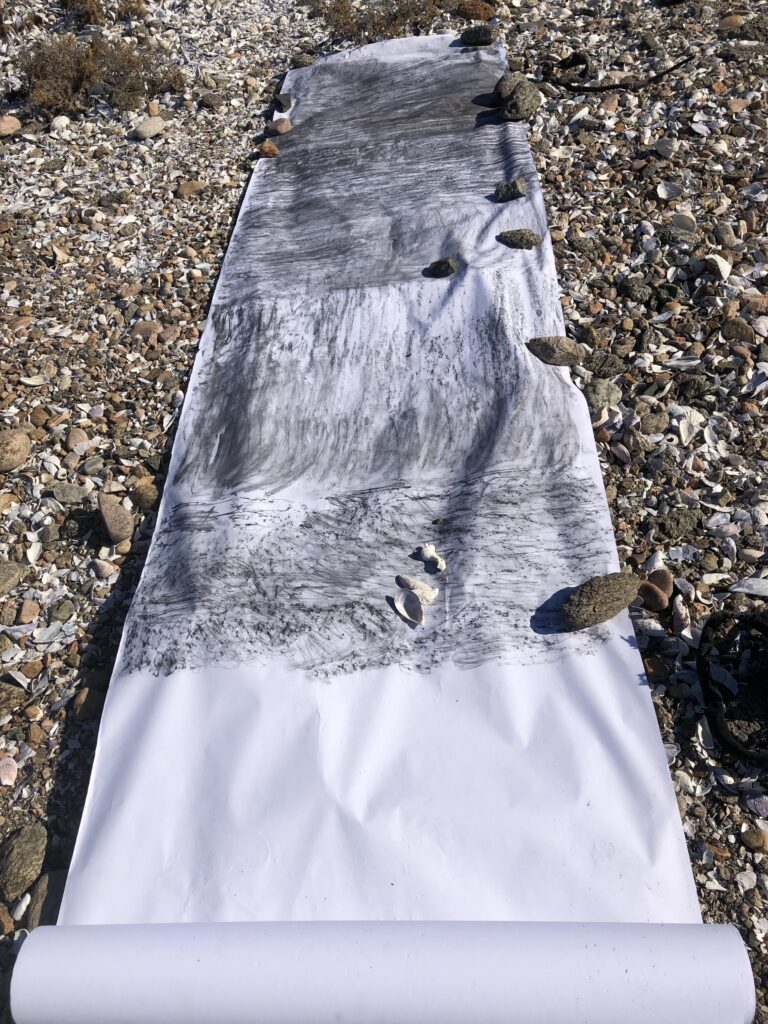
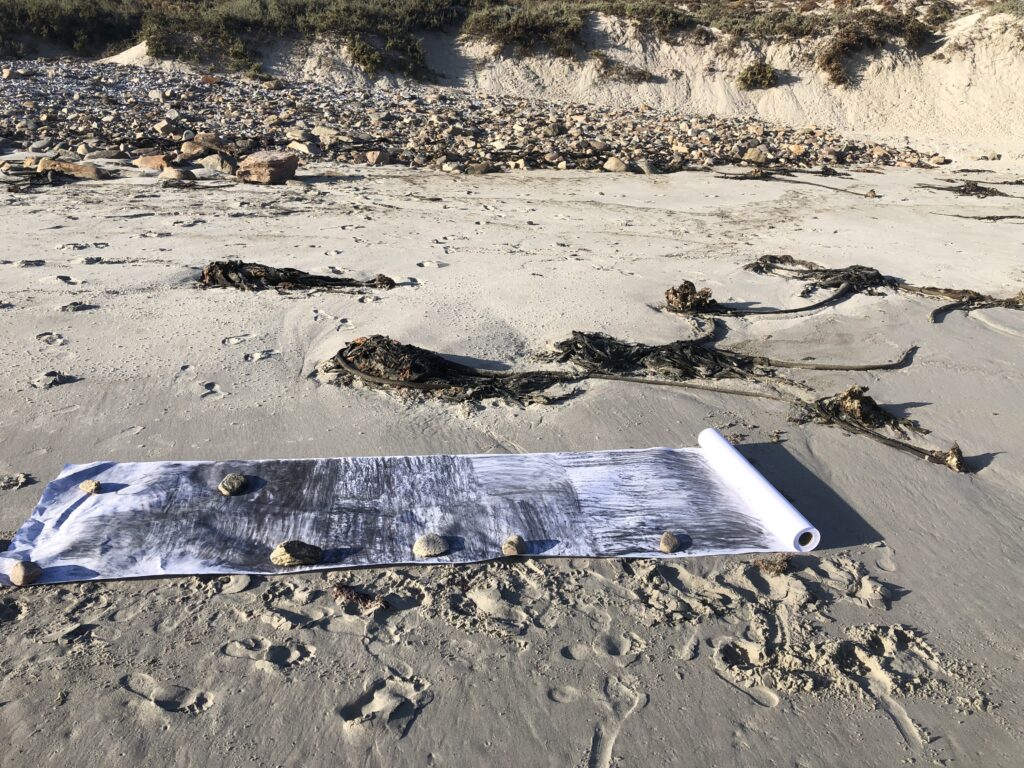
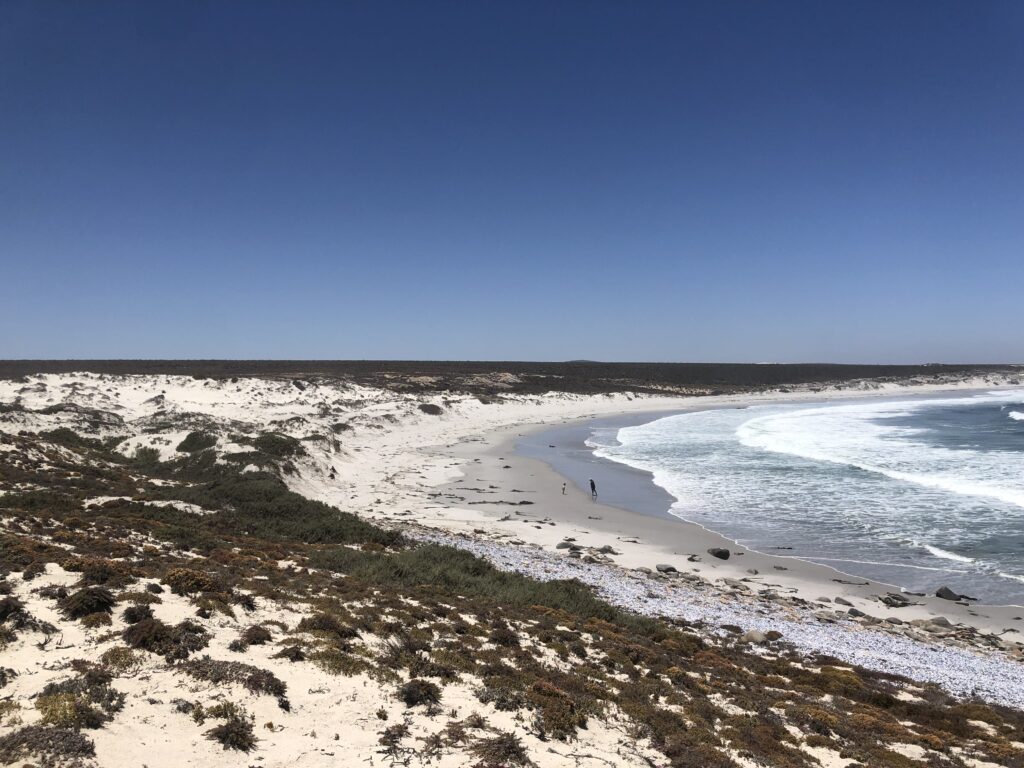
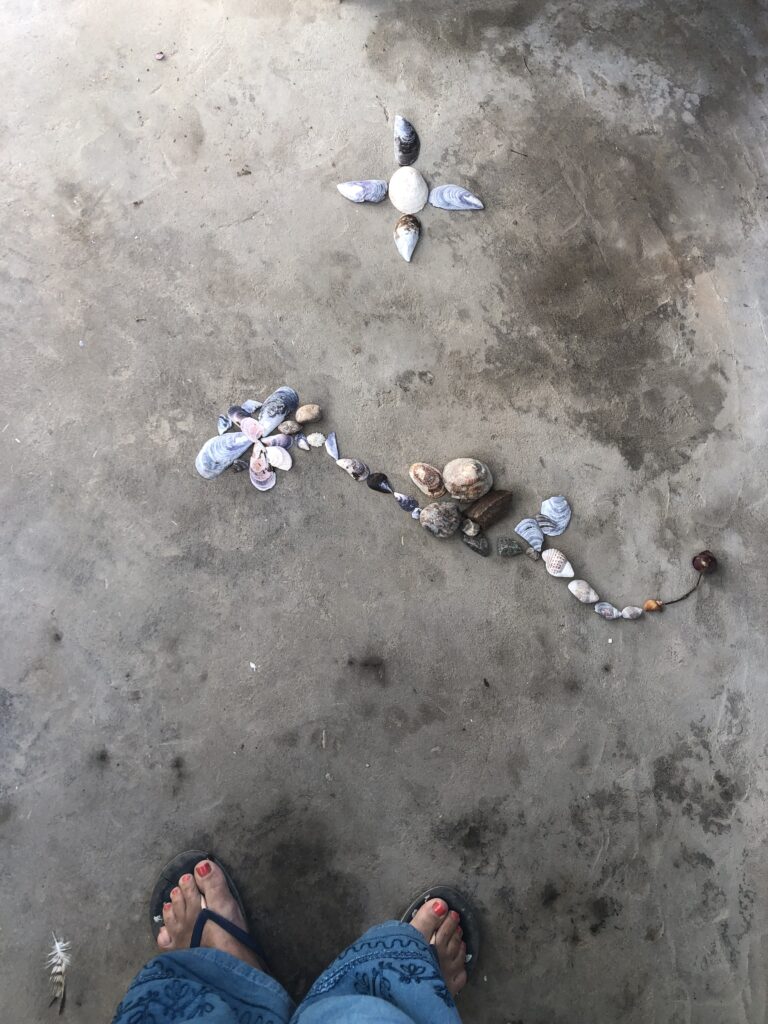
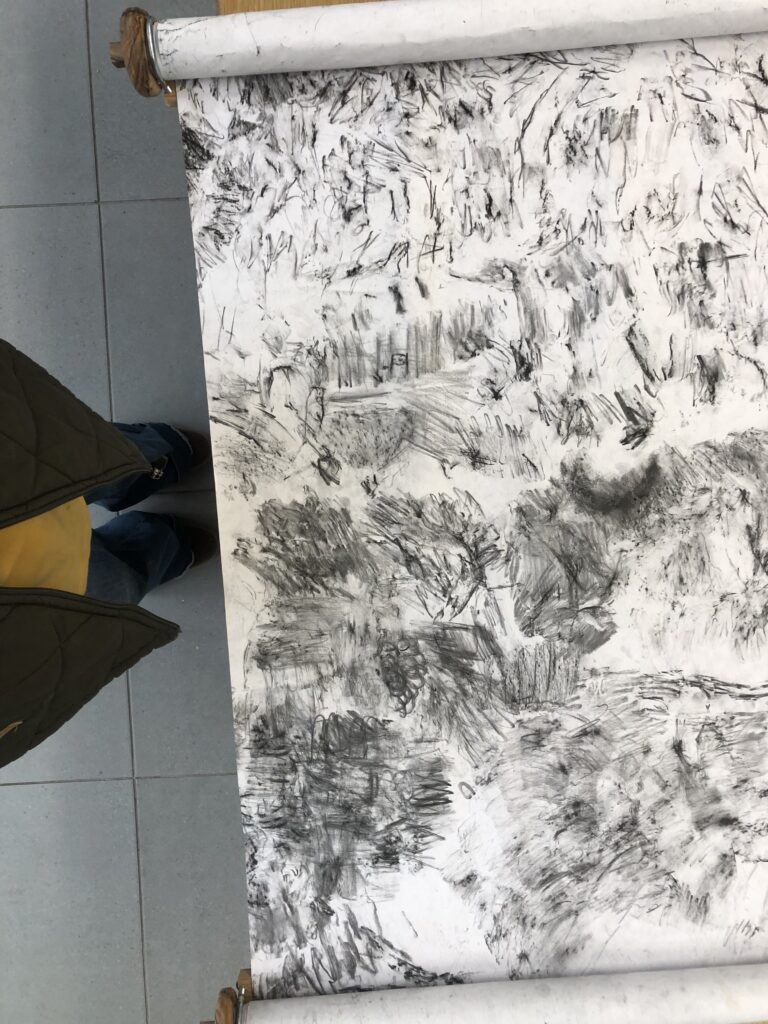
The drawings were made over a period of 10 days, whilst camping with family and friends on the West Coast of South Africa. I initially planned to take tide-line rubbings and see what the coast offers at different times of the day. Low tide identified more natural mark-making opportunities as I found seaweed stems, kelp and shells. We camped at two different places – the coast was less sandy in one area, and here I mostly worked on the rocks. I felt that I not only gathered marks of the coast, but also captured a sequence of attention to what was around me. The process was more about non-linear time, and already here, the idea of scrolls came to mind. I had to roll the paper and work as if I were using a scroll. This prevented the wind from blowing the work around or tearing the paper.
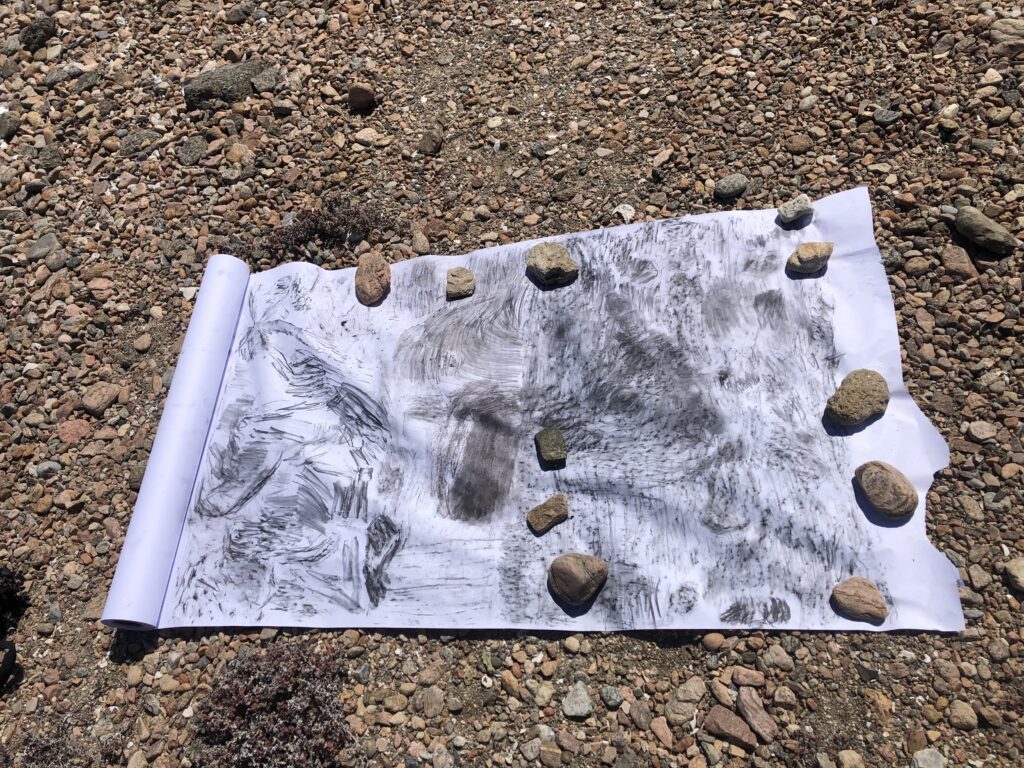
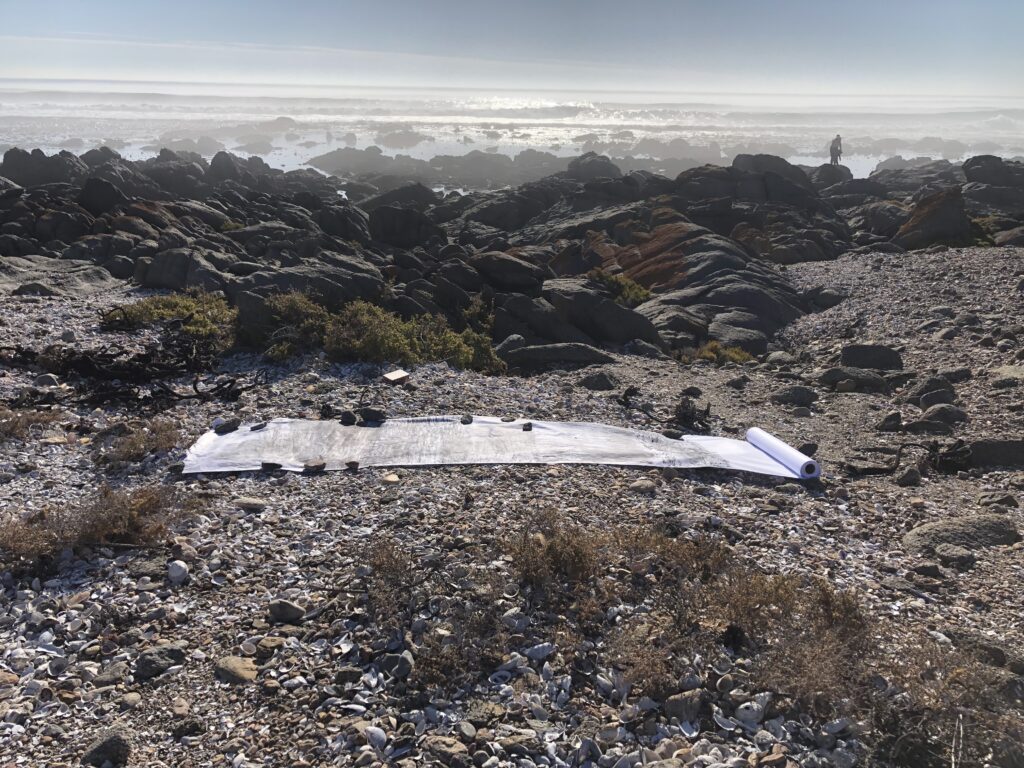
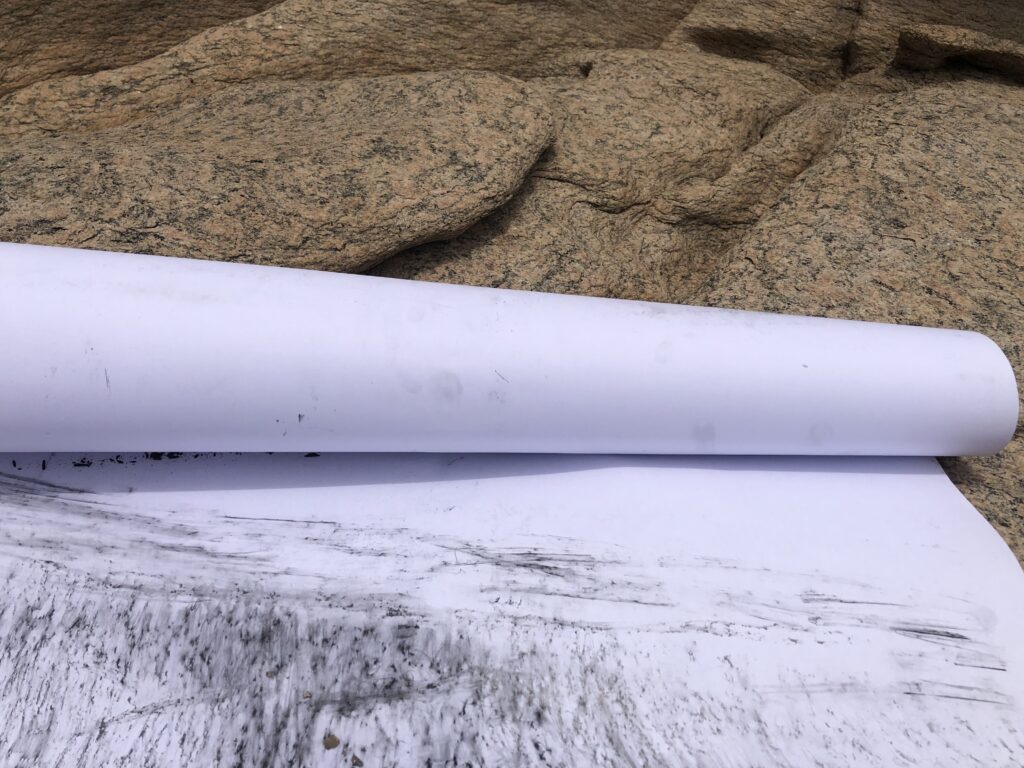
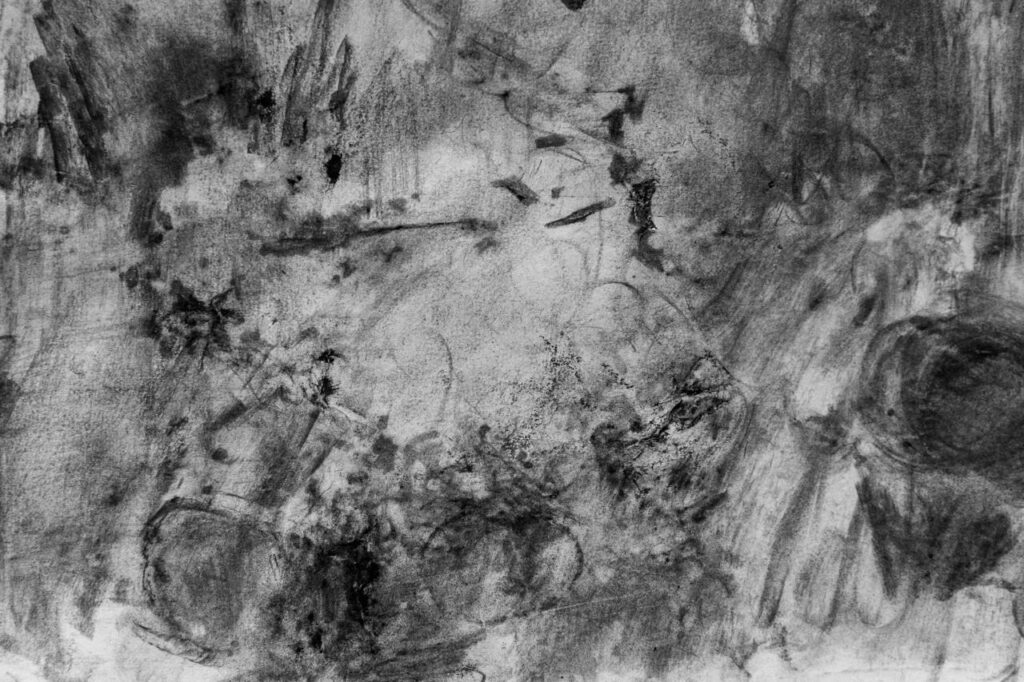
I recently joined the two roles I worked on and now have at least 4.8 metres to exhibit. To me, these rubbings and mark-making records can function as an installation shaped by wind, weather, time, and natural change. They were made through direct contact: my body leaning into the paper, the wind shifting the sheet, the textures of rocks and weathered surfaces rising through graphite and charcoal. These marks are not representations but traces of encounter. They echo Bachelard’s sense that imagination is not a flight from the world, but a deep dwelling within it — what he would call an interiority shaped by contact with matter. I enjoyed how the rock’s microtopography emerges like a tide map in the drawings.
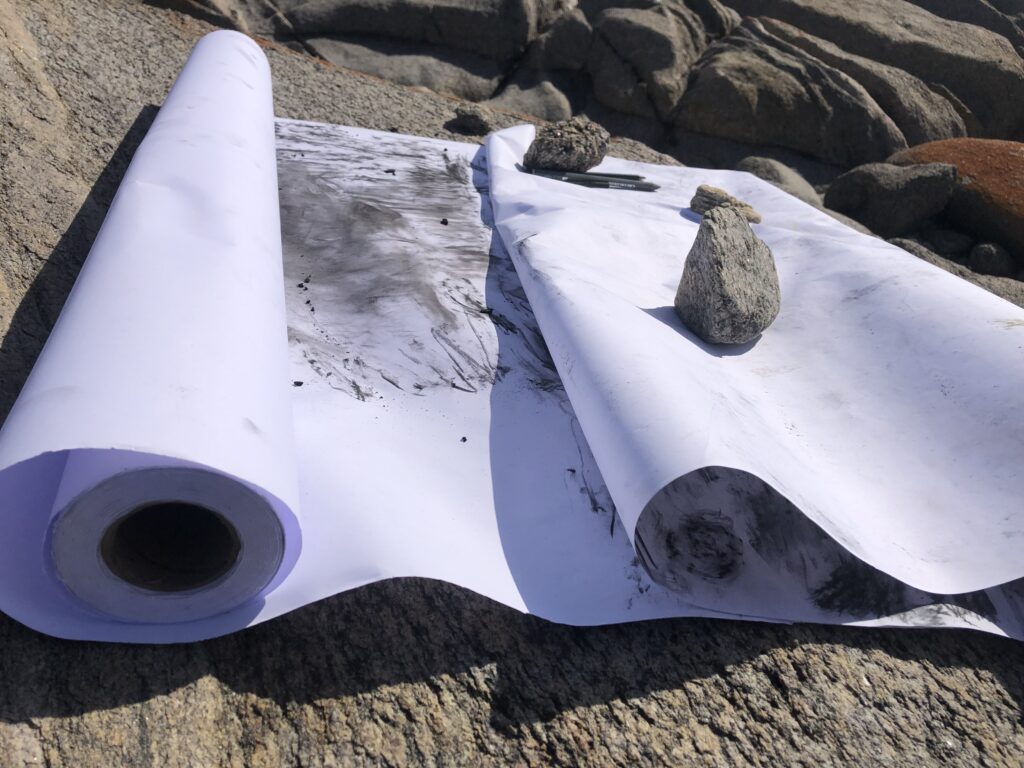
I loved the thoughts that came to mind whilst I was working – like ‘What does water, sand, rocks and wind teach me about holding and dissolving memory?” (I am reminded that I was also reading, There Are Rivers in the Sky, in this period)
Returning to the studio, I began to recognise that these drawings were already in conversation with earlier works—particularly the wind drawings and the pine-forest installation. This led me back to Karen Barad’s writing, which offers a way of understanding the world not as separate from us, but as something we are continuously entangled with.
The coastline, rocks, and campsite actively shaped my marks. The paper roll became a temporary membrane between my body and the environment, where wind, sand, salt, and charcoal participated in the making. Matter was not passive, but part of the negotiation.
At times, fragments of language entered the work—repeated words, dates, or brief inscriptions. These were often worked over and partially concealed, so that they remain as traces within the surface, marking moments without fixing them. I feel like this exploration of displaying the work as a scroll is a first articulation of a language, which I discovered about a work becoming a screen, sharing partial visibility and looking at a field of possibilities. In this sense, the coastal rubbings are not endpoints. They are beginnings, invitations, and markers of a path walked in collaboration with land, memory, and the fragile but persistent pulse of life that continues.
To me, this is an ongoing investigation, and further work may emerge as we learn how people engage with it during the exhibition. These could be observations of how people interact with the work: do they touch it, do they miss the ‘rest’, and/or do they understand the fragment?
Ultimately, the work became a proposition rather than a statement. I think it asks:
What does it mean to move with a place rather than through it?
What does it mean to listen to materials?
What does it mean to let grief and beauty coexist without resolving one into the other?
What does it mean to make work that lives, changes, and becomes fragile, as part of its natural cycle?
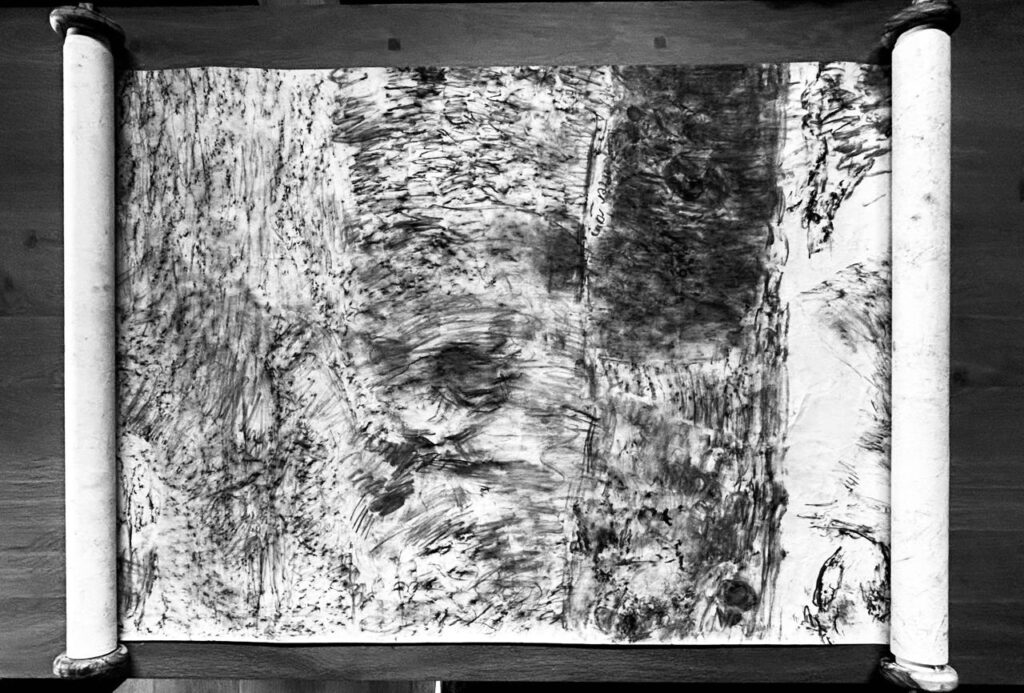
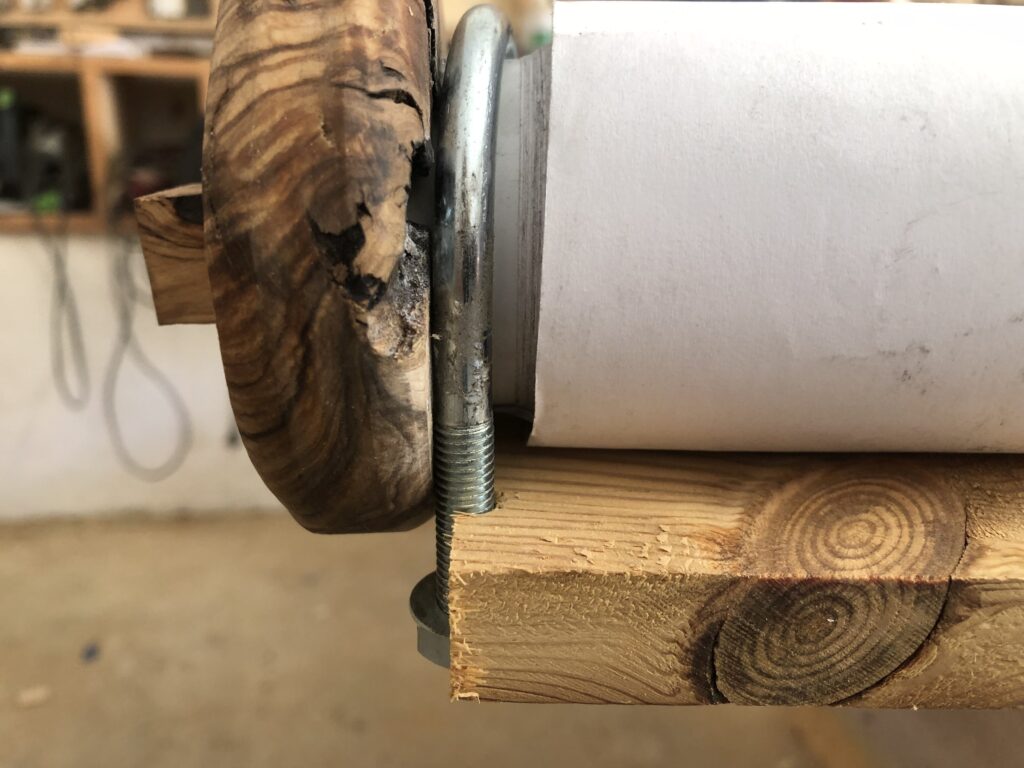
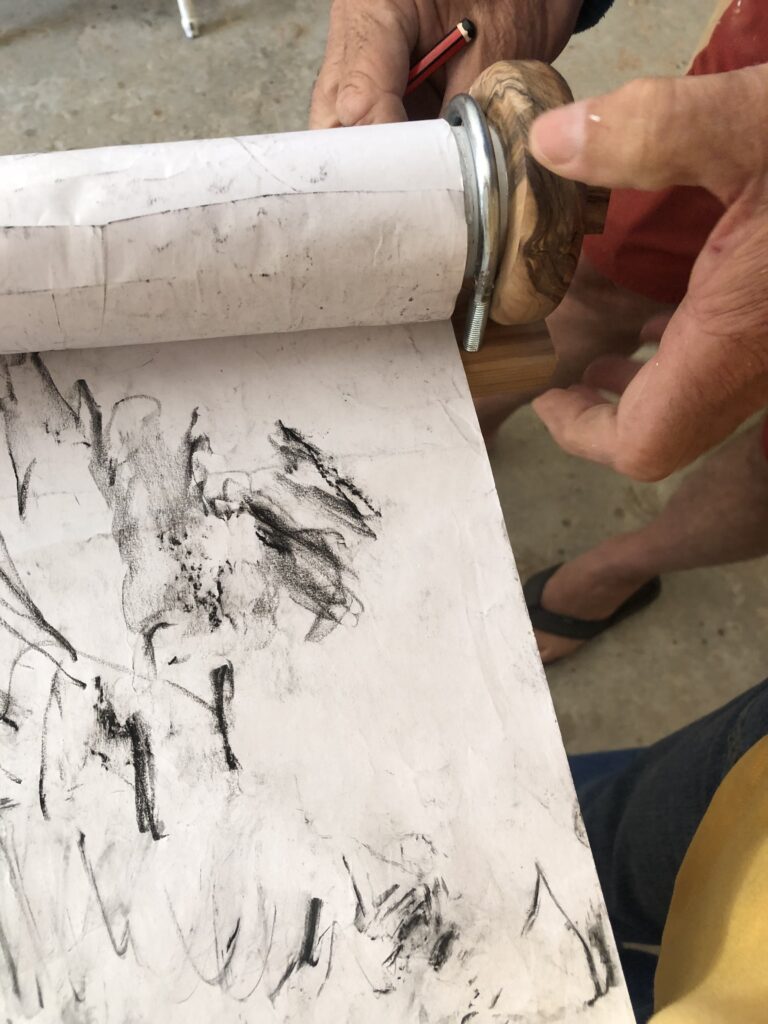
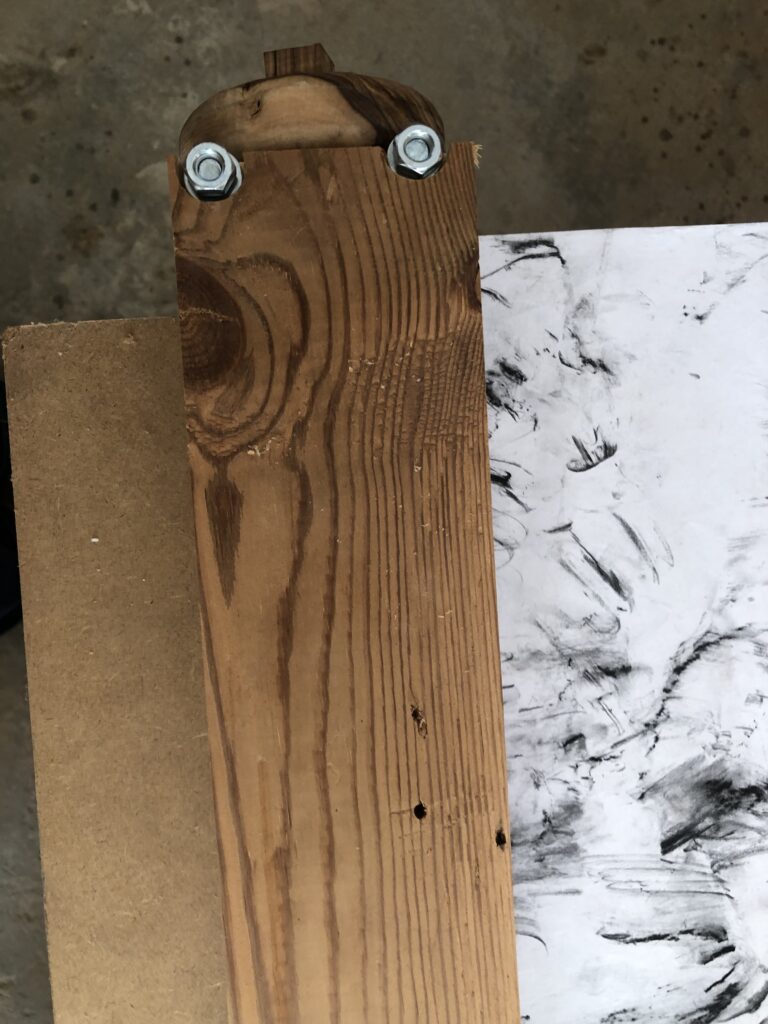
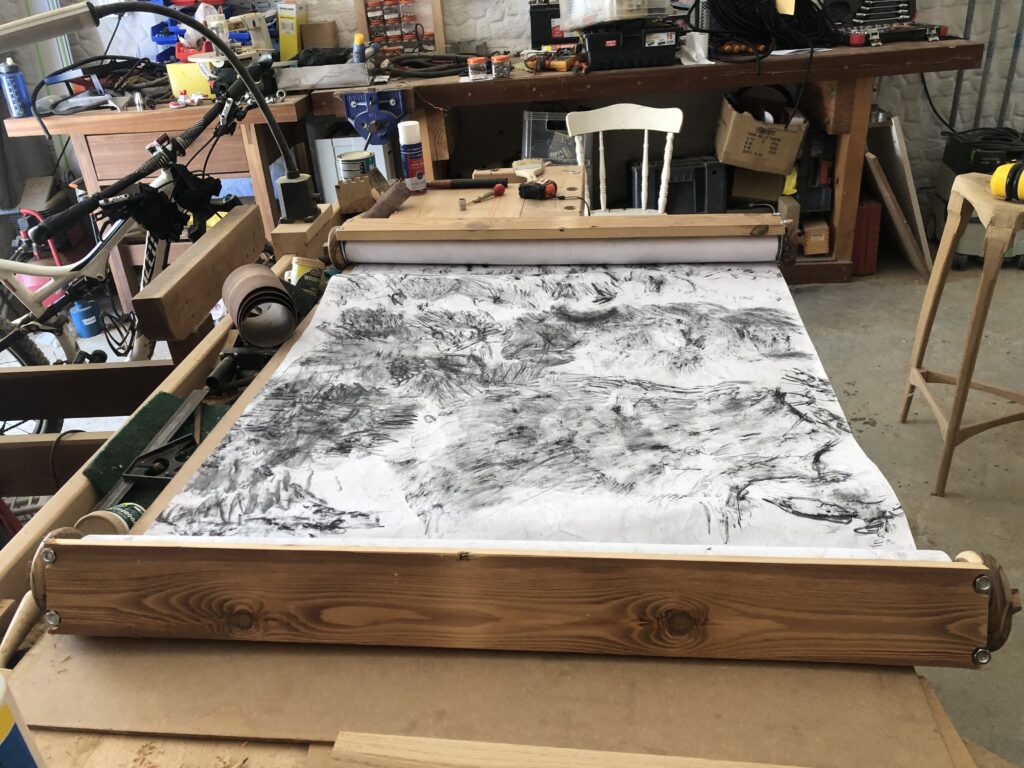
In late February, I decided to enter the work in a local members-only art exhibition of an art association where I am a member. The only constraint is size: 1.2 x 1.2 m. All mediums will be accepted. The scroll idea is again in my mind, this time it can act as the frame for the work, almost like a tide line selecting what is visible. I bought PVC pipe to act as the supporting scrolls, and my husband assisted in making a wooden decoration on the sides of these poles with olive wood offcuts he had. I will show only a small part of the full drawing due to size constraints. I think the way the work hangs between the scrolls will state that the drawing continues beyond what is seen. I want the work to give the viewer an experience and an energy shift, thus showing different marks and considering internal movement within the ‘frame’.
The scroll already carries the idea of unfolding over time, of continuity, and of duration. I really like that there is a tension in the work which this format will convey: a durational drawing that has been temporarily stilled and partially revealed within the constraints of the exhibition. The scroll should not be a device, but a ‘held condition’ – where time is present, but not fully released. I hope the work will not be read as a continuous narrative, but as shifts, accumulations and interruptions.
Hesitation to put the work forward
I see the work and idea to display it as a scroll, very much a work that is not presenting smoething completed. I think the work opens toward time as ‘material’ (not being linear) and that it is experienced in fragments.
This work unfolds over time rather than presenting itself all at once. The scroll format allows parts of the drawing to remain hidden, so what is seen is always partial.
I consider my own doubts: do I sense a type of fear for rejection? To bring this into the open is to be calm and to find clarity and trust in my work. I want to present and accept the uncertainties around it. I wonder about what the work needs in terms of curation.
I came to the question of myself: can I let/allow the work (to) stand in the same way I stood while making it?
A great lesson learned here: Urgency that comes from fear asks, How do I protect myself? Urgency that comes from clarity asks: How do I remain faithful to the work? I gave some thought to how I view the outcome of a work, but I think in this case, there is a more compelling question: what is the ground from which I take my stand?
Short statement about the work, called ‘a fragment of time’:
This work is a durational drawing made over a series of days on the West Coast of South Africa and prepared for a specific site where it had to fit within size constraints. Presented as a scroll, only a portion is visible at any one time. The rest remains rolled, held just beyond view. The drawing holds marks shaped by wind, sand, rocks, movement, and the act of carrying. I look back on the process and also think it represents ‘sites’ I visited daily – sometimes it was the same ‘site’, but wind, sea currents and debris changed the markings onto which I placed my paper to make the drawings. The work is also about documenting my artistic or creative practice.
As a work, a fragment of time resists full visibility. What is seen is only a portion; It doesn’t try to hold the whole; It accepts that what we encounter is always partial. I’m interested in how memory and experience don’t arrive as complete images, but in fragments—revealed, obscured, and reconfigured through movement.
hanging the work
The scroll is firmly supported along the top and bottom, with minimal visible intervention.
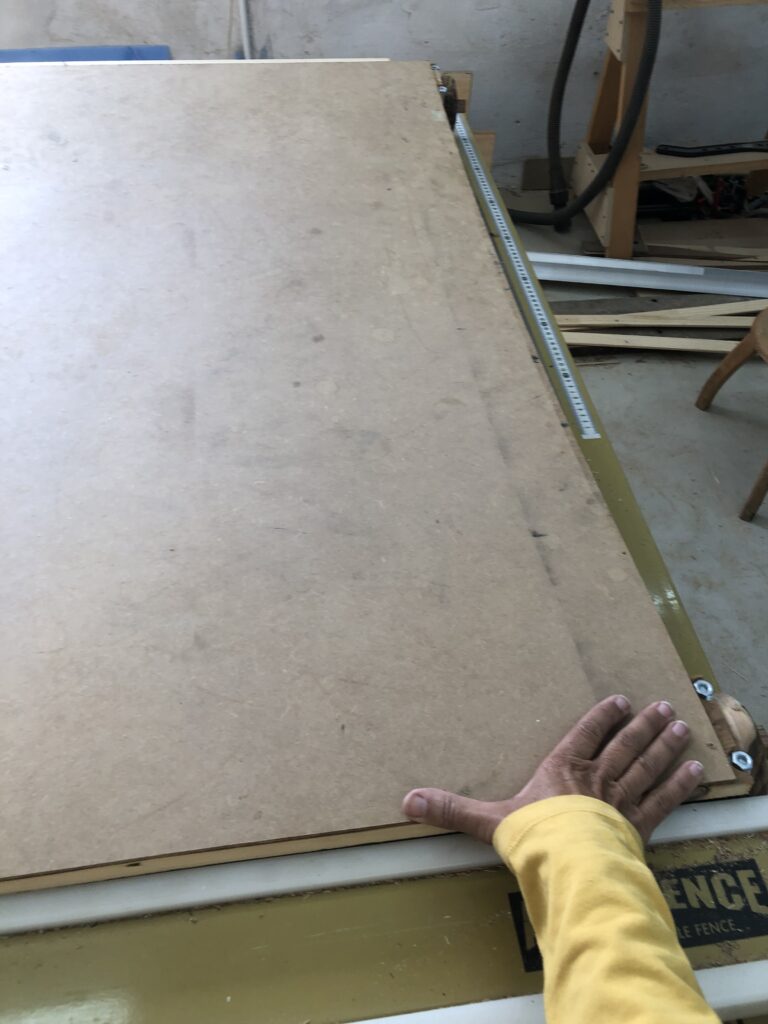
All fixings should remain visually unobtrusive and behind the work. A steel cable is attached to the top for hanging purposes. At the back of the scroll, I have placed some hardboard to prevent tearing or creasing. Viewing the work would involve unrolling from one side while rolling up the other to keep the paper under control. I am concerned for the edges, where the scroll is attached to rollers, as these could be weak points. I did not leave any instructions to move the scroll, as I believe movement should feel necessary, not demonstrative.
(The exhibition will take place from 7 – 27 March 2026 at ArbB, Bellville)
Thoughts about the now-completed work and how it could live publicly (Monday 2 March 2026)
I think, in essence, it is a work that withholds completion and resists full visibility, but it shares an unfolding of time and of presence and absence, by revealing and concealing.
It is a process-based, conceptual drawing with performative and installation qualities I still need to unpack.
The conceptual aspect lies in how the work resists being fully seen—the image is always partial, and revealed through time and movement. In a way, the work gestures toward performance, not as spectacle, but as a quiet unfolding: toward what remains unseen yet present. The scroll became a structure that holds continuity and interruption in simultaneous tension. My biggest hope is that the scroll becomes an encounter rather than an object.
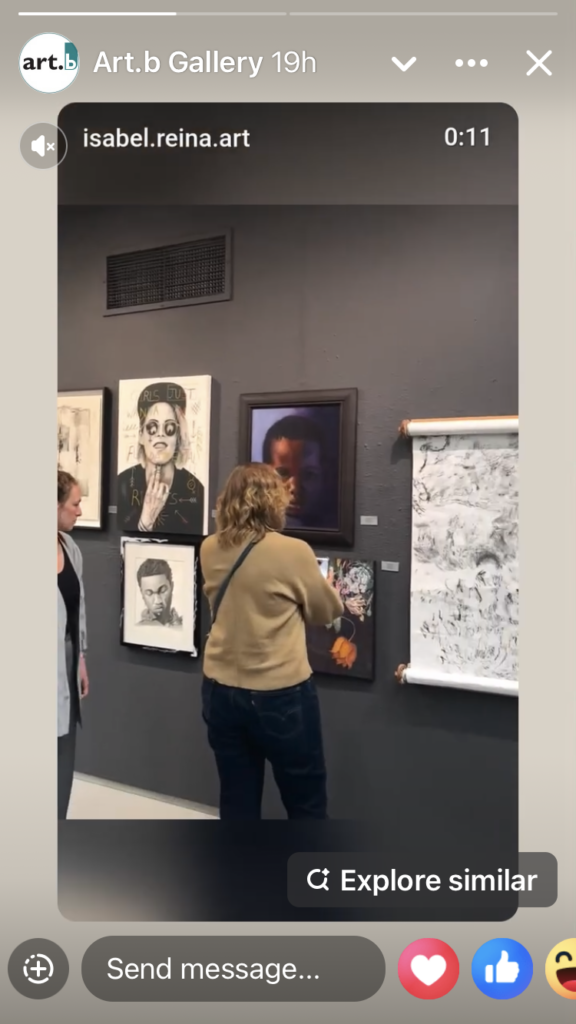
This work unfolds over time rather than presenting itself all at once.
The scroll format allows parts of the drawing to remain hidden, so what is seen is always partial.