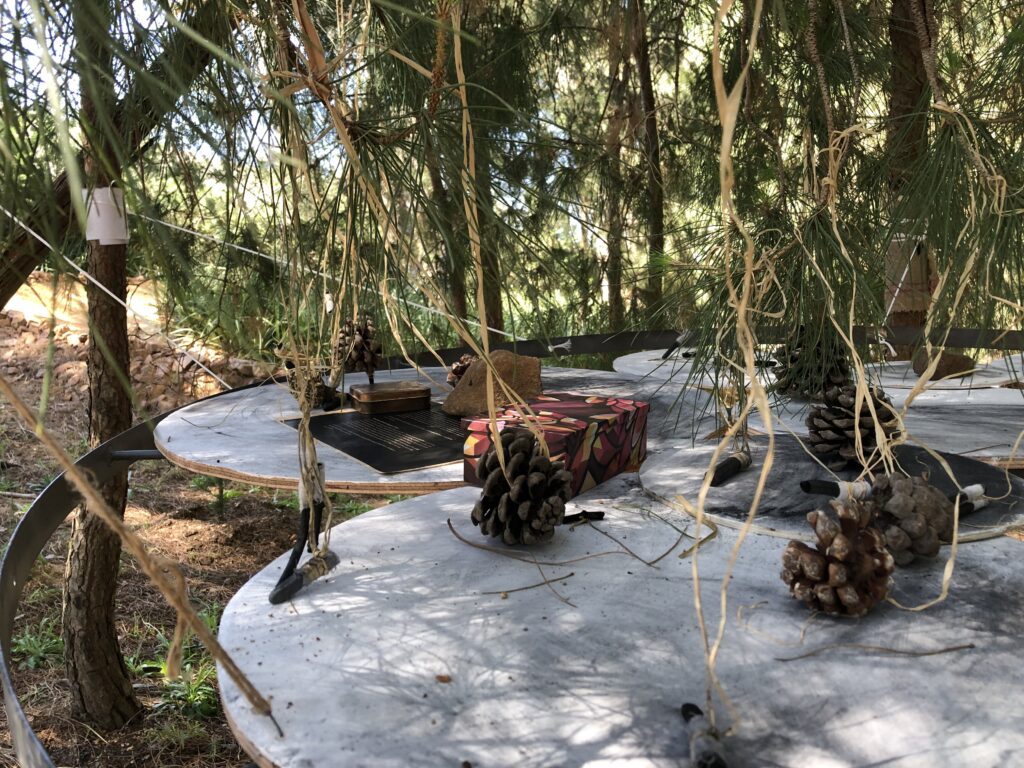
I am thinking about how the materials I work with create a starting point for reflections on memory, community, and my relationship with place, and how this then continues to present in the next making. When working with or in nature—whether creating nest shapes, hollow forms, drawings, or weavings—I find myself continually meditating on the relationship between the interior and the exterior. Recently, I am more interested in why I choose a material. What does the material itself have to do with the work I produce? Is it about the final object, or is it purely conceptual? I am interested in where a material can take me. I am also aware that this is a space of conflict – how to hold so many paradoxes and uncertainties? I came upon Wu Hung and think I am at the place where I feel that I need to look at Material Art. To me it asks: “What does this material already know, carry, or resist—and how can I let that speak instead of forcing my own image onto it?”
(Scholar Wu Hung writes that this ‘type of art entails an artist’s consistent use of unconventional materials to produce works in which material, rather than image or style, is paramount in manifesting the artist’s aesthetic judgment or social critique’ (p.15). In other words, material is the key element in deciphering the meaning of a work of art, taking precedence over image or concept. Wu deliberately distinguishes ‘Material Art’ from ‘Conceptual Art,’ arguing that contemporary Chinese artworks have previously ‘been vaguely – and often inaccurately – labelled as Conceptual Art, assemblage, readymades, or object-based art.’)
In my own practice, I am interested in exploring what comes to the forefront: is it an architectural, protective instinct found in nature—an exploration of physical presence and the human need for shelter? Ultimately, this material investigation brings me back to themes of care, vulnerability, and concealment. What is protected or trapped within the interior cavity of a form? In this blog, I want to consider these questions through a recent on-site installation. (see images above).”
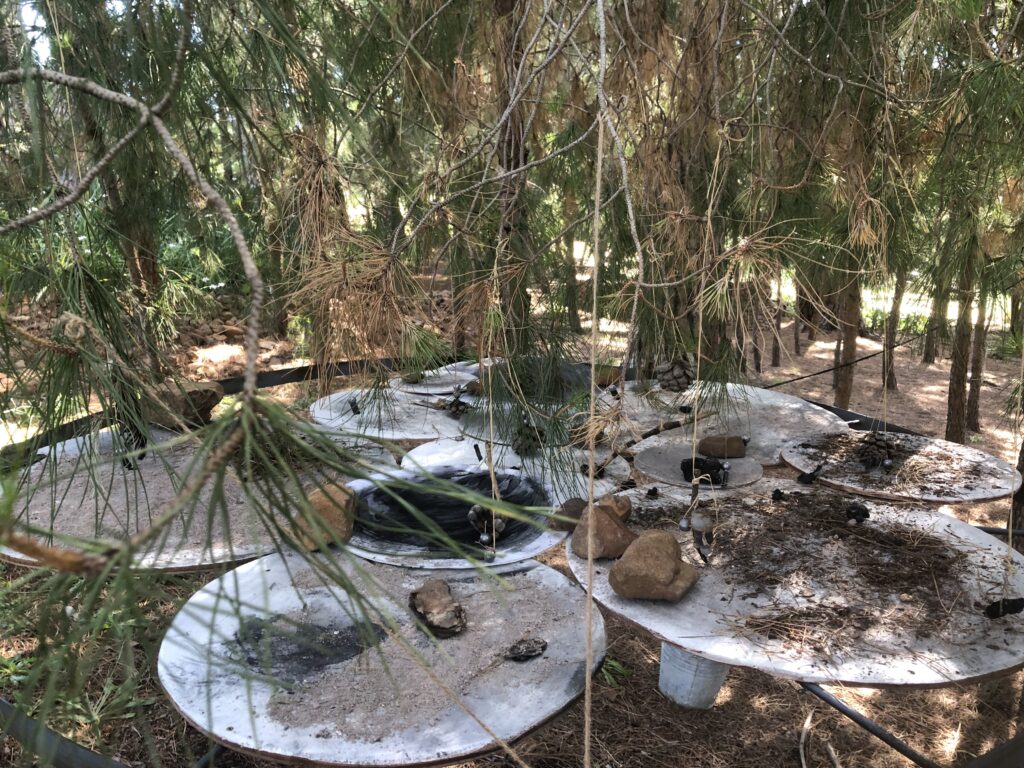
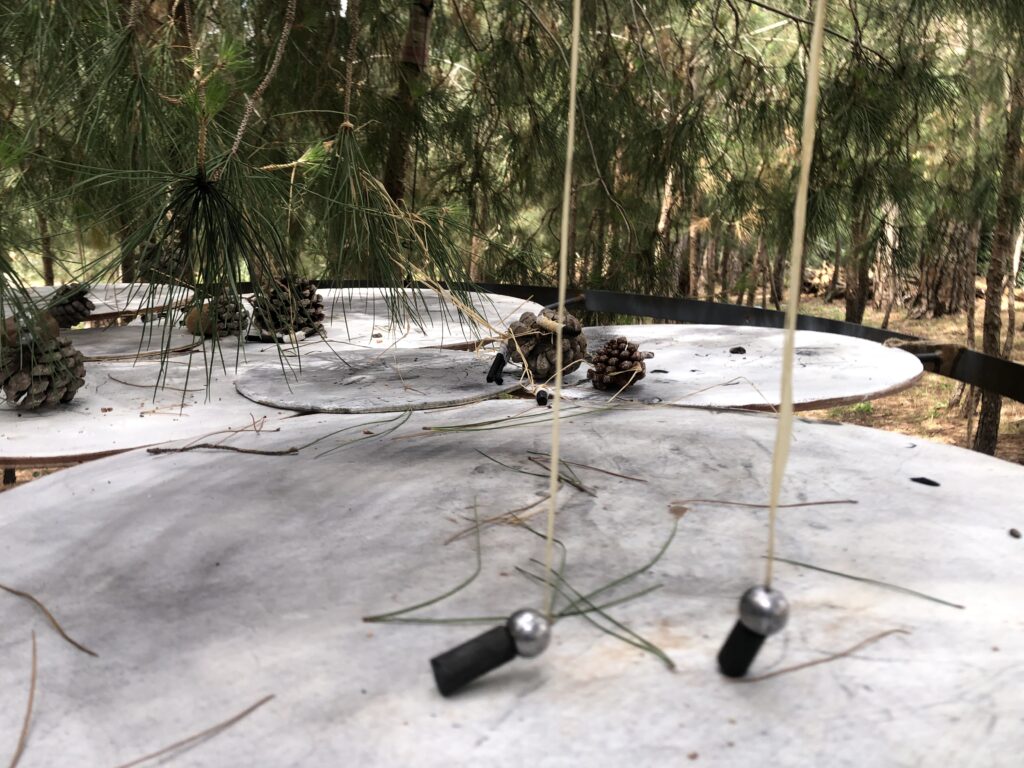
The wind drawings outside the installation space where the work was created
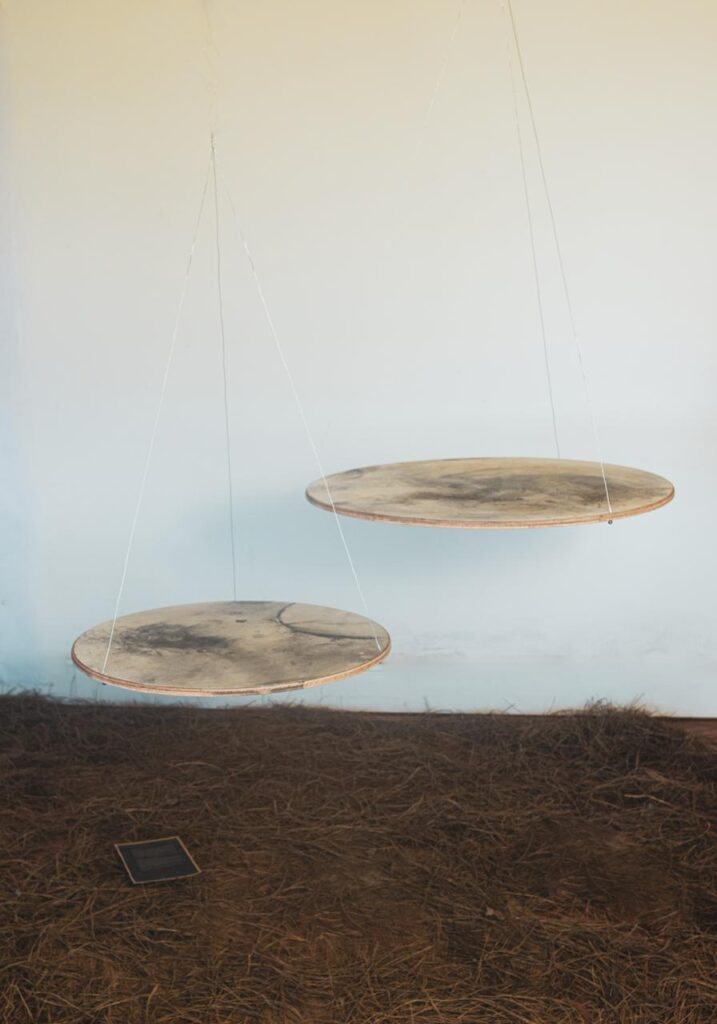
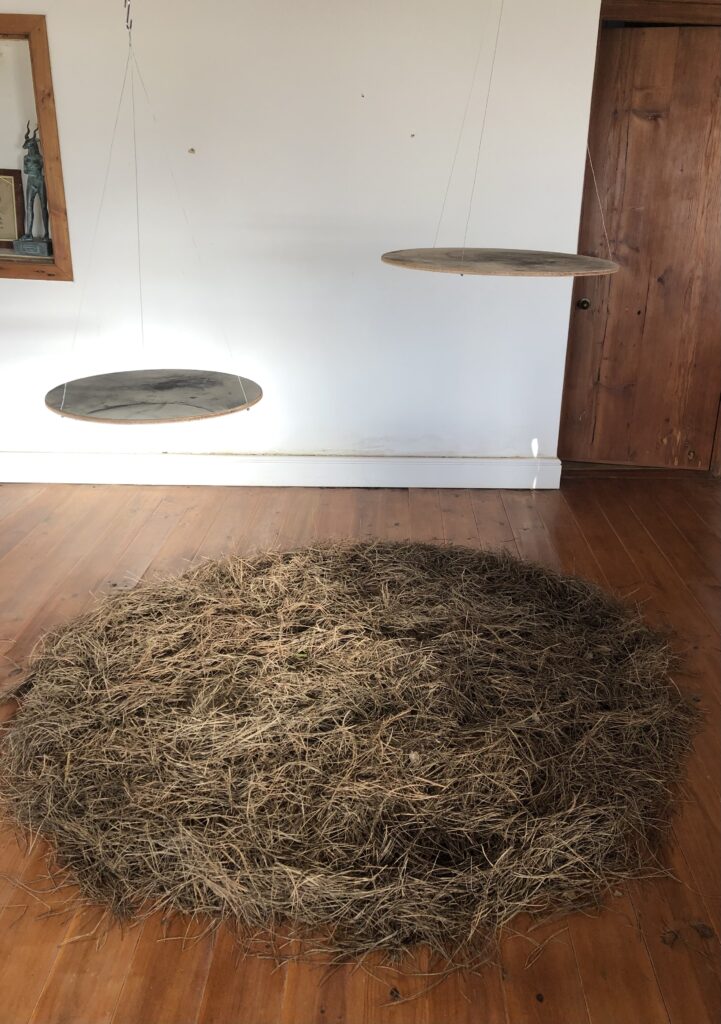
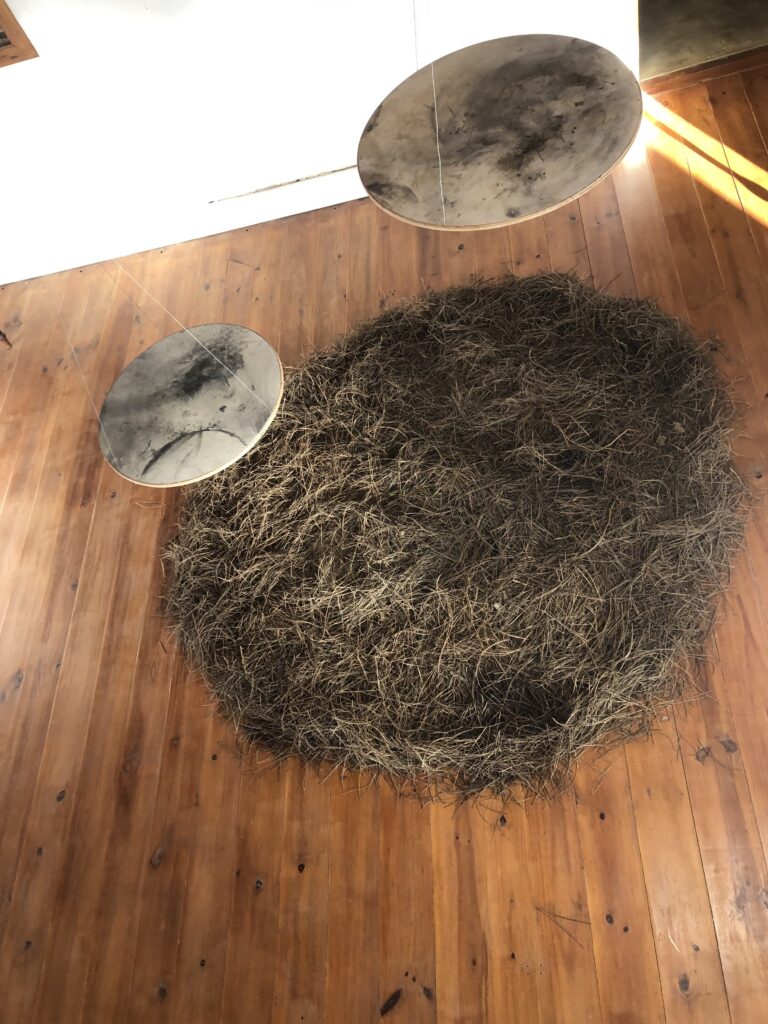
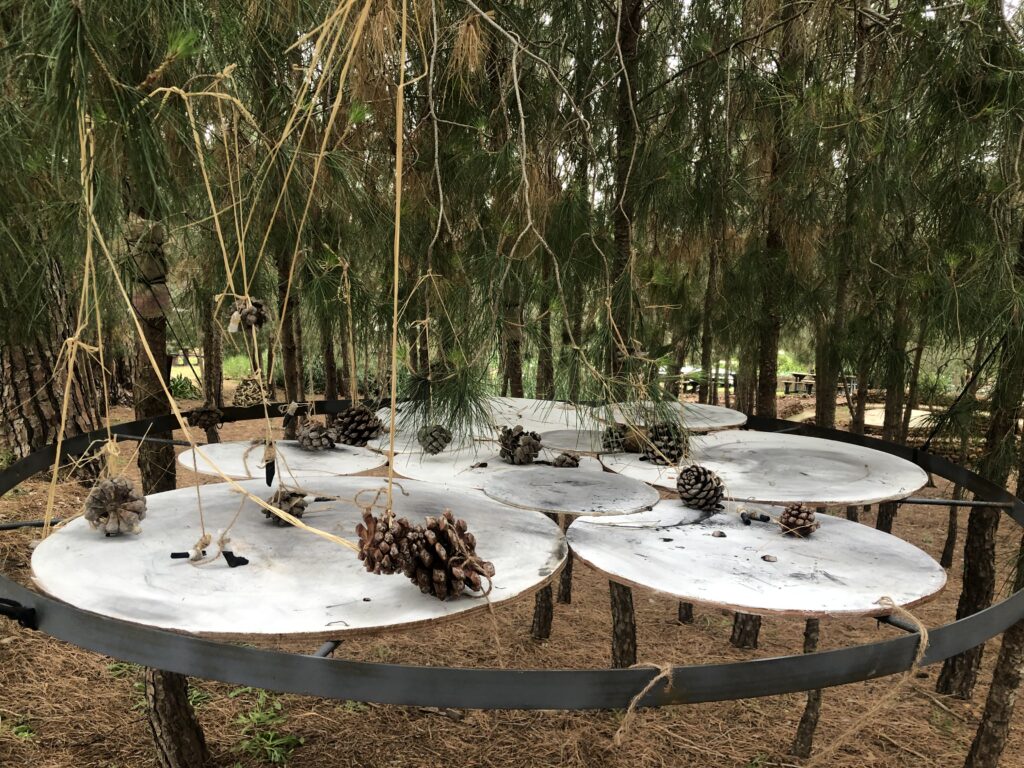
This iteration is called Susurrations of the Pines no II (small installation for a small space)
When I moved the wind drawings from their birthplace—the kinetic, wild space between the trees—into a controlled hanging space, I was not just exhibiting them in a new space; I was translating them. It tells a story of my work connecting with concepts of gravity, concealment, and the “shared experiential space” that offer a profound framework for how the wind drawings will continue to generate meaning once they are detached from the machine. (For my research on this, I looked at other artists and the work of a collaboration, Materialistern was very inspiring to learn from)
Concealing the machine:
These works were made in a pine forest on the Kloovenburg Wine/Olive farm, Riebeek Kasteel. They are now removed from the site.
In the woods, the drawing machine was the “body”, and the wind was the “force.” It was a public, outdoor performance of nature.
- The Act of Removal: When you take the drawings away from the trees and the machine, you are performing an act of concealment. The viewer no longer sees the branches swaying or hears the creaking of the wind and the movement of the steel rings between the trees. Even the weather is now concealed. (I do have documentation of that)
- The Intensity of Absence: By concealing the how, I can now focus all the intensity on the what. The drawing becomes a sacred relic. The “outside” (the wild, chaotic wind) is now folded “inside” (the quiet gallery). The paper holds the memory of a storm or a breeze, trapped in ink or graphite lines, making the invisible wind visible and contained.
Sharing material gravity – the ghost of physical force
- The Trace of Past Force: On the wooden surface of the drawings, the lines are a record of physical force—tension, release, movement, and resistance.
- The Submission to Present Gravity: Once I hung these drawings in a different space, they are no longer being pulled and marked by the machine. Instead, they surrender to the quiet gravity of the room. They drape, curve, or flutter. The artwork is caught in a beautiful duality: it displays a frozen image of past dynamic energy (the wind), while physically responding to present quiet forces (gravity and drafts in the new space).
Becoming a vulnerable ‘counter-body’
Lammert talks about the artwork transforming into a “counter-image of the physical body.”
- Wooden circles as Skin: Suspended in the air, the hanging drawings become incredibly vulnerable. Without the rigid support of a frame, they are separate, fragile works. They react to the environment.
- The Viewer’s Shared Space: When a viewer walks into the room, their physical body displacing the air will cause your hanging drawings to gently sway or shiver. The viewer’s breath literally interacts with the record of the wind’s breath. The artwork becomes a counter-body—vulnerable, breathing, and completely dependent on the shared space it occupies with the human beings looking at it.
By removing the drawings from the trees, I did not stop the process. I simply changed the actor. In the forest, the wind was the animator; in the gallery, the viewer’s presence and the room’s quiet physics become the new wind.
I will be asking myself a few questions in this regard:
1. The Object as a “Translator”
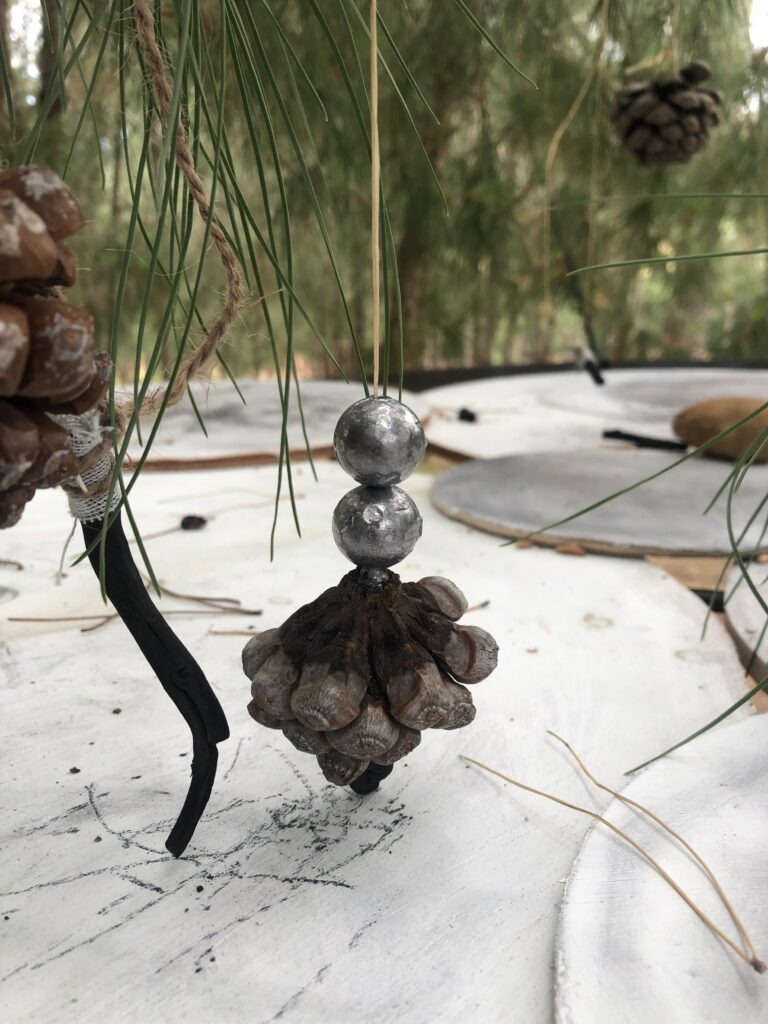
I want to look at what happens between function and meaning. In a gallery space or any exhibition space, for that matter, which is full of static objects (like ceramics and assemblage), a drawing apparatus is a highly active object. Its “function” is mechanical—it is built to hold a pen, swing, pivot, or catch the breeze. But its “meaning” is about surrendering control to the environment. The delicate charcoal and ink writing tools became quite fragile in the wind, which ‘controlled’ their performance whilst making these drawings.
- The Physicality of the Machine: Think about the materials of the drawing mechanism itself. Is it delicate and fragile, mimicking the air? Or is it made of heavy, rustic, or found materials that contrast with the lightness of the wind?
- The “Performance” of the Object: Even if there is no wind inside the gallery, the apparatus itself can be displayed. It becomes a quiet monument to a past movement—like a sleeping instrument. It sits “between use and display” because while it is currently still, it holds the potential for motion.
2. Capturing the “Invisible Presence” (Between Memory and Material)
The wind is invisible, but its path is not. These drawings are the physical proof of something that cannot be seen.
- The Residue of Time: A wind drawing is essentially a time-lapse of weather. The work displays the “material memory” of a specific day, hour, or season.
- Site-Specificity: Where did the wind blow? The apparatus was set up on Kloovenburg Farm, Riebeek Kasteel. Letting the viewer know where and when the invisible force occurred adds a deep layer of memory to the final mark – I have daily logsheets
- The Trace of the Elements: These drawings can also hang outdoors. Will the work continue to catch traces of dust, rain, or humidity? Those physical “contaminations” are beautiful proofs of the air’s presence.
3. Creating the “Space Between” in the Gallery
This installation can act as the “breath”.
- The Contrast of Weight: Think of the contrast between a heavy, fired-clay vessel (born of earth and fire) and these drawings (born of air and movement). I am bringing the sky into a room of clay.
- The Installation Layout: I hope the way the work is hung will emphasise transience. For instance, rather than framing the circles behind heavy glass (which might “contain” it too much), the drawings should be suspended, lightly moving with the air currents created by visitors walking past. This makes the gallery’s own “invisible presence” part of the work.
- I have recorded sound clips which can be used with the work.
These images were taken inside my own home to illustrate a small space as an installation area for the work. Here I worked with an area of 200 x 200x 200 cm. The work is suspended on a thin steel cable, and fresh pine needles were placed under the work. It also has accompanying logsheets made during the ‘on-site installation, as well as QR code access to sound recordings at the site.