I want to explore a hybrid and fragmented form of writing about making Walk the Line. My conceptual thinking about walking is based on the idea of it becoming a vessel or bag that holds disparate things together along the way. I like how these things are all like a nest/weaving/contaier, as they look as if they want to come together, or sit together, or keep revealing themselves. I like the idea that walking art feels like my work becomes more socially engaged and relational.
It is important to acknowledge the landowner of Knolfontein farm for allowing me access on his farm to the rail line, as well as others who joined and shared stories.
By taking a 13-meter scroll out of the studio and letting the wind tear it, you are rejecting that rigid control. This asks that my artistic practice recover this tradition by treating the walk as a collaborative performance among the human body, the physical terrain, and the site’s historical memory. I hope to show that, by amplifying the walk, it isn’t about building better paved pathways; it is about cultivating a deep, uninterrupted “quality of attention” to the hidden stories underfoot.
Walking this line is not an exercise in drawing conclusions, but an act of listening to materials. The steel knows the weight of the harvest and the weight of exclusion. The Renosterveld knows how to bloom in the cracks of decommissioned iron. The objects carried across the tracks know a home that no longer exists on any map. My role is not to force an image onto this landscape, but to open a vessel wide enough to hold what the land and its people have already remembered.
Four main ‘things’ happened in my practice during the making of Walk the Line, which happened from March to June 2026.
- Slow making
Through repetition and return, I followed a slow and repetitive act.
My practice was a “regular pilgrimage”—returning to the same decommissioned line at the entrance of our farm over and over again.
I would almost think the walk was linear along a line, but due to taking it slow, stopping, listening, touching, rubbing, drawing, an almost organic sprawl was part of this slower process. Walking would mean starting at random points, but following the same line, staying with the route between the station and our farm gate.
I learned the slow, patient work of remembering a defunct rural lifeline, preserving its local patterns, and honouring the history of the Swartland before it gets swallowed by the speed of the outside world.
Every step became a return to the earth.
I foraged materials along the tracks by sketching and collecting.
I had to stop, sit, bend, and crawl over to make a rubbing and look at what was unfolding during the walk.
I did not walk at the speed of the train. I am happy and actually choose to walk slowly, choosing to move at my pace, became an intentional political and creative act of resistance, outside my studio!
- The work became a lived experience
I felt the rail and ballast under my feet, touched the plants, saw the weeds and Renosterveld reclaiming the gravel and hiding the lines. I heard birdsong, the movement of the grasses, the bat-eared foxes running away and learned that when I walk, it engages all my senses. It was about a sensory process of moving to get to making my art.
I ‘met’ the non-human along the rail – sounds, tracks, saw them running away.
By working with indexical traces and rubbing/frottage, my body and hands were able to extract a physical print of history that is becoming more hidden by the day.
I was aware that this path is defined by my emotions, my energy, and my intentions. Walking actively transforms abstract space into a meaningful place. As makers, we aren’t just moving through a landscape; our movement is literally mapping and giving meaning to it.
I made contact with people in the community who experience the rail, either working for the Railway system or farming or living alongside – memories were shared.
I became aware that the railway line is not merely infrastructure; it is part of the living history which alos include displacement and segregation. Under the Group Areas Act, forced relocation and railway networks were weaponised as strict physical barriers to keep communities structurally separated. Across these tracks, Esterhof was intentionally created—a Coloured community severed from the rest of the town of Riebeek Kasteel. In Riebeek West, the geography tells the same story: the colored community is relegated alongside the rail and below the main road, an enduring architecture of separation.
- The quality of attention became elevated
By taking a 11+-meter scroll out of the studio and letting the wind tear it, I rejected that rigid control which traditional landscape design (art?) often struggles with because material specifications and safety regulations treat walking space as something to be neatly manicured, controlled, and standardised. My artistic practice recovers this tradition by treating the walk as a collaborative performance among the human body, the physical terrain, and the site’s historical memory. I think this shows that amplifying the walk isn’t about building better paved pathways; it is about cultivating a deep, uninterrupted “quality of attention” to the hidden stories underfoot.
- The work shares an honest portrayal of making
I kept returning to specific areas along the rail.
I began again when I lost track of place.
The scroll got damaged – tears and holes.
I could not work outside when it was windy – I used the back of my car as an outside studio to continue with the making.
I made peace with not being able to control all by allowing mistakes to happen and show up in the work.
I misrepresented the place in terms of distance walked, versus the place where it happened.
The finished work, hung at 2m from the floor
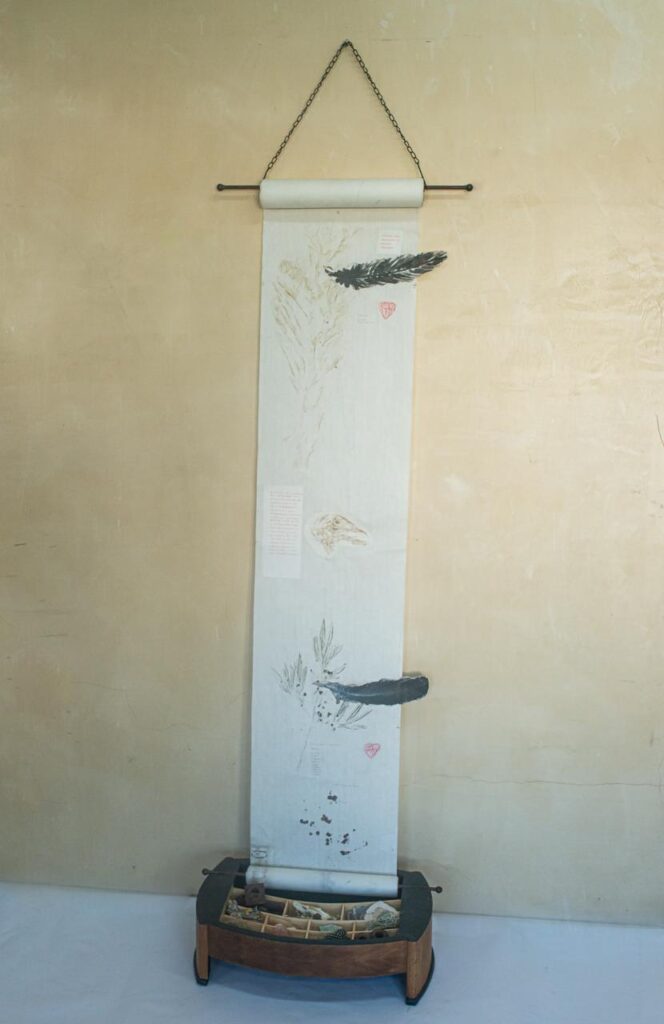
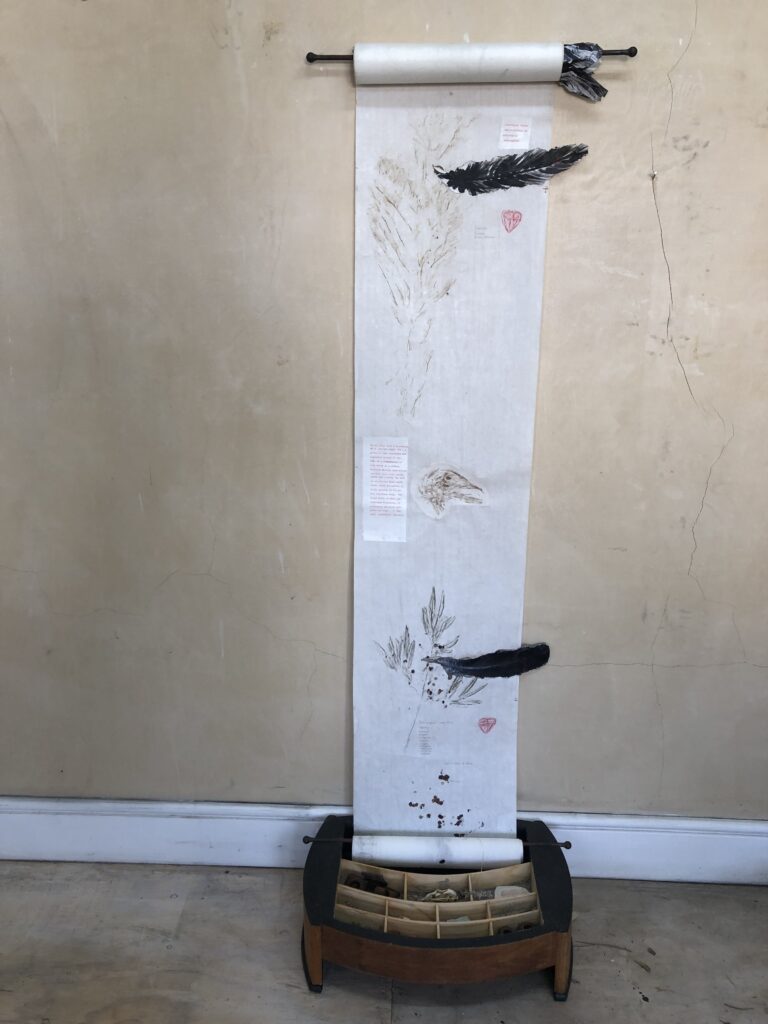
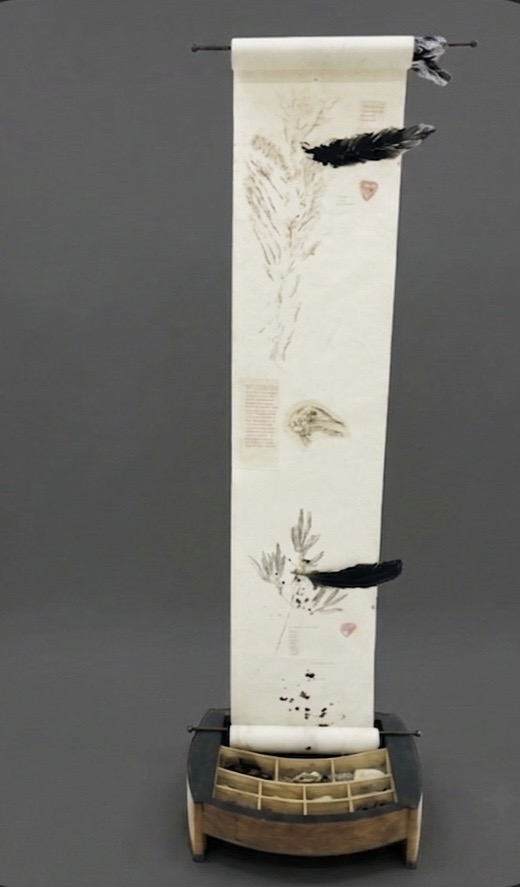
A cleaned up image, I used Gemini Ai to change the background colour to a dark grey.
I feel I am ready to share my writings:
This blog post is an attempt to bridge the theoretical and the practical. By showing the messy realities—the wind, the car-studio, the physical strain—I present the heavy socio-political narrative in the anthology with a tangible, real-world foundation. It shows that my art isn’t just about a site; it is actively born from the physical friction of that site.