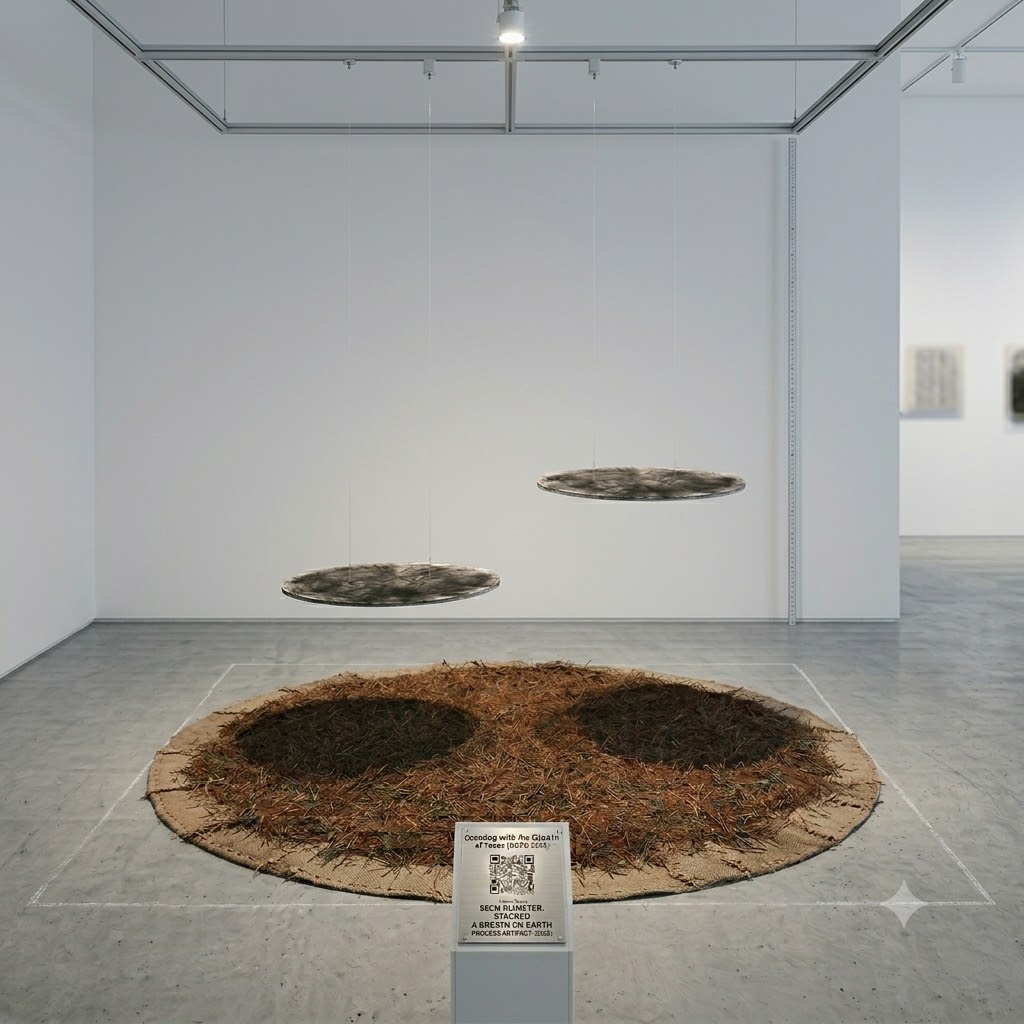
An AI-created image.
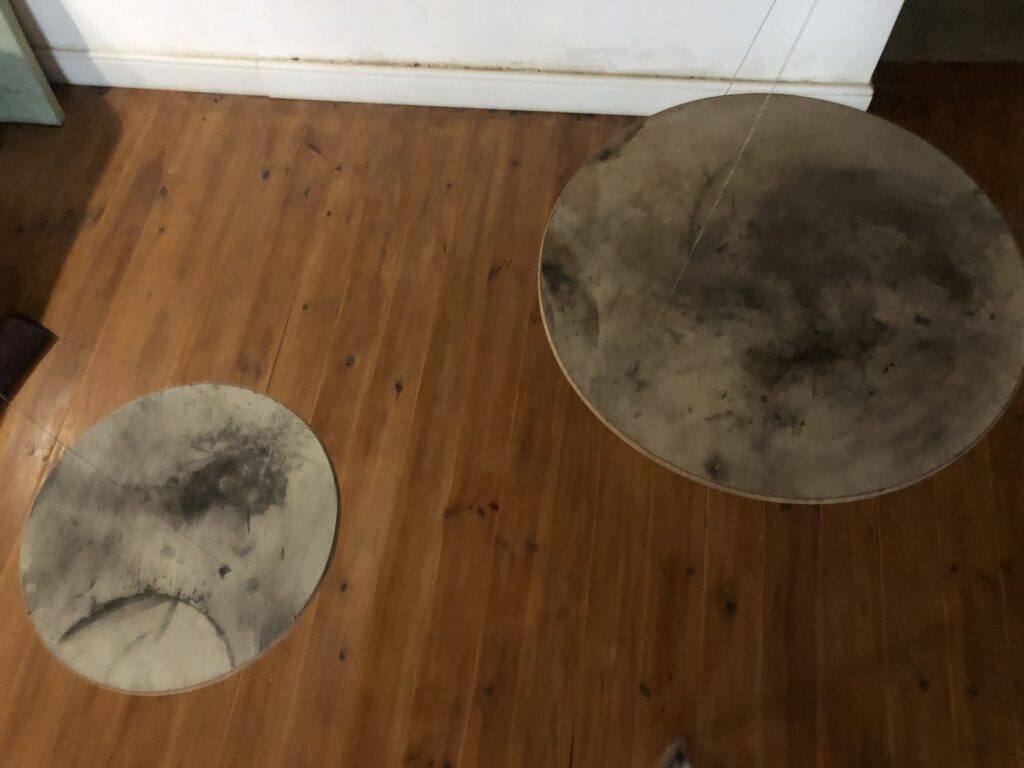
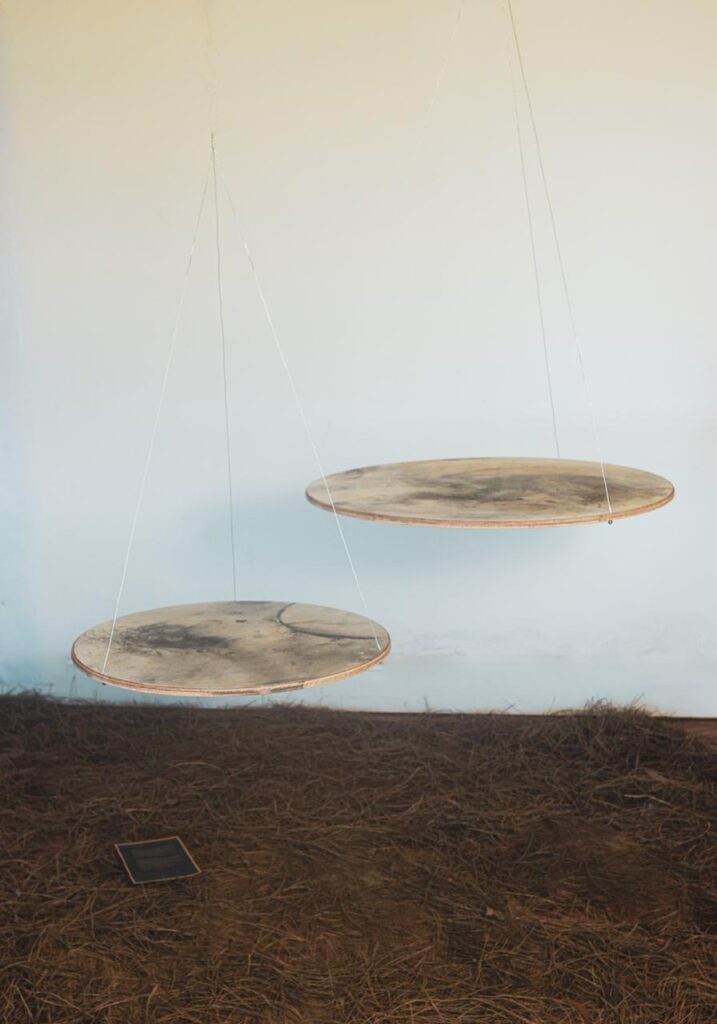
The above image of a small-scale installation is very close to how the work was done in a pine forest. The core of the work is an ecological collaboration showing smudges, faint lines, and deep charcoal burns, which serve as a literal indexical record of the Swartland’s atmospheric energy between late 2025 and January 2026. The wind is the artist; I am the curator, the witness, and the archivist. By leaving the drawings completely raw and untouched, while sanding the edges and considering painting the backs a velvety matte black, I want to create tension. The viewer will see a meticulously cared-for, professional gallery object that holds a wild, untamed, and completely honest natural history within it.
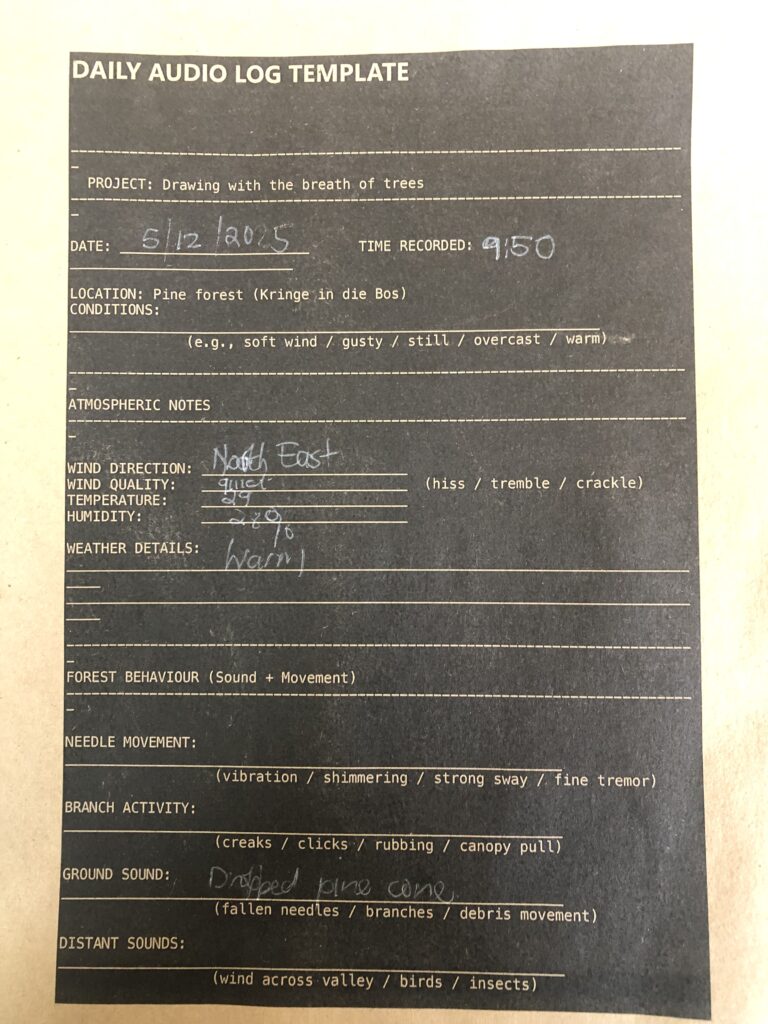
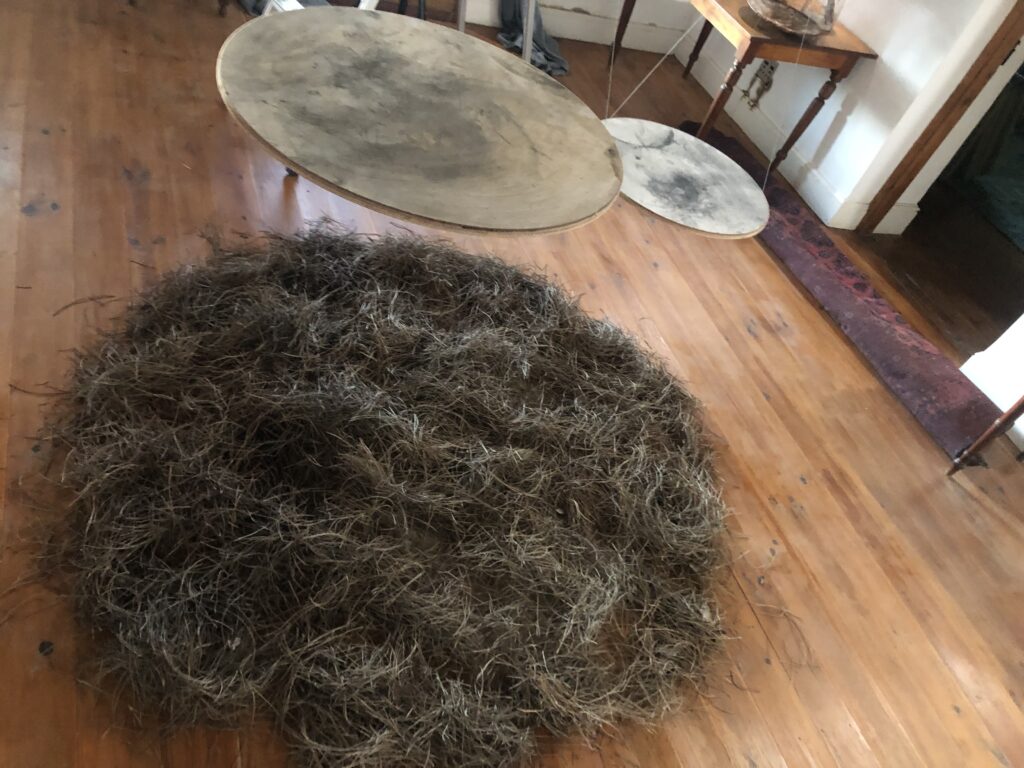
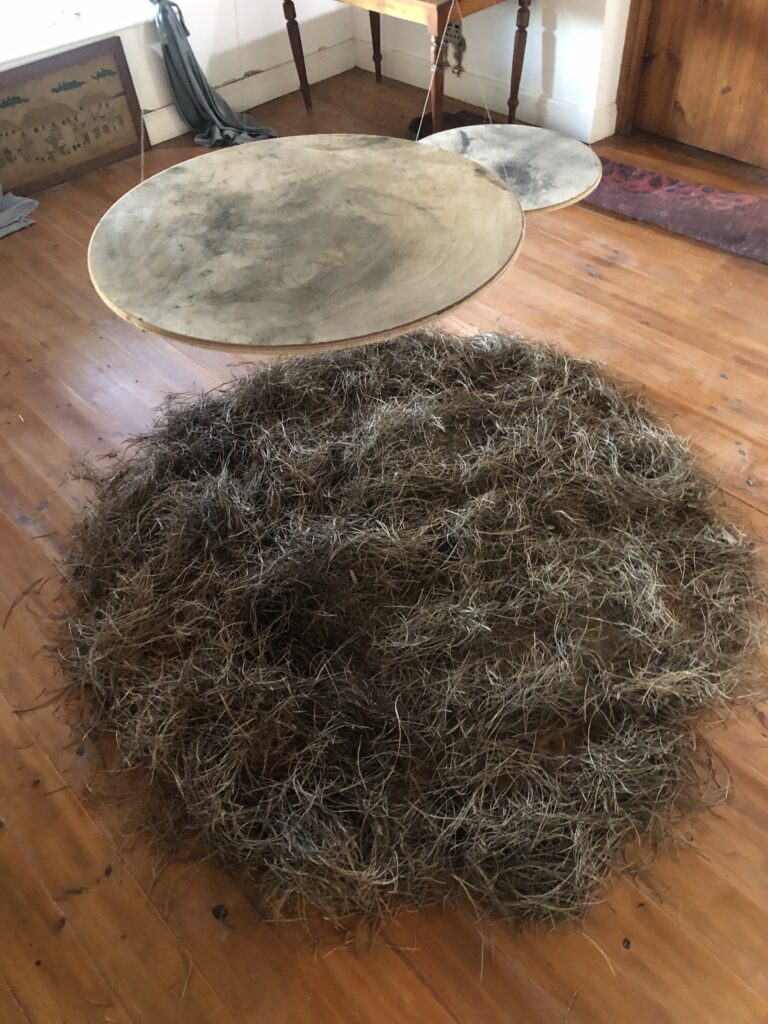
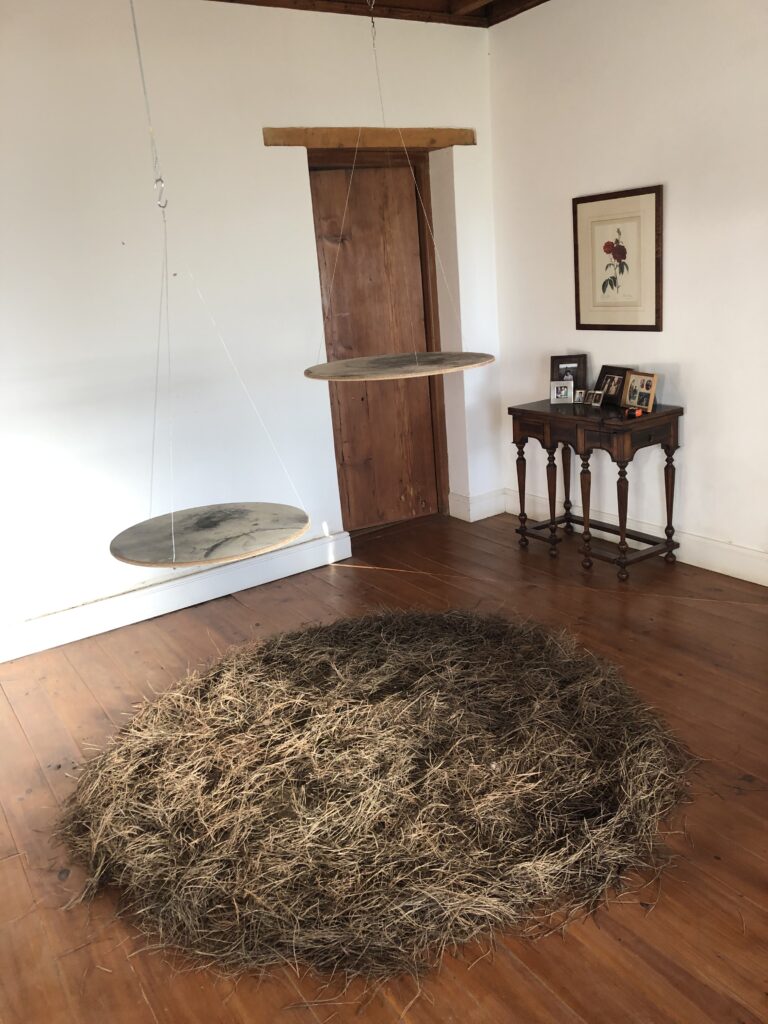
To install the work, it needs to hang within a 200 x 200 x 200 area allowed. (specific site consideration) The two circular drawings will hang from the ceiling, and the floor underneath will be covered with pine needles, also in a circular form. A sound clip using a QR code will be on the plinth next to the work. I will also place the daily log sheets there.
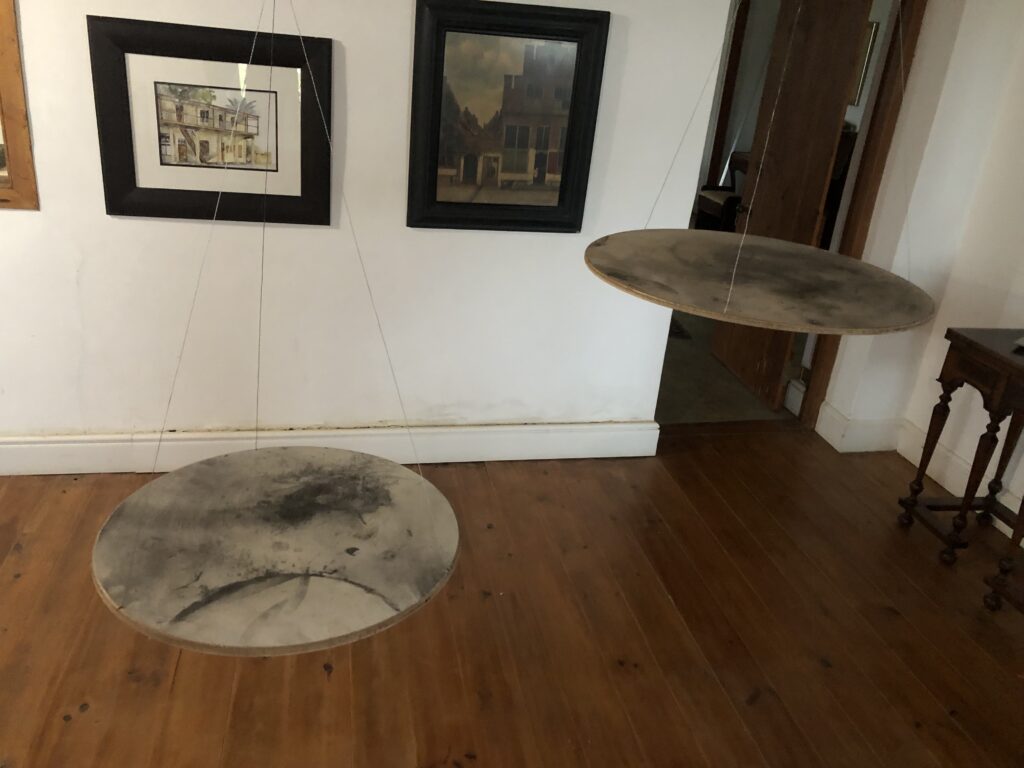
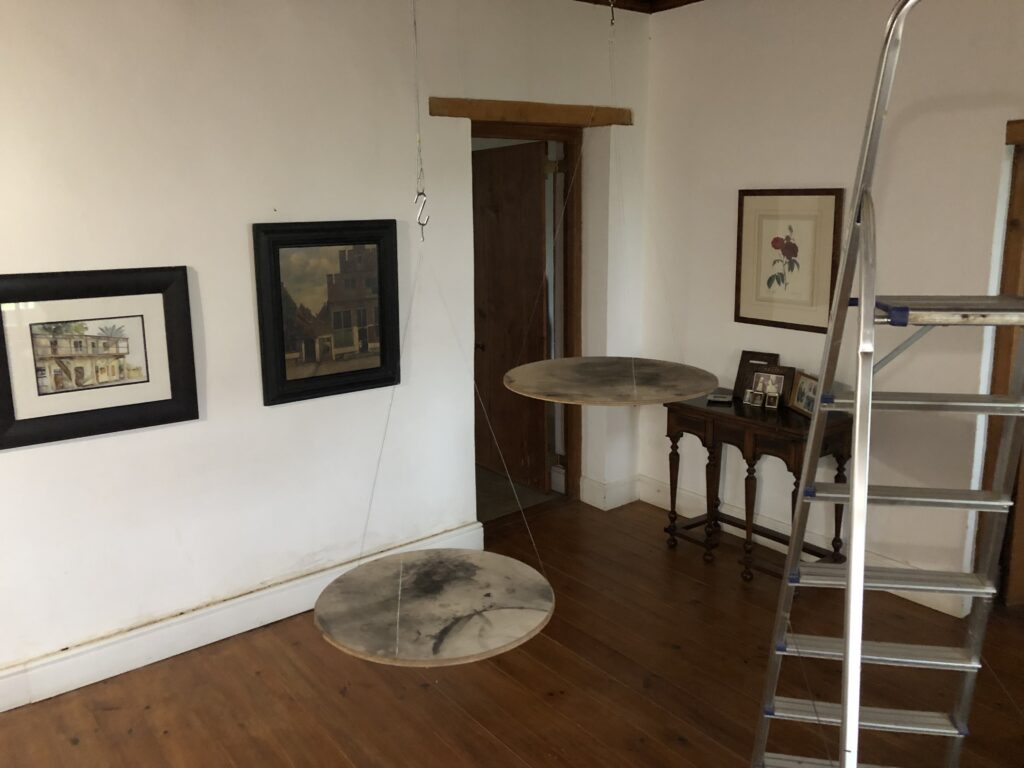
To install the horizontal circles, I will tie them to overhead lighting tracks or the structural ceiling grid with clear line. Because the ceiling is high, the clear monofilament lines will connect with steel cable which should have plenty of vertical space to disappear into the upper shadows, making the 69 cm-and smaller disc genuinely look like it is floating in mid-air.
The discs will hang on a clear monofilament line rated as 35.2lbs (approx. 16kg ) breaking strain. I will work with a 3-point monofilament rigging bridle that attaches directly to the discs and meets at an apex knot (where these 3 lines join together) and sits below the 200cm mark from the floor.
The bigger disk will be the anchor and hang at 170cm from the floor and the smaller disc at 110cm from the floor.
To install
The three clear lines should meet at a knot of 25cm above the bigger (top) disc, which means the apex is at 195cm.
The smaller disk will be at 110cm.
Ideas for my Artist Statement
The wind is not an empty force; it is a collaborator. It moves through the landscape, leaves its trace, and bends the world to its rhythm. In this work, I am not the master of the mark—I am a listener, creating a quiet space where a forest can write its own biography.
Situated within a compact two-meter cube, this installation is a displaced fragment of Kringe in die Bos, a grove of Mediterranean Stone Pines on a working Swartland farm. These trees are not native to the Western Cape. They carry a heavy, complex history of colonial planting, monoculture, and human intervention. Yet, beneath their canopy, they breathe, shed, and live. Rather than judging this landscape from a distance, this project is an act of slow attunement—a daily practice of care within its quiet residue.
The installation stretches vertically to mimic the architecture of the forest itself. Suspended in mid-air are two circular drawing boards, lifted from the forest floor where they sat beneath the trees. Upon their surfaces, charcoal, ink, water,and plant/animal materials have recorded the invisible choreography of the wind, the deep vibrations of swaying trunks, and the accidental spray of the farm’s irrigation lines.
Directly beneath these floating horizons lies a circular carpet of fallen pine needles, grounding the sky to the scented, heavy reality of the earth. Between the two sits a plinth holding my handwritten daily log sheets and the recorded rustle of the canopy.
This space is an invitation to step into a shared conversation. The drawings are entirely reactive; even now, the subtle air currents created by your movement in the gallery cause the suspended discs to sway. Here, the forest is released from being mere scenery. It is recognised for what it truly is: an active witness, a breather, and a co-maker of the world we share.

OR
This is a site-responsive installation that condenses a complex South African landscape into a quiet, two-meter sanctuary, but can also be envisioned as a bigger, more immersive installation, as I have 12 circular boards in this body of work.
Working with naturalised Mediterranean Stone Pines in the Swartland—a forest deeply marked by histories of colonial land-use—I set up an analogue drawing apparatus to listen rather than to judge. Suspended at eye level are two (12) circular boards where charcoal and ink have recorded the invisible gestures of the wind, the tremors of the canopy, and the accidental mist of the farm’s sprinklers. Below them, a mirrored circle of fallen pine needles anchors these floating skies to the earth.
Beside a folder of handwritten field logs, a QR code invites you to stream the audio archive of the forest’s breath. By compressing the vertical space of the forest into the gallery, the installation functions as a living correspondence. It is a threshold where human intention and environmental agency meet, proving that the land is not passive scenery but an active witness and a co-author of its own memory.
Final Presentation Checklist for a gallery Setup:
- Lighting: Ensure the gallery spotlight hits the two hanging boards from an angle that casts their shadows—and the textures of the marks—directly onto the pine needles below. This visually binds the sky to the earth.
- The Log Sheets: Display the log sheets on the plinth in a way that invites touch. I want the judges/viewers to feel the paper I took into the field. It emphasises my daily practice of “attunement and care.”
- The Sound: Make sure the audio loop is clear and unhurried. It should slow the viewer down, matching the meditative pace of my blog posts.
More notes on the work:
The installation was hung on 24 November 2025. Daily visits were conducted during weekdays, and a log sheet and a notebook were kept. The first images and sound recording were shared on my Instagram and Facebook accounts on 30 November 2026. I left the site on its own when I went on a family holiday from 11 December till end of December 2025. The plan was to dismantle the installation in early January, as it was the school holidays and visitors were visiting the site.
After dismanteling the site I picked up pieces of one of the drawings – it must have came loose from the steel circle and was damaged to the extend that it could be seen as useless. I considered fixing it, but this should be more an act of care.
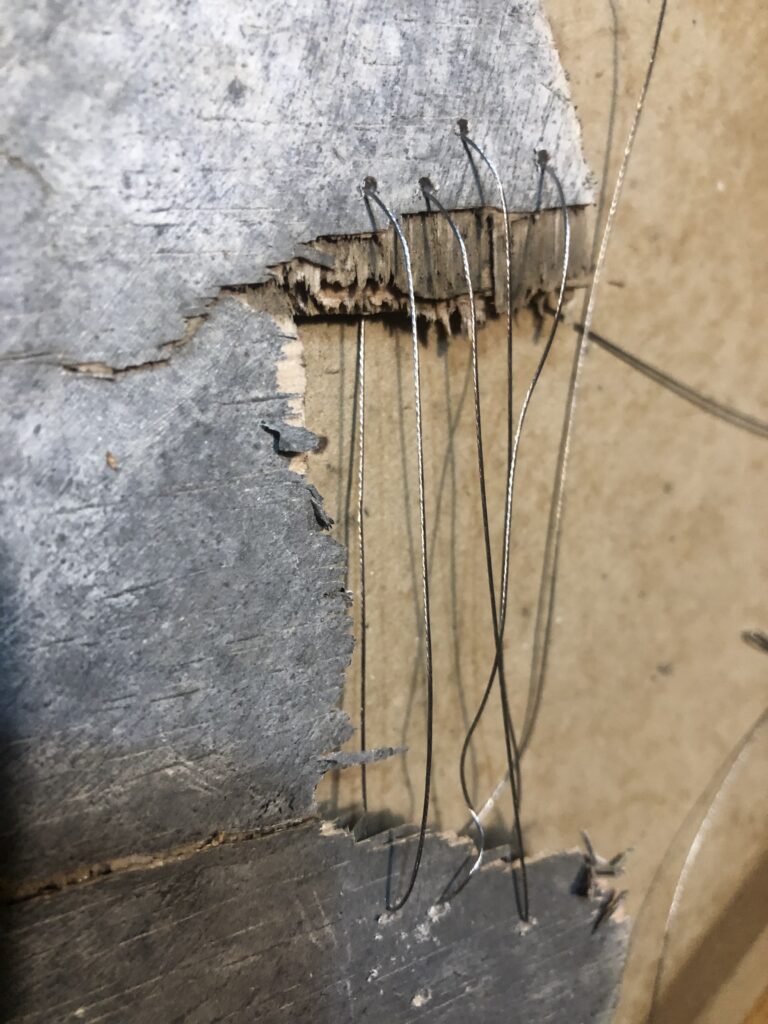
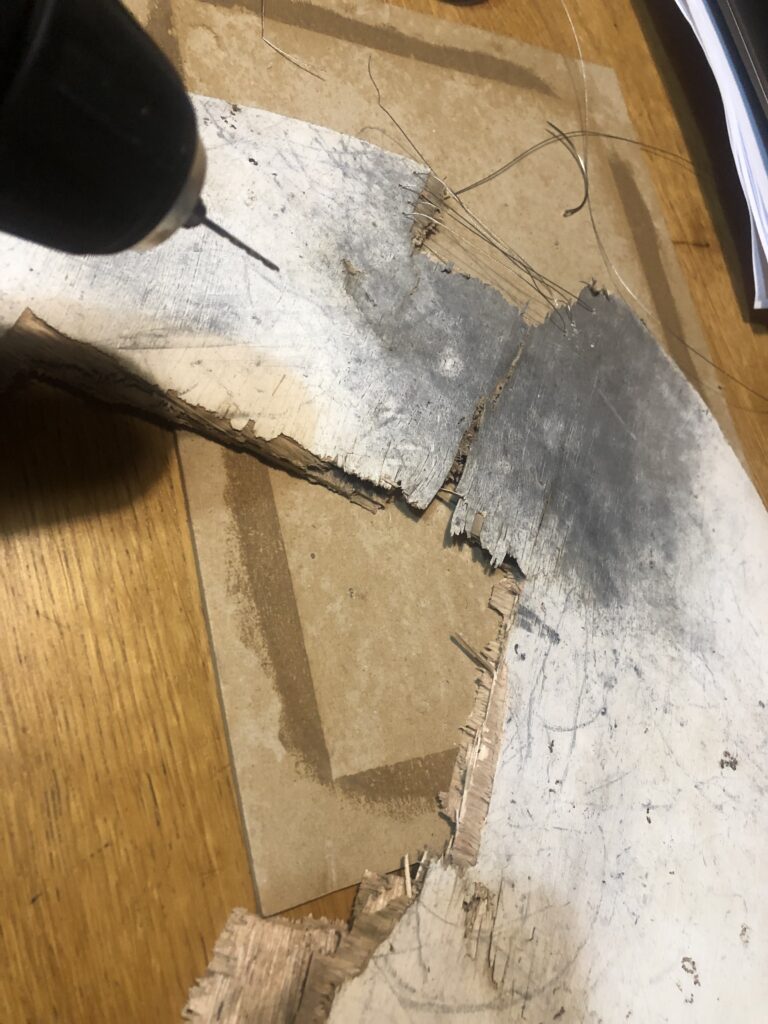
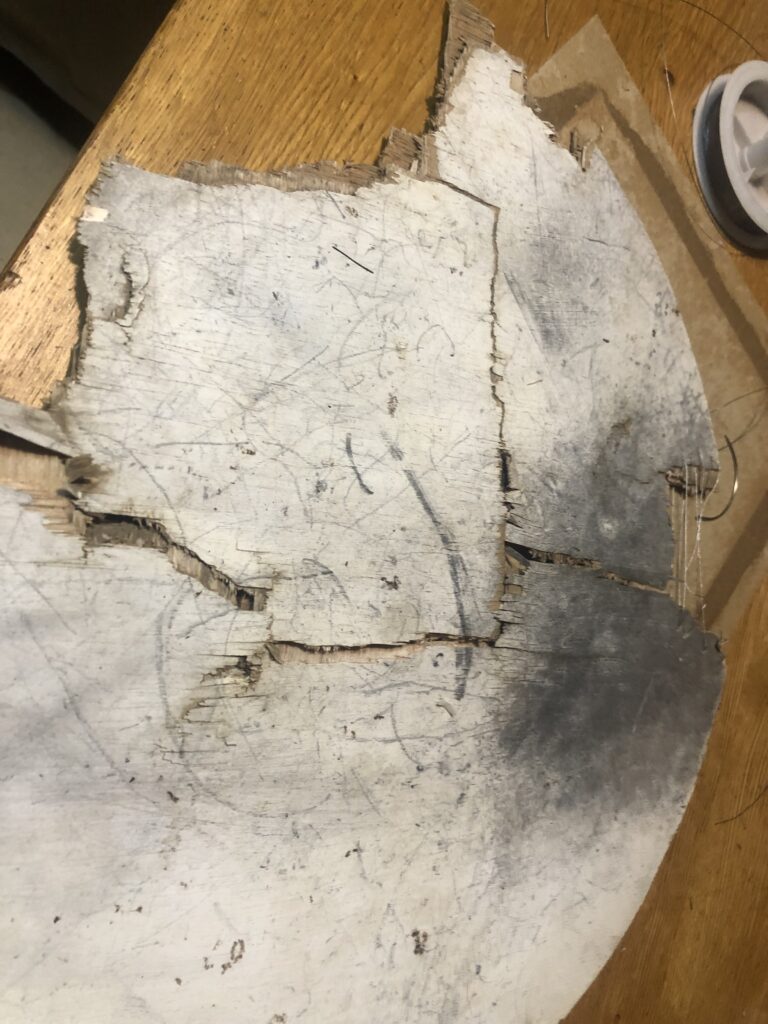
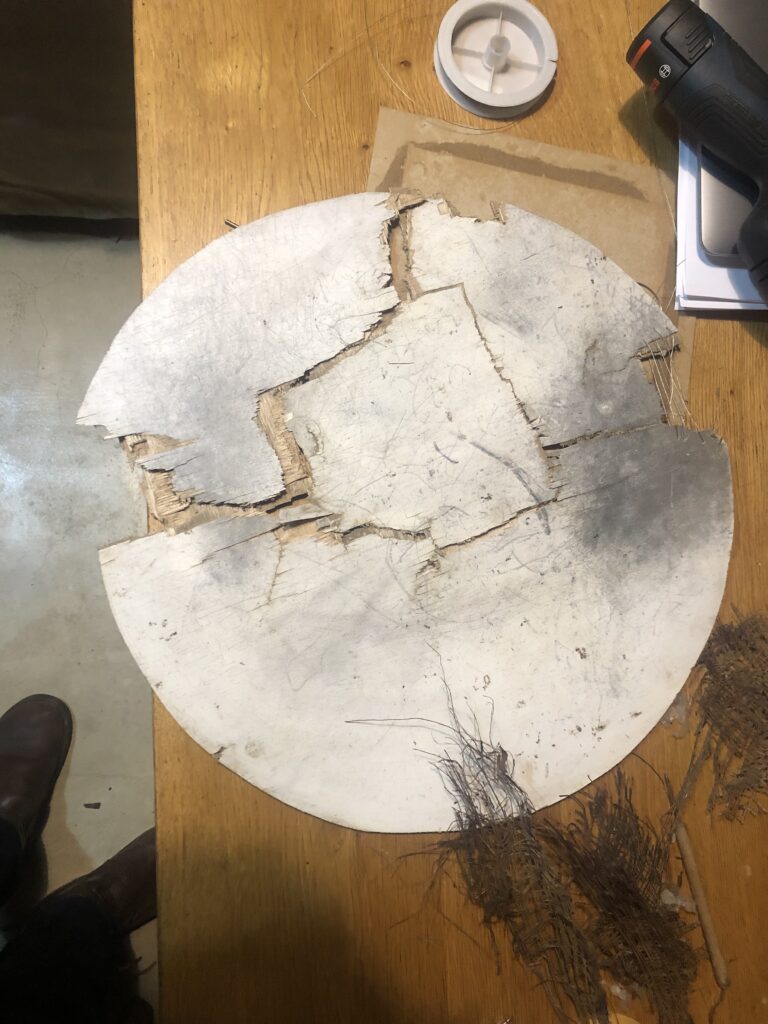
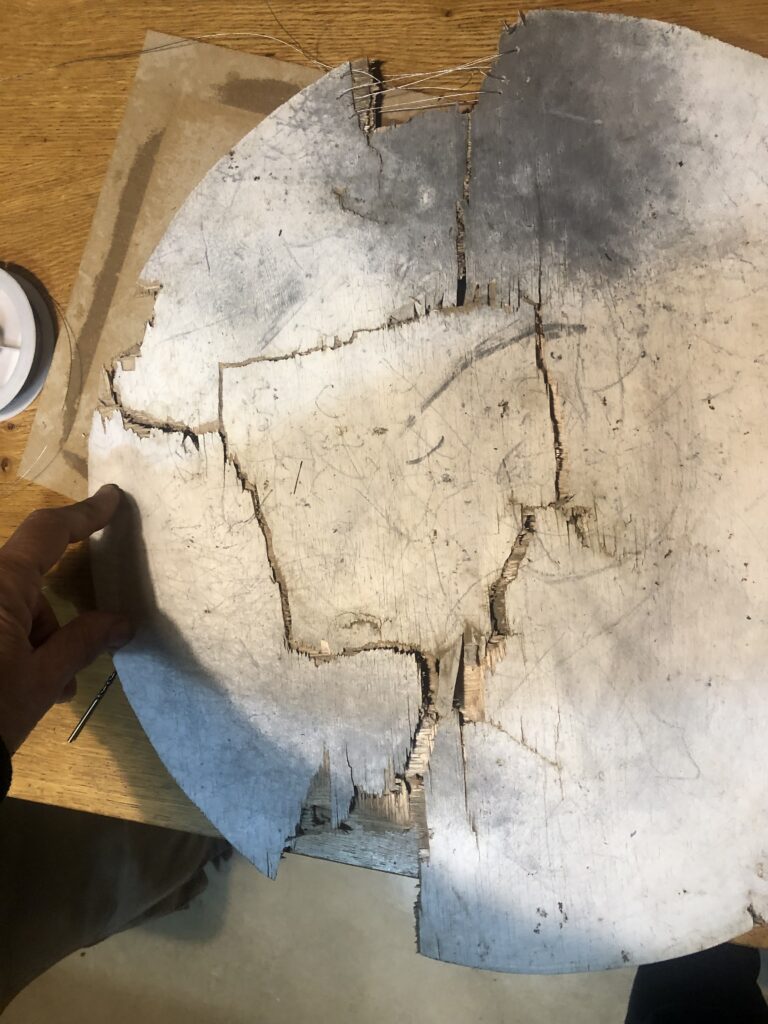
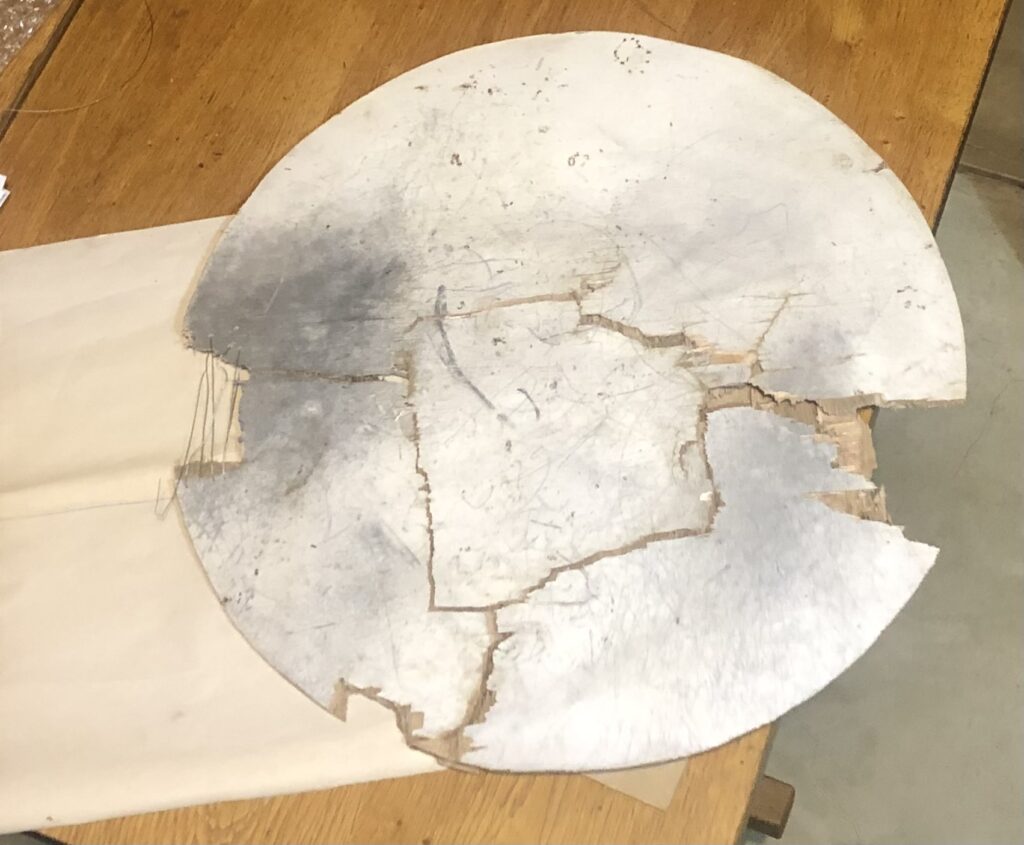
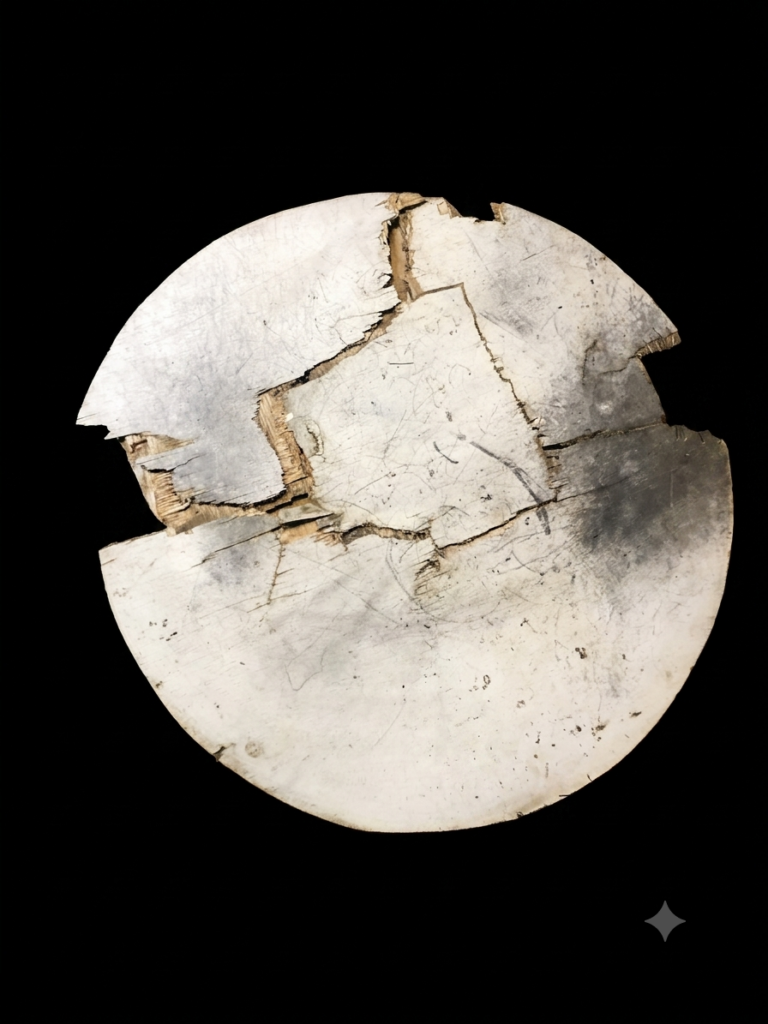
I am exploring the possibilities – drilling small holes into the fragments and ‘stitching’ them loosely together with a Silver Tiger Tall cable.
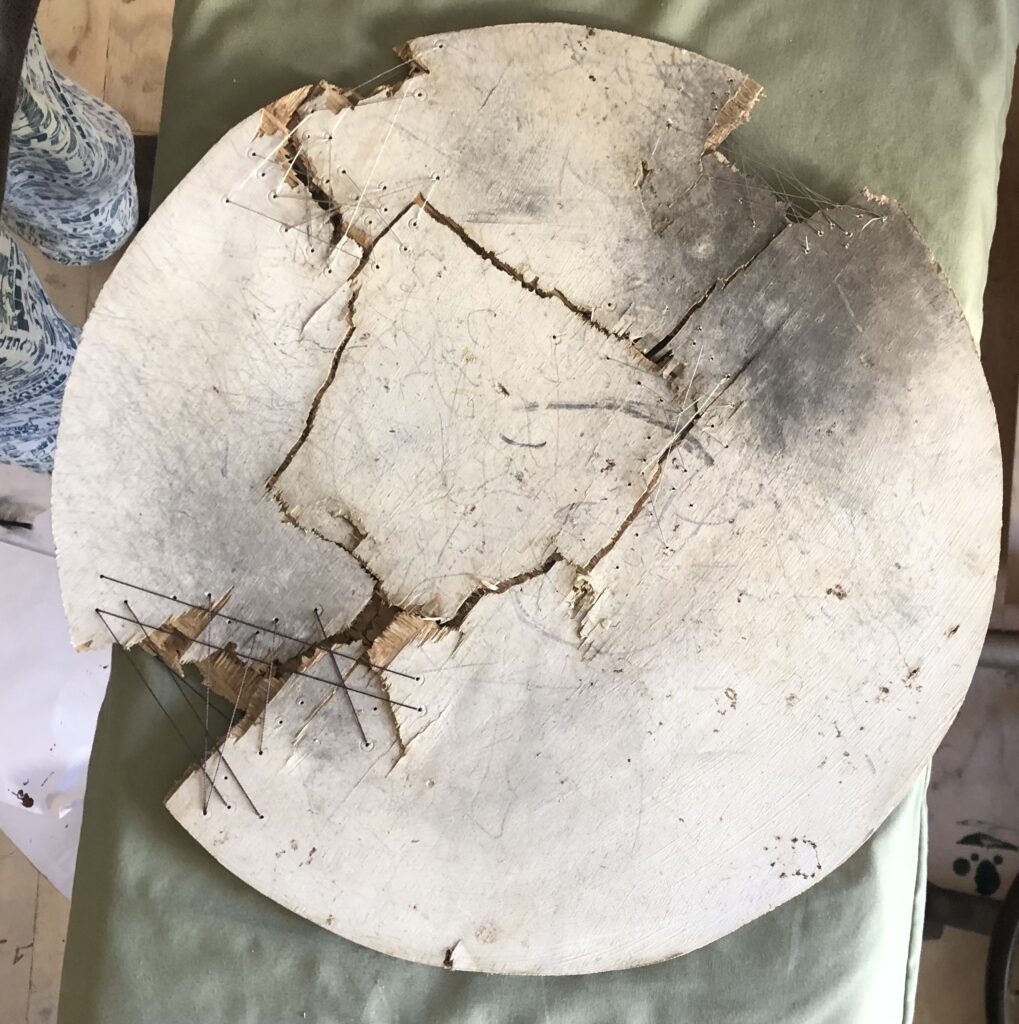
Will the repaired piece, alongside the other 11 circles, recontextualise the work?
The circles represent the wind caught in a moment of pure, fluid movement; the repaired one represents the wind as an active, physical force capable of disruption—and my response to that disruption.
By leaving the cracks open and binding the splinters with thread, I want to state that true care doesn’t mean erasing/covering a wound or pretending it never happened. It means holding the pieces together so they can continue to exist in their new, altered form.
REFLECTION
Somehow, part of this installation is showing me the open-ended continuation of the forest, and that I was just passing as a witness. The drawings happen as the trees are still growing and the forest is there. I had a moment there to share with viewers, but now in a different space. I do like the idea of bringing the smell of the forest, using pine needles.
Sometimes work needs a little room to breathe before it can become something new.