I saw this quote this morning: ‘East, West, South or North, no matter what your destination, just be sure to make every journey a journey within. If you travel within, you will traverse the whole wide world and beyond. ‘ Shams Tabrizi
Walking as an act of witness has become central to my life here, as I live in and traverse the remnant patches of the Renosterveld. In the Renosterveld, those gifts are often small and tucked away—a tiny plant hidden in a rock crevice or a fragrant shrub alongside the road. Receiving those gifts requires: the strolling, the stopping, and the quiet listening.
It brings me right back to Shams Tabrizi. By accepting these gifts from the earth, my journey within becomes richer. I am not just walking across a piece of land; I am allowing the spirit of that land to move through me. This journey becomes much easier when the physical body is in motion. When you walk, the landscape changes around you, but your internal dialogue remains steady. Eventually, the chatter of the day fades away, leaving room for the big questions—or the creative breakthroughs—to surface.
Since it’s late April in the Riebeek Valley, the air is likely starting to turn, and the earth is waiting for the big rains.
Nan Shephard was adamant that “walking came from Africa, from evolution and from necessity, and it went everywhere, usually looking for something”. Nan Shephard (Wanderlust, Chapter 4). I also like to think about walking as it isn’t just a spiritual feeling; there is a biological reason why walking sparks creativity. When you walk, your heart rate increases, pumping more blood and oxygen to the brain. The physical fact that walking requires just enough “peripheral” focus to keep the body busy, which then allows the conscious mind to loosen its grip, makes walking a wonderful experience. One can say that this state often leads to divergent thinking, where the brain starts making unexpected connections that it can’t make while sitting still at a desk.
Recent walks took me to consider how to work with the soul or essence of a thing, and reminded me that I walk to participate in the world. I am not just passing through the world. I view the Renosterveld not as a pristine relic of the past, but as a wounded space—a landscape of contamination where the ancient and the industrial are forced into a new, uneasy intimacy. My work witnesses this ‘reclamation,’ where the Wild Olive stands as a survivor among its uprooted neighbours: the railroad, the wheat, and the vine.”
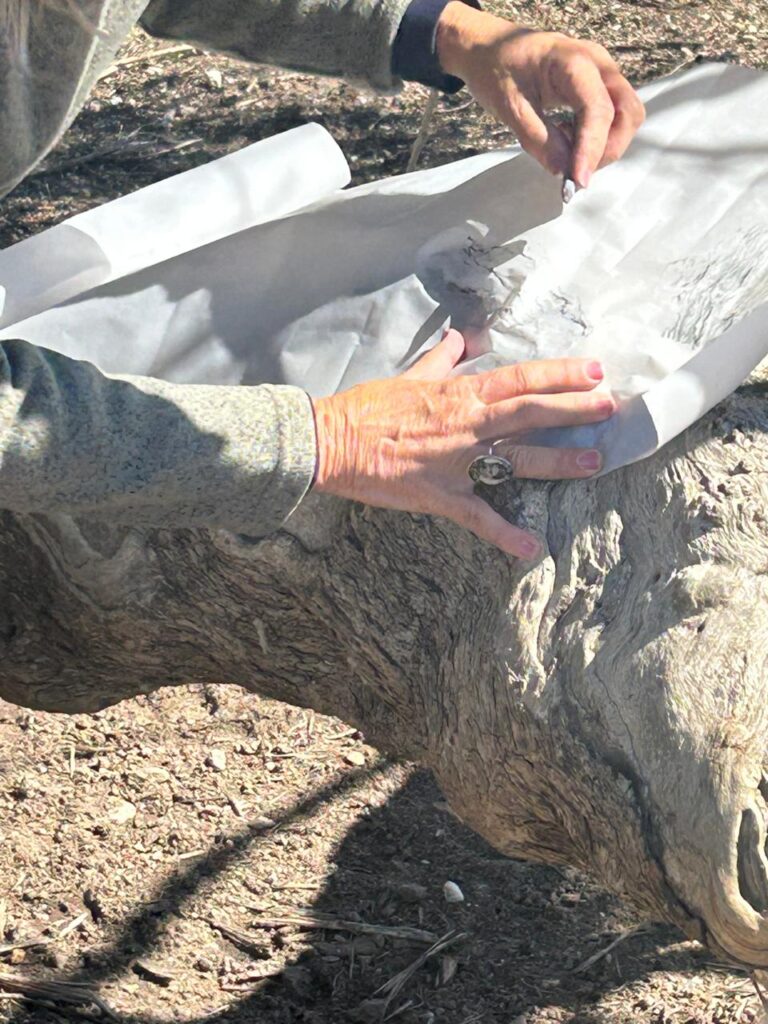
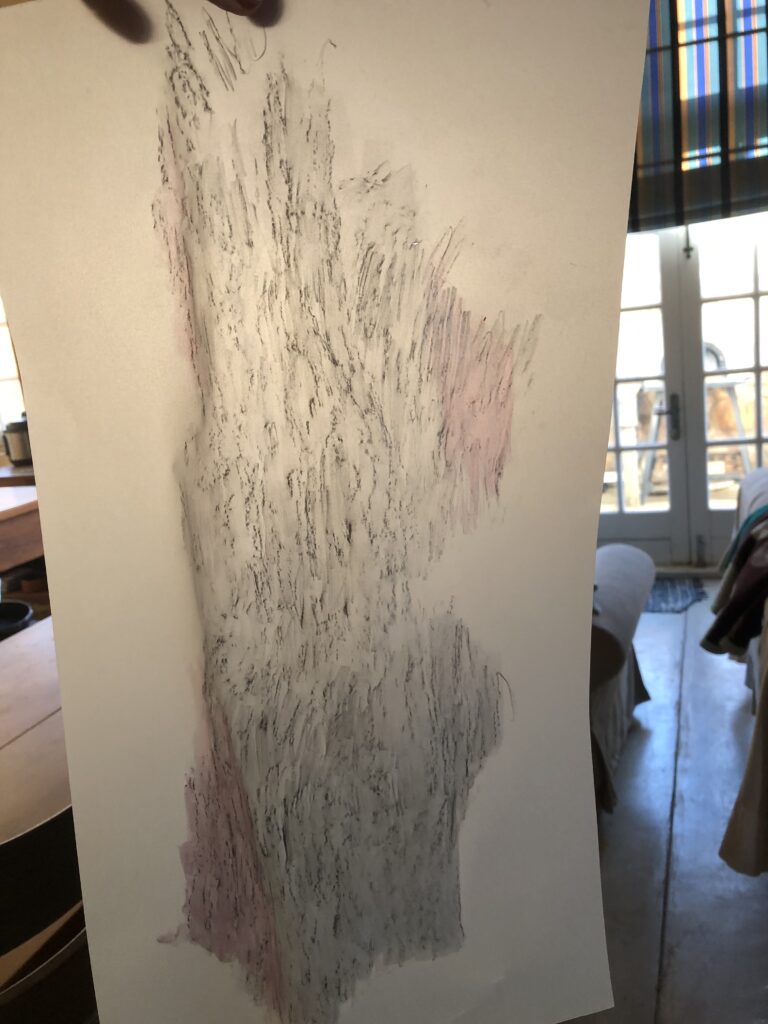
I consult an app when I need identification of a plant, as carrying a field guide becomes too many things I need to take on my walks. This is a great convenience, assisting me in making a plant or tree, seen. The almost ‘uprooted tree made be to re think my idea about the Renosterveld, visualised as the landscape before European arrival, farming and development, but one cannot freeze it in a moment in time, the Renosterveld has changed, seeds travel, and climate is shifting – is it not denying nature its power to move, adapt to survive? ‘My’ tree is no longer in the ground, it is on the ground and in a state of transition, much like a displaced person. I wonder about belonging because of DNA and belonging because of tenacity? Nature is not static.
The words “indigenous” (in English) and “inheems” (in Afrikaans) carry heavy baggage because they imply a “rightful place” or a “purity” of origin. When we apply these terms to plants in a landscape as politically and socially charged as South Africa, the metaphor often collides with the human experience of migration and belonging. Many ecologists are moving toward the term “Autochthonous” (found where it originated) or simply “Endemic” to describe plants, because these are clinical, geographical terms that don’t carry the emotional or moral weight of “home” and “belonging.” In a world of mass human displacement, using “indigenous” as a gold standard of “goodness” can be dangerous. It suggests that
There is a growing movement in science to recognise Novel Ecosystems. These are places where “indigenous” and “introduced” species have lived together for so long that they have formed a new, functional community. In the Riebeek Valley, the Wild Olive (inheems) stands next to the Vineyard (introduced) and the Railroad (industrial). To ignore the vineyard or the rail because they aren’t “inheems” is to ignore the reality of the 2026 landscape.
In a world of mass human displacement, using “indigenous” as a gold standard of “goodness” can be dangerous. It suggests that:
- Origin equals value. (If you aren’t from here, you are worth less.
- Movement is “contamination.” (If a plant or person moves, they “spoil” the purity of the destination.
I might consider a term like “Naturalised Presence” or “Co-inhabitant.” In my planned work of the Wild Olive, where I describe the Wild Olive as an “ancestor.”An ancestor isn’t just someone who was “here first”; an ancestor is someone who laid the foundation for what comes after.
“I view the Renosterveld not as a pristine relic of the past, but as a wounded space—a landscape of contamination where the ancient and the industrial are forced into a new, uneasy intimacy. My work witnesses this ‘reclamation,’ where the Wild Olive stands as a survivor among its uprooted neighbours: the railroad, the wheat, and the vine.
Other ideas I had to consider are ‘anthropocentrism’ versus an ecocentric paradigm. I am so aware of how a worldview shapes so much of one’s thinking. I am convinced of my own change in view that humans are part of nature itself, and not the rulers. My relationship with places I come to recognise I depend on has changed – land, water, forests and oceans are living systems and ask that I live in balance with them, not just simply see them as how I benefit from them.