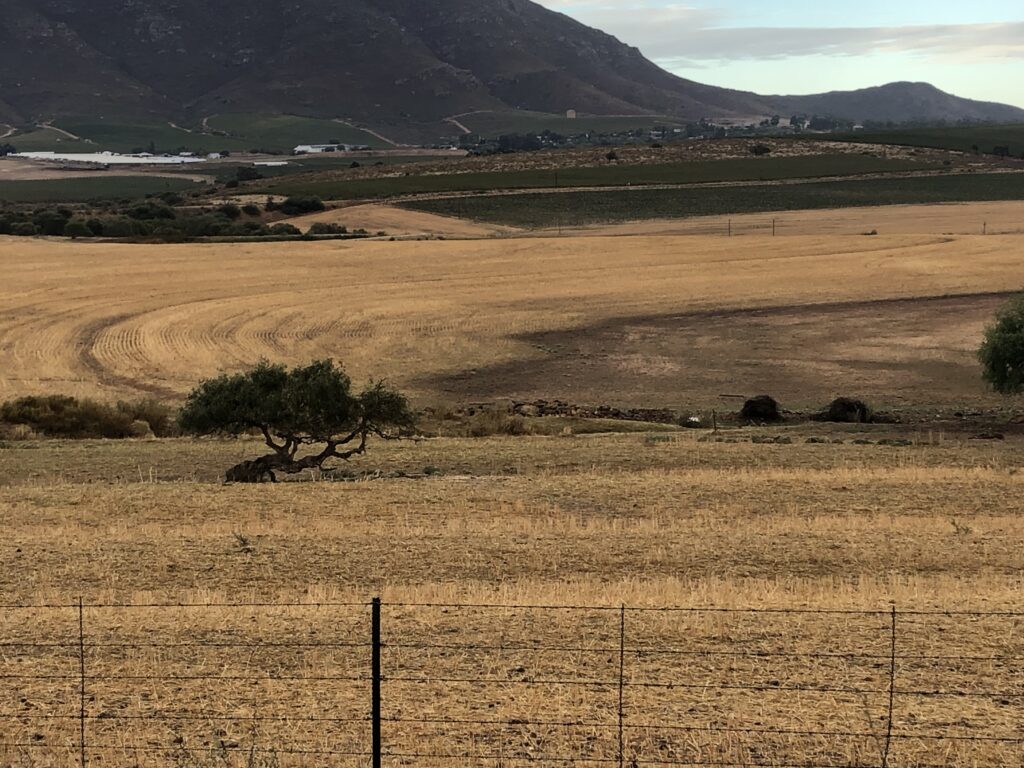
Influenced by the Conceptual and Land Art movements, my practice is rooted in the act of walking. With Silent Protesters, walking became part of a site-specific inquiry. During April and May 2026, I walked an unused railroad line cutting through the Riebeek Valley. This path traverses the transition zone between the fertile valley floor and the rugged slopes of Kasteelberg—a landscape defined by the remnants of the critically endangered Renosterveld and the encroachment of human industry.
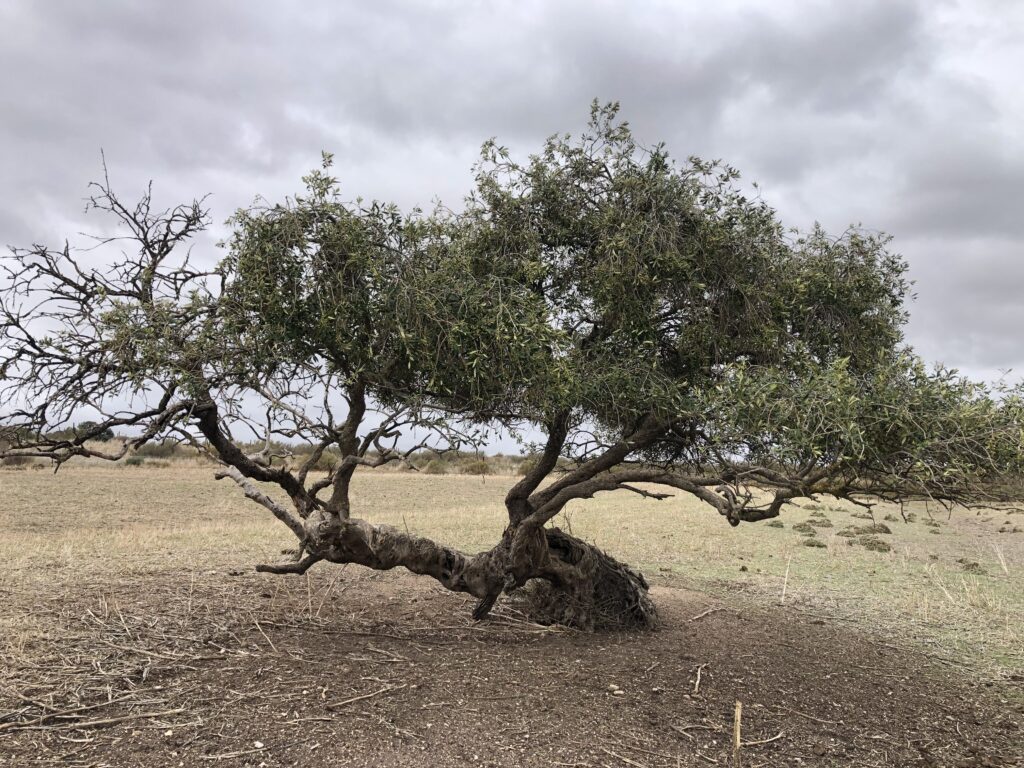
My focus settled on a lone ancestor: a Wild Olive (Olea europaea subsp. africana) standing in the resting lands beneath the iron rails. Unlike the olives safely growing together in another part of this farm, this tree has stood its ground in the direct path of progress. Meeting it felt less like finding a tree and more like encountering a person who has stood in the wind for a century and refused to move.
To reach this tree, I stepped off the tracks, crawled through fences, and detoured into a deeper layer of history. This journey opened a sensory dialogue with the land—the touch of grainy bark fissures, the sound of birdsong, and the discovery of ripe olives that, when crushed, provided the very ink used in this work. I witnessed this site through sun, rain, and the winter fogs, watching the surrounding wheat fields rest and prepare for a new season of planting.
I have chosen Glassine as an archival skin for this work. To me, Glassine is the solidified fog of a Riebeek morning; it holds the image while remaining partially transparent, mirroring the ethereal quality of a winter landscape.
Rebecca Solnit writes: “The things we lose are with us in the form of an invisible presence.” This is exactly what I attempted to do with my scroll. By capturing the ghost print, I documented what is lost or uprooted. I was finding the beauty in the disappearance.
Through the process of frottage (rubbing), I captured an indexical, forensic facsimile of an uprooted—yet still living—Wild Olive. The work exists on a dual plane:
- The Front: Rendered in graphite, it maps the tree’s physical endurance and the “map of the wood.”
- The Back: An ink wash applied to the “ghost print” represents the shadow and the “map of the soul.”
I choose frottage not to represent the landscape, but to touch it. By moving away from the interpretive brush and toward the indexical mark, I allow the ‘uprooted neighbours’—the thorns of a tolbos and the fissures of the Wild Olive—to write their own signatures. It is not an image; it is an encounter. While the graphite marks physical survival, the ink wash captures biological decay. Together, they represent the “presence” in the landscape. By unrolling only a fragment of this 8-meter scroll, I invite the viewer to witness a signature of existence. The success of this work lies in the slow observation—a call for the viewer to stand as a witness to a tree that continues to grow, roots exposed, amidst the shifting tides of the Swartland.
On the railroad at Knolfontein, I am not a neighbour, a mother, or a Vuleka contestant; I became a sensor. I am simply a pair of eyes witnessing the Wild Olive, a hand feeling the bark, a set of lungs breathing the cement dust and the mountain air.
When I step off the rail and crawl through the fence to reach that lone tree, I am leaving the “track” of who I am supposed to be and entering the “wild” of who I actually am.
My first attempt was with the glassine paper I ordered, but I am not happy with the texture of the paper. It is too flimsy and crinkles too much. I am happy with the mark-making and how it shows, but it will not be my preferred material to work on. It is clear I made the wrong choice – with this material, I will not be able to work with the ghost print and do a dry brush ink layer at the back.
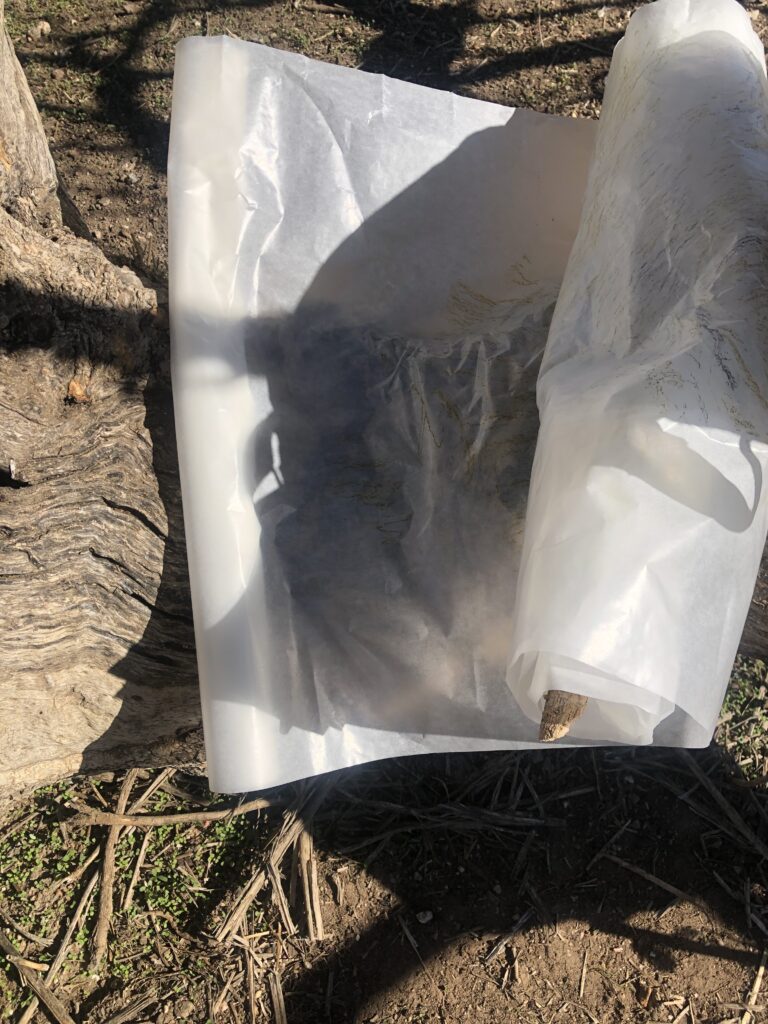
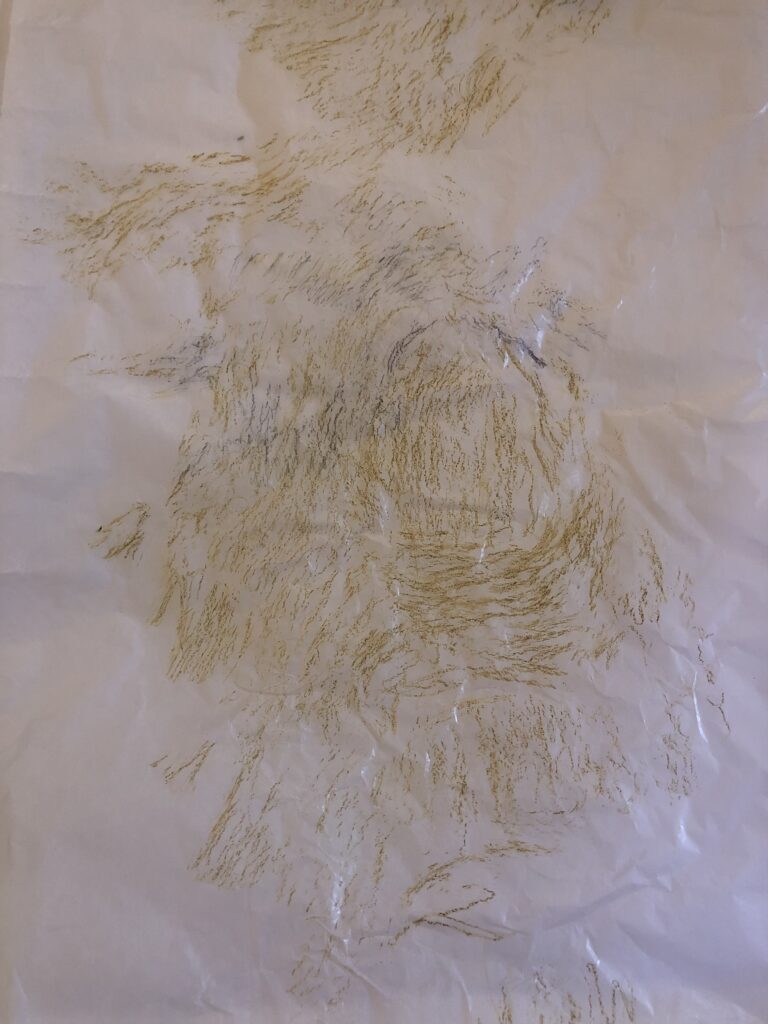
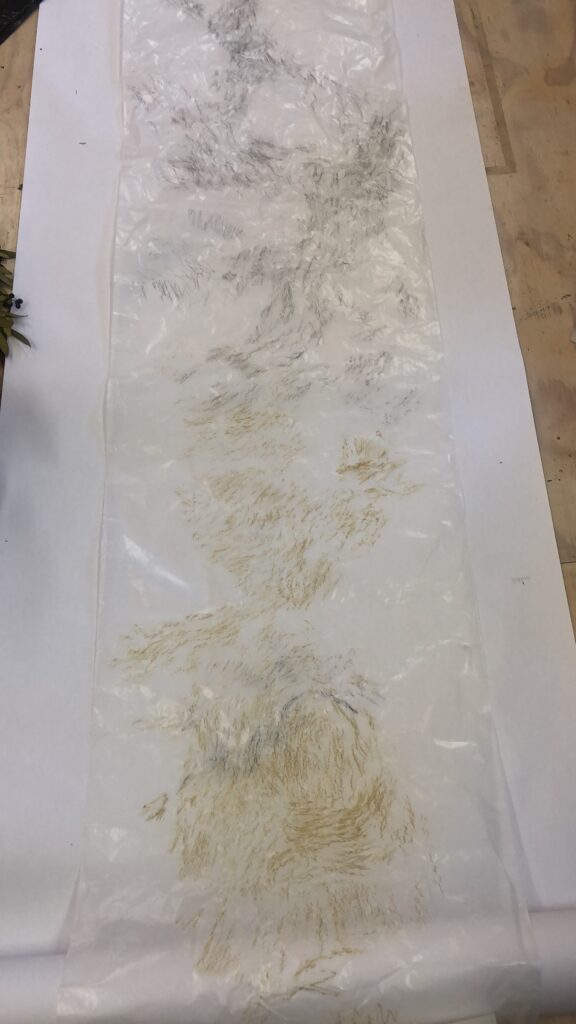
In my practice, I am learning that the process of trying to understand a material is often more authentic than forcing it to work
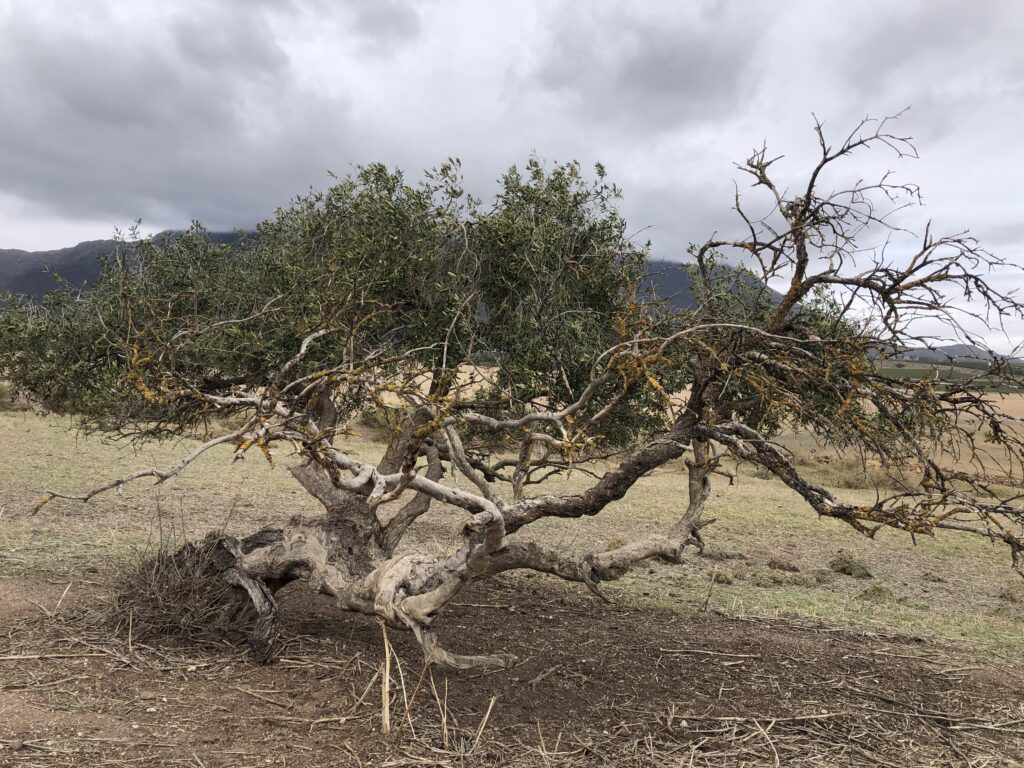
Drawing and Frottage with graphite, wild olive ink and take-sumi ink on Transparent paper
Other uses of the tree (Making the Most of Indigenous Trees, Fanie & Julye-Anne Venter p 268)
- Ink
- Tea with leaves
- Leave infusion to be used for eye infection in cattle and/or humans
- Leave nfusion can be gargled for a sore throat
- Snuff can be made from dried leaves to stop bleeding in the nose
A wild olive is also known as Olienthout and is number 617 on the National tree list. I learned that the tree commonly occurs on calcrete soil and acts as an indicator for calcrete.
I spoke to my husband about this tree and he was touched that it shows the battle scars of its past or time; contorted, half fallen. I wonder if mycelium connects with other trees that have grown around it. My husband commented that the tree is stoic – (hy doen wat hy kan doen). To me, the tree leaves the impression that its loneliness makes it beautiful, separated from the earlier forest I have seen.
My husband reminded me of one of his favourite songs by Brandi Carlile, “The Story “
All of these lines across my face
Tell you the story of who I am So many stories of where I’ve been
And how I got to where I am
But these stories don’t mean anything
When you’ve got no one to tell them to
It’s true: I was made for you
I climbed across the mountain tops
Swam all across the ocean blue
I crossed all the lines and I broke all the rules But baby, I broke them all for you
Because even when I was flat broke You made me feel like a million bucks You do
And I was made for you
You see the smile that’s on my mouth
It’s hiding the words that don’t come out
And all of my friends who think I’m blessed They don’t know my head is a mess No, they don’t know who I really am
And they don’t know what
I’ve been through like you do
And I was made for you
I imagine the valley not as a carpet of crops, but as a vast, rolling sea of grey-green shrubs, punctuated by dark, sturdy “islands” of Wild Olive and Karee. These clumps were the hubs of life: for birds and mulch for the soil. This makes the walking connection with the old Wild Olive grove so profound as I view them with so much respect. They are silent survivors of a messy ecology