I want to share thoughts about connecting – making art whilst walking along a train line. I thought I was walking a ghost line alone, but I found that others carry their own maps of this place. My photographer friend didn’t just capture light and vistas; he captured the skin of the station. Maarten’s generous photographs gave me a way to see the human shadow before it disappears completely. His lens and my hand are both trying to slow down time.
My walking companions didn’t just provide safety; they provided the ‘human noise’ that makes the ‘Beautiful Silence’ of the line so profound.
I connected with people who had real connections to the SAR – working on the rail, and who have shared images and memories of this experience. Fellow walkers in the valley joined my ‘scouting’ trips, and even suggested this be listed as a walking route for the group. My son came a long to make a video of the walk with a drone – what a beautiful way to view the line.
In my research, I’ve had to ask: ‘What used to be here?’ The answers are always a mix of fact and melancholy. People don’t just remember the trains; they remember the sound of the signal or the smell of the smoke. These stories are the ‘Prima Materia’—the raw material I am now rubbing into the Xuan paper.
Talks with other artists lead to interesting discussions and possibilities of collaborating with each other. Below is a letter from an artist friend in Italy who started a durational painting working project that he calls Correspondence. I joined his project and became part of a growing online network of participants whose observations become paintings, which David then literally shares around the world. In short, the artist randomly selects one observation and uses it as the starting point for a painting. In practice, he will make five paintings each week, each beginning with a different participant’s observation. Each painting begins as a work measuring 48 × 24 cm. When it is finished, he cuts the painting into two halves and posts the other half to the participant whose observation he used. One-half remains in the project archive. Below is my letter from him, which I received on 14 April, telling me he has chosen my observation.
Hi Karen Your observation has been chosen during the random selection process and will be used as the starting point for a painting made today. “I found the trace of a decommissioned train line. Finding that ‘Invisible Line’ wasn’t a discovery, it became the birth of a new way of seeing the ground beneath my …”(I had to invoke a rule to truncate all observations at 30 words because some people wrote me chapter and verse) I plan to send you half of the painting via standard (untracked) postal service, folded gently inside an envelope. Please reply to this email with your postal address, including:
- Name (as it should appear on the envelope)
- Full address
- Country
The address should be one where you are normally able to receive personal mail. Project documentation (exhibitions and online) may include your name, city/region, and country. If you would prefer your name to appear as “Anonymous”, then please state this in your reply. I promise that I will only use your full postal address for sending the painting, and it will never be made public. Please reply to this email with your postal details within 7 calendar days. After that date, the painting will be classified as an orphan and retained in the project archive. Once received, I will email you an acknowledgement of receipt. Thank you for taking part in Correspondence. If anything is unclear, please feel free to ask. Best wishes, David. (Karen – apologies for the formal mail – it’s a standard template 🤓)
My reason for including this letter is that it is connected to my project and to people. I love how David invoked his rules – he had to shorten the words I sent him. I like how my work has now crossed with another – creativity never stops to amaze me! It reminds me that these ‘missing pieces’, which I am so drawn to, are universal. The decay of a paint chip in Riebeek West speaks the same language as a ruin in Europe. (Now I hope the South African Postal Service keeps its end of the deal and delivers my part of David’s artwork.)
8,000 kilometres from Riebeek West to Italy, bridged by a single sentence about a 1928 rail.
A few days later, David replied that the work had been done during this week in his studio:
Day 4. “I found the trace of a decommissioned train line. Finding that ‘Invisible Line’ wasn’t a discovery, it became the birth of a new way of seeing the ground beneath my …”
K.S, South Africa
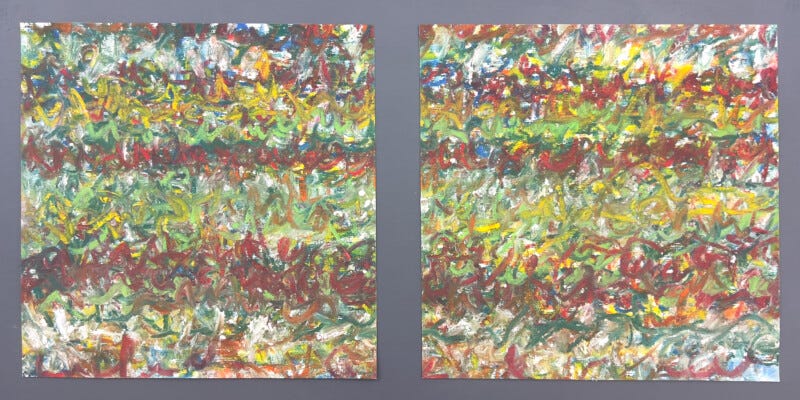
“He’s gone all Jackson Pollock!”
This observation allowed me to make a performance piece. Listening intently to a 25-minute recording of a steam train, I drew continuously, with both hands, using oil pastel — translating the implied movement of an absent railway into a shift in how the ground is read.
Below are the twin halves of David’s original painting, which he did with oil pastels while interpreting the sound of a steam train. I now look forward to receiving my half in the post.
Interestingly, I explored sound in a short drawing on my scroll earlier this week.
David’s work never arrived.
I joined another call later and was lucky to be drawn again. This time I used a friend’s address in Europe, the artwork will arrive at my house late July – per hand. This was the new prompt: Describe somewhere, real or imagined, that offers an escape from daily life. I wrote: “Walking on the pan in Deadvlei, near Sossosvlei, Namibia.”
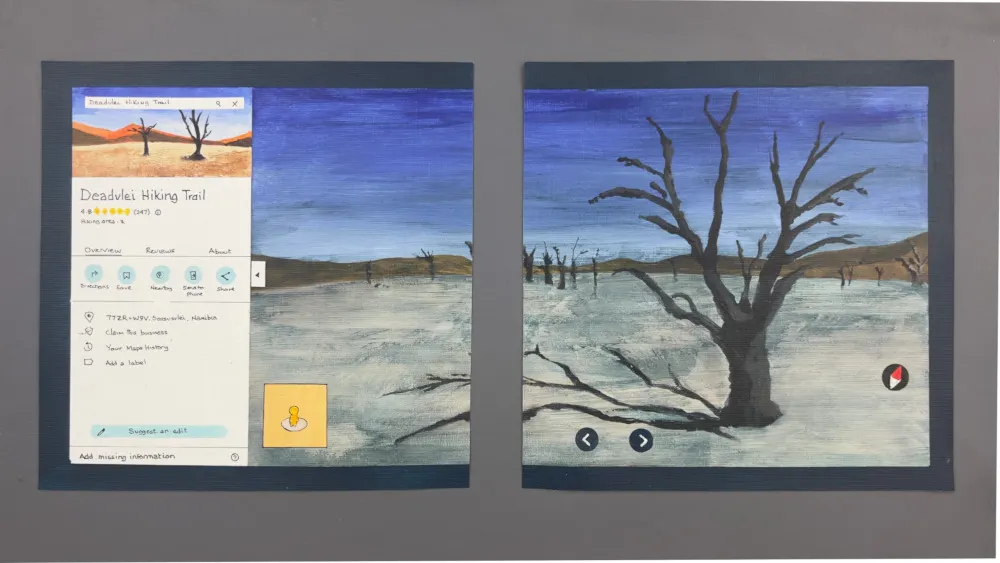
David wrote the following on the work: “Sometimes I make random trips using Google Street View – exploring far-flung places in the world. So now I’m wandering the pan in Deadvlei, Namibia. But rather than simply paint the desert scene, I also painted the mechanism that gave me access to it: the information panel, rating, icons, map inset, navigation marks. The result is a place of escape seen at a distance, already mapped and indexed, then slowed down again through painting.“
I sent the following note to David on Substrac after he indicated that the work was posted, this time to the Netherlands, to my friends, adress.
Good morning David, my second (half) painting from you has arrived at my friends house in Amsterdam. She is an airhostes so it should arrive here in Riebeek West by the end July, when she flies out and will have a stay here in the village. I really enjoy following your project. My friend and her husband owns a house here in our valley, so they visit a few times a year and love South Africa. I hope to use here address – seems our postal services has really collapsed. We use courier services for normal packages, never send letters to any one! What a sad situation, reminds me of my rail line walk on a decomissioned line, what once was part of an almost wonder, is now just a memory. I have fond memories of opening the postbox, later driving to the box and using a key to collect post – now its emails and junk mail. Kindest regards, sorry the note just expanded xxxin
on 01/07/2026 David wrote back: Thanks for advising, Karen. I love your thoughts about the decommissioned railway line being the ghost now reflected in the collapsed postal system. The painting inspired by the railway ghost itself becomes a ghost in the postal system. A cool concept. 😁
.